How Did Michael Jackson Die? The Official Answer
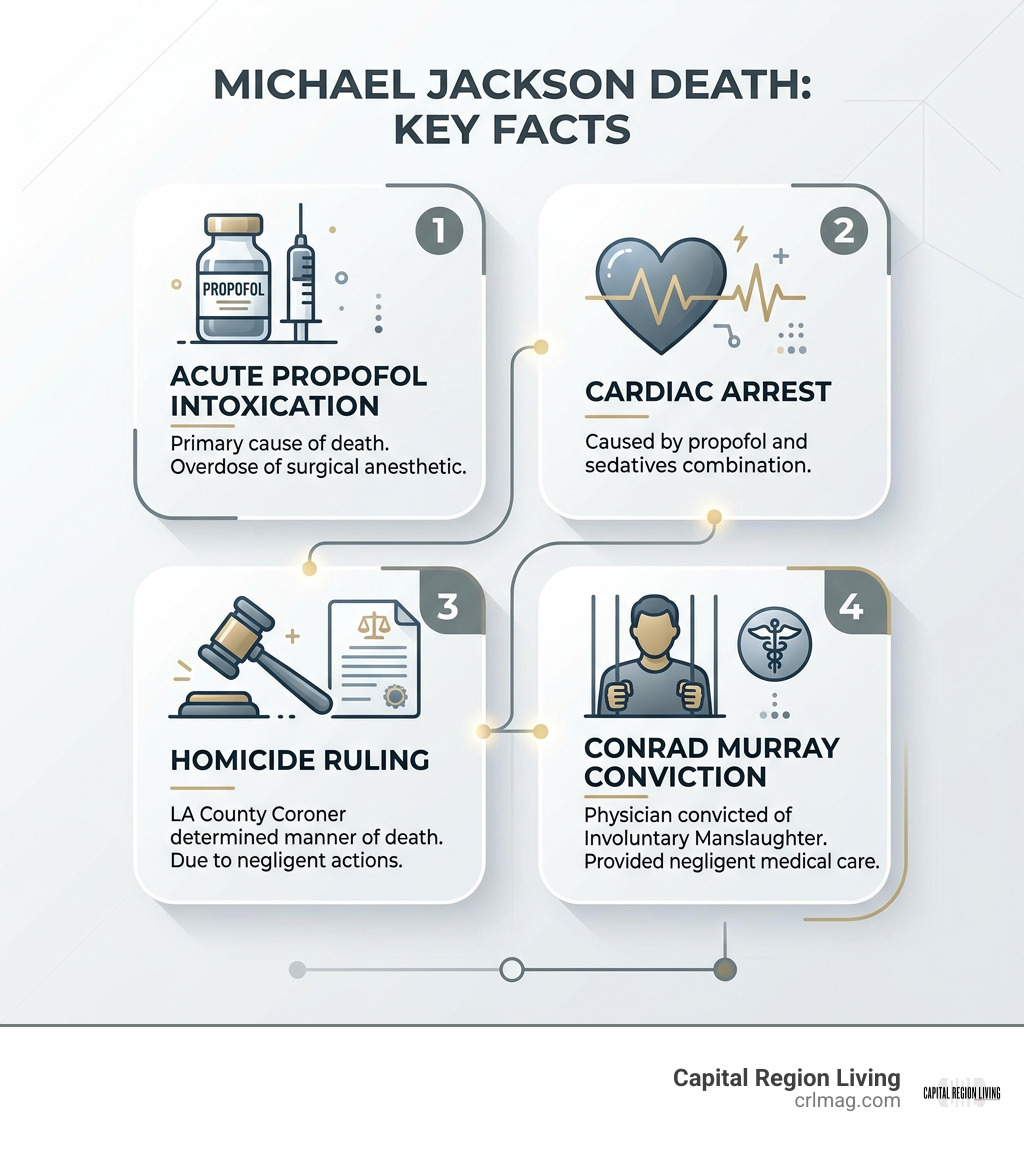
How did Michael Jackson die? Michael Jackson died on June 25, 2009, at age 50 after acute propofol intoxication caused cardiac arrest. The Los Angeles County Coroner ruled the manner of death a homicide, finding that the powerful surgical anesthetic propofol, along with sedatives, had been given to him at his Los Angeles home.
His personal physician, Dr. Conrad Murray, was later convicted of involuntary manslaughter for negligent medical care connected to Jackson’s death.
Jackson had performed at a rehearsal for his planned This Is It comeback concerts the night before. News of his collapse at his Holmby Hills home, and his death later that afternoon at Ronald Reagan UCLA Medical Center, stunned fans and the music world around the globe.
This article explains the medical findings, the events of June 25, the criminal case against Murray, and the far-reaching impact of the King of Pop’s death.
Discover more about how did michael jackson die:
Medical Autopsy Findings: How Did Michael Jackson Die?
When news broke of the pop icon’s passing, initial reports indicated that he had suffered a sudden cardiac arrest at his rented mansion in Bel-Air/Holmby Hills. However, as medical examiners began probing the underlying cause of that sudden collapse, a far more complex and troubling story emerged. The Los Angeles County Department of Medical Examiner conducted an extensive post-mortem evaluation, culminating in a detailed 51-page autopsy report that changed the entire direction of the investigation.
The official findings revealed that Jackson’s heart stopped because of acute propofol intoxication, heavily exacerbated by the presence of anti-anxiety benzodiazepines—specifically lorazepam and midazolam. Because the surgical anesthetic had been improperly administered in a residential setting without standard safety safeguards or emergency equipment, the coroner officially classified the manner of death as a homicide resulting from medical malpractice.
For additional background on the toxicological revelations that stunned the medical community, you can read how the Coroner releases new details about Michael Jackson’s death following the completion of the formal examination.
Examining How Did Michael Jackson Die on June 25, 2009
To fully grasp how did michael jackson die, we must examine the final 24 hours of his life. On the evening of June 24, 2009, Jackson attended rehearsals at the Staples Center in downtown Los Angeles for his upcoming residency in London. Observers, including production staff and musicians, noted that he appeared energized and in good spirits as he ran through grueling vocal and dance choreography past midnight.
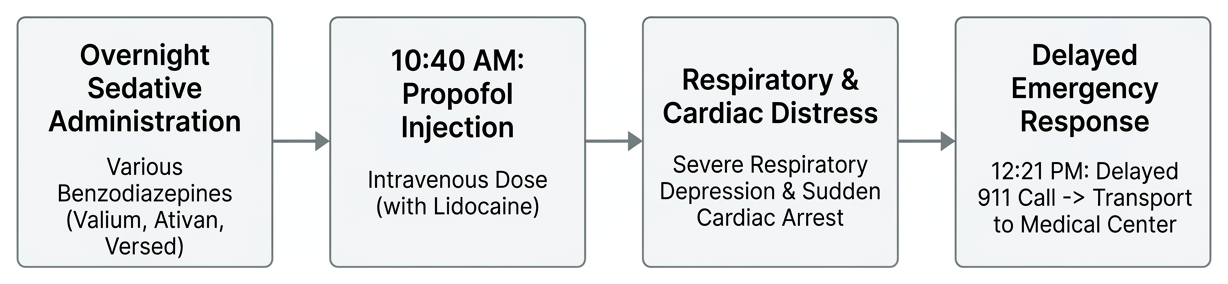
Upon returning to his rented Holmby Hills home early on June 25, Jackson struggled with severe, chronic insomnia—a condition that had plagued him for years. Over the course of nine hours, his personal physician attempted to induce sleep using various sedatives, including Valium (diazepam), Ativan (lorazepam), and Versed (midazolam). When these failed to put Jackson to sleep, Dr. Murray prepared a dose of propofol diluted with lidocaine and administered it intravenously at approximately 10:40 a.m.
Shortly after administering the drug, Murray left the bedroom. When he returned, he discovered Jackson unresponsive and no longer breathing, though a faint pulse was still detectable. Instead of immediately dialing emergency services, Murray attempted to administer resuscitation on the bed. A frantic series of events followed, and a staff member finally placed a 911 call at 12:21 p.m.—an 82-minute delay after Murray first noticed something was wrong. Paramedics arrived within three minutes and seventeen seconds, attempting resuscitation for 42 minutes at the home before transporting Jackson to Ronald Reagan UCLA Medical Center. Despite extended life-saving measures by emergency room physicians, Jackson was officially pronounced dead at 2:26 p.m. PDT.
For a complete breakdown of every critical minute on that fateful day, examine the exhaustive Timeline of the death of Michael Jackson.
Toxicological Analysis: Lethal Anesthetics and Sedatives
The toxicology reports were crucial in answering how did michael jackson die. Propofol is a potent, fast-acting intravenous hypnotic agent widely used in hospital operating rooms to induce and maintain general anesthesia during major surgeries. Due to its milky white appearance, Jackson frequently referred to propofol as his “milk” or “milk of amnesia.”
In standard hospital care, propofol is strictly administered by trained anesthesiologists equipped with continuous physiological monitoring tools—such as pulse oximeters, electrocardiograms, and capnographs—alongside immediate access to mechanical ventilation equipment. When given without airway support, propofol severely depresses respiratory drive, causing patients to stop breathing entirely.
The autopsy confirmed that Jackson had lethal concentrations of propofol in his bloodstream, equivalent to levels required for major surgical procedures. The danger was further compounded by the cocktail of lorazepam, midazolam, and lidocaine found in his system. When combined, benzodiazepines and propofol create a synergistic effect that rapidly shuts down the central nervous system.
Early legal documents corroborated these medical findings, as highlighted when Court Papers Show Jackson Died of Propofol, exposing how an off-label use of a surgical drug as a residential sleep aid led directly to fatal respiratory collapse.
The Role of Dr. Conrad Murray and the Criminal Investigation
Following Jackson’s death, public scrutiny turned immediately to his personal physician, Dr. Conrad Murray. A cardiologist hired through concert promoter AEG Live, Murray was being paid an extraordinary salary of $150,000 per month to oversee Jackson’s health during preparations for his 50-show tour.
The Los Angeles Police Department (LAPD) Robbery-Homicide Division, working alongside federal agents from the Drug Enforcement Administration (DEA), launched an immediate criminal investigation. What investigators uncovered inside Jackson’s home was a devastating story of gross medical negligence.
Key Evidence Explaining How Did Michael Jackson Die Under Medical Care
As law enforcement officers searched the Holmby Hills residence, they uncovered dozens of prescription medication bottles alongside IV bags, needles, and empty vials of propofol hidden in bags inside a closet. Key pieces of evidence gathered during the investigation included:
- Complete Absence of Standard Monitoring: Murray had no continuous blood pressure monitor, pulse oximeter alarm, or capnography equipment in the bedroom to detect respiratory failure.
- Inadequate Emergency Supplies: The oxygen setup present in the home was missing functional regulator components, and emergency resuscitation drugs were improperly stored.
- Substandard CPR Execution: Murray performed CPR on Jackson while the singer lay on a soft mattress rather than transferring him to a hard floor, rendering chest compressions largely ineffective.
- Critical Delay in Calling 911: Rather than placing an immediate emergency call when Jackson stopped breathing, Murray spent over an hour making private phone calls and clearing away drug vials.
The official summary of the law enforcement proceedings and autopsy results can be reviewed in detail in the public record on the Death of Michael Jackson.
Involuntary Manslaughter Conviction and Legal Verdicts
In February 2010, the Los Angeles District Attorney’s Office formally charged Dr. Conrad Murray with involuntary manslaughter. The highly publicized trial, The People of the State of California v. Conrad Murray, began in September 2011. Prosecutors argued that Murray had abandoned his medical oath by conducting an reckless home experiment, using surgical anesthetics to treat insomnia without proper safeguards.
The defense claimed that Jackson had self-administered the fatal dose of propofol while Murray was out of the room. However, expert medical testimony demonstrated that even if self-administration had occurred, Murray’s gross negligence in providing the drug and leaving the patient unmonitored created the direct conditions for his death.
On November 7, 2011, the jury returned a unanimous guilty verdict. Judge Michael Pastor sentenced Murray to the maximum penalty of four years in state prison, describing his medical treatment of Jackson as an “unacceptable medical experiment.” Due to California prison realignment policies designed to manage facility overcrowding, Murray served two years in a Los Angeles County jail before being released in October 2013. His medical licenses in California, Texas, and Nevada were suspended or revoked.
In a separate legal matter, Jackson’s mother and children filed a civil wrongful death lawsuit against concert promoter AEG Live in 2013, alleging negligent hiring and supervision of Murray. Following a five-month trial, a jury found that AEG Live had hired Murray, but determined he was not unfit or incompetent for the specific task he was hired to perform at the time of his hiring, exonerating the company of financial liability.
The ‘This Is It’ Comeback Tour and Final Days

To understand why Jackson was receiving such intense medical treatments, we must look at the pressures surrounding his planned comeback. In March 2009, Jackson announced a series of 10 residency shows titled This Is It at London’s O2 Arena. Due to overwhelming public demand, the run was quickly expanded to 50 dates, scheduled to run from July 2009 to March 2010.
The upcoming tour represented a massive professional and financial effort. Jackson was determined to rebuild his global brand, pay off substantial personal debts, and present an extraordinary live spectacle for his children and millions of fans. However, the grueling rehearsal schedule placed severe physical and psychological strain on the 50-year-old artist.
Jackson suffered from chronic insomnia, which worsened as opening night approached. Desperate to sleep between long rehearsals, he relied heavily on medical assistance, leading to the risky off-label use of propofol in his bedroom.
The table below highlights the stark contrast between standard medical guidelines for propofol use and the conditions under which Jackson received the drug:
| Medical Parameter | Standard Clinical Anesthesia Protocol | Home Usage Conditions (June 25, 2009) |
|---|---|---|
| Administration Setting | Hospital operating room or accredited clinic | Private residential bedroom |
| Provider Specialty | Board-certified anesthesiologist | Personal cardiologist |
| Patient Monitoring | Continuous ECG, pulse oximetry, blood pressure, capnography | No active electronic monitoring equipment |
| Airway Safety | Endotracheal intubation & supplemental oxygen available | No mechanical ventilator or resuscitation gear |
| Indication | General surgical anesthesia / ICU sedation | Off-label treatment for chronic insomnia |
| Emergency Response | Immediate code team activation | 82-minute delay before calling 911 |
Global Impact, Cultural Reaction, and Estate Legacy
The sudden loss of the King of Pop triggered an unprecedented wave of global grief and digital activity. On the afternoon of June 25, 2009, as rumors of his collapse spread, internet traffic hit historic peaks. Major news websites and social channels experienced severe outages:
- Google Infrastructure: Automated defense algorithms flagged the sudden surge in searches for “Michael Jackson” as a potential Distributed Denial of Service (DDoS) cyberattack, temporarily blocking search queries for roughly 30 minutes.
- Social Networks: Twitter reported that nearly 15% of all global tweets mentioned Jackson’s death, causing repeated platform crashes.
- Breaking News Coverage: Breaking reports from outlets like CNN confirmed the loss, detailing how Michael Jackson dead at 50 after cardiac arrest made shockwaves across every continent.
Simultaneously, major news publications produced extensive retrospectives honoring his legendary career, such as the coverage in the Los Angeles Times confirming Michael Jackson, King of Pop, is dead at 50.
On July 7, 2009, a public memorial service was held at the Staples Center in Los Angeles. Over 1.6 billion fans applied for the 17,500 free tickets distributed to the public. Broadcast live around the world, the memorial drew an estimated television audience of 2.5 billion viewers, making it one of the most-watched events in television history.
Jackson’s passing also triggered a commercial resurgence:
- Album Sales Surge: In the 12 months following his death, Jackson sold over 9 million albums in the United States and 35 million albums worldwide.
- Posthumous Estate Earnings: In 2010, the Michael Jackson Estate signed a record-breaking $250 million distribution deal with Sony Music Entertainment.
- Lifetime Catalog Sales: Over his lifetime and posthumous career, Jackson sold an estimated 750 million albums globally, with Thriller remaining the best-selling album of all time.
Frequently Asked Questions About Michael Jackson’s Death
What was the official cause and manner of Michael Jackson’s death?
The Los Angeles County Coroner determined that the official cause of death was acute propofol intoxication, combined with the depressive effects of secondary sedatives including lorazepam and midazolam. The manner of death was ruled a homicide caused by medical malpractice.
Why was Dr. Conrad Murray convicted in connection with Jackson’s death?
Dr. Conrad Murray was convicted of involuntary manslaughter because he acted with gross negligence. He administered hospital-grade surgical anesthetics in a home bedroom to treat insomnia, lacked required monitoring equipment, failed to maintain an open airway, performed flawed CPR, and delayed calling 911 for over an hour.
How quickly was emergency help called after Michael Jackson collapsed?
Emergency services were not contacted immediately. After administering the fatal dose of propofol around 10:40 a.m., Murray discovered Jackson unresponsive shortly thereafter. Instead of calling 911 right away, he made private phone calls and attempted unmonitored resuscitation attempts. A security guard finally dialed 911 at 12:21 p.m.—82 minutes after the initial discovery. Emergency physicians at UCLA Medical Center pronounced Jackson dead at 2:26 p.m.
Conclusion
Understanding how did michael jackson die reveals a tragic intersection of severe chronic insomnia, the pressures of a massive career comeback, and dangerous medical malpractice. The loss of Michael Jackson highlighted the extreme dangers of using surgical anesthetics outside controlled clinical environments, prompting lasting debates around medical ethics and private concierge care.
While his sudden death at age 50 shocked the world, Jackson’s artistic achievements remain unmatched. From breaking sales records with Thriller to redefining music videos and dance, his cultural influence continues to inspire new generations of performers.
At Capital Region Living, we bring our readers deep dives into cultural milestones, regional lifestyle stories, and community events across New York’s Capital Region. Stay connected with the latest arts, entertainment, and local happenings by checking out the Capital Region Living Events Calendar.