The Rectangular Prism: A Quick Definition
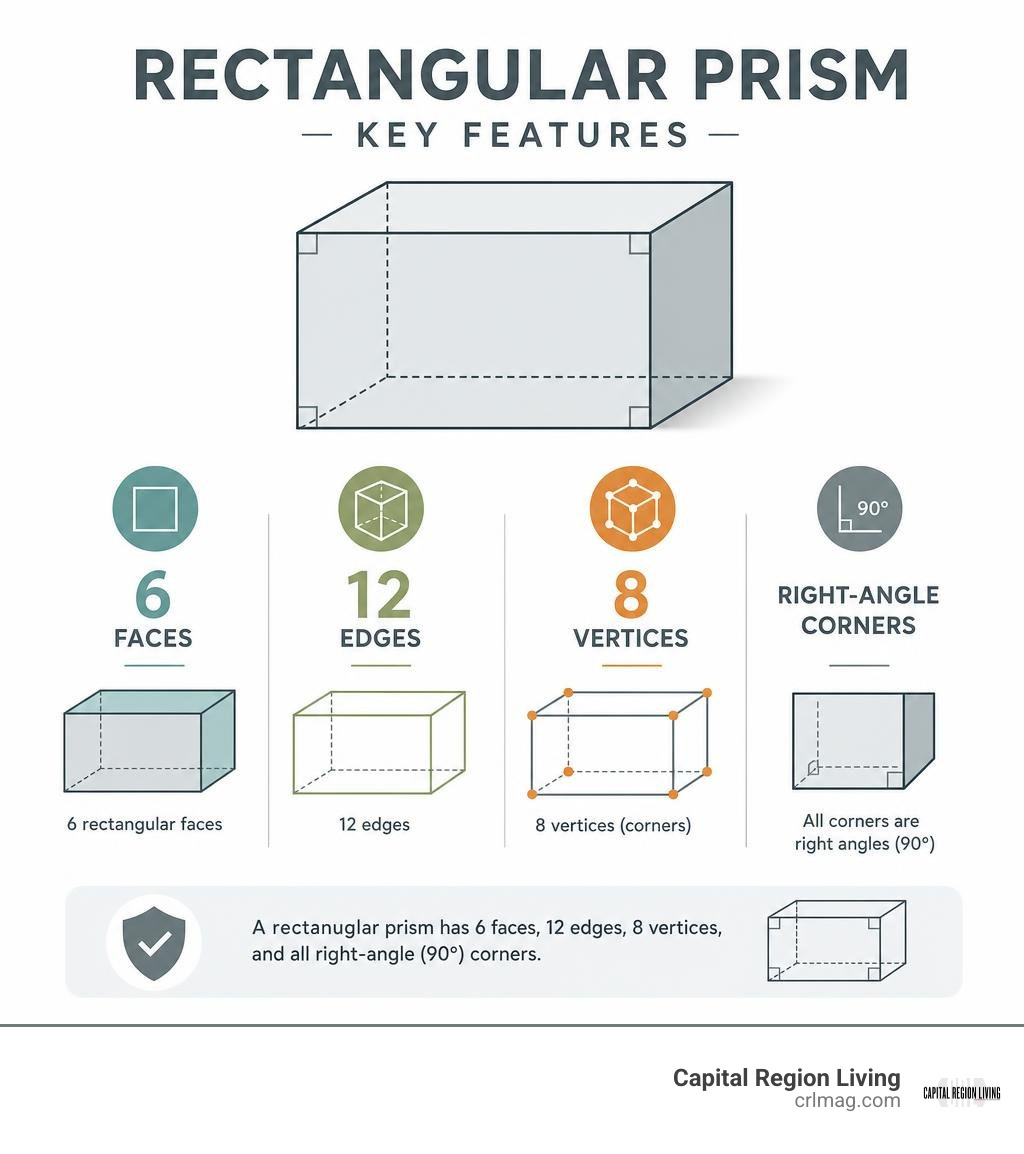
A rectangular prism is a 3D solid with six rectangular faces, 12 edges, and 8 vertices, or corners. Its opposite faces match in size, and the edges meet at 90-degree right angles.
Also called a cuboid, a rectangular prism is the familiar box-like shape seen in books, bricks, shoeboxes, shipping cartons, and many buildings. Learning to spot one is a useful first step in understanding 3D geometry, space, volume, and surface area.
| Key feature | Rectangular prism |
|---|---|
| Faces | 6 rectangles |
| Edges | 12 |
| Vertices | 8 |
| Main dimensions | Length, width, and height |
| Common name | Cuboid |
A cube is also a special kind of rectangular prism: it has the same features, but all of its edges are equal in length.
What Is a Rectangular Prism?
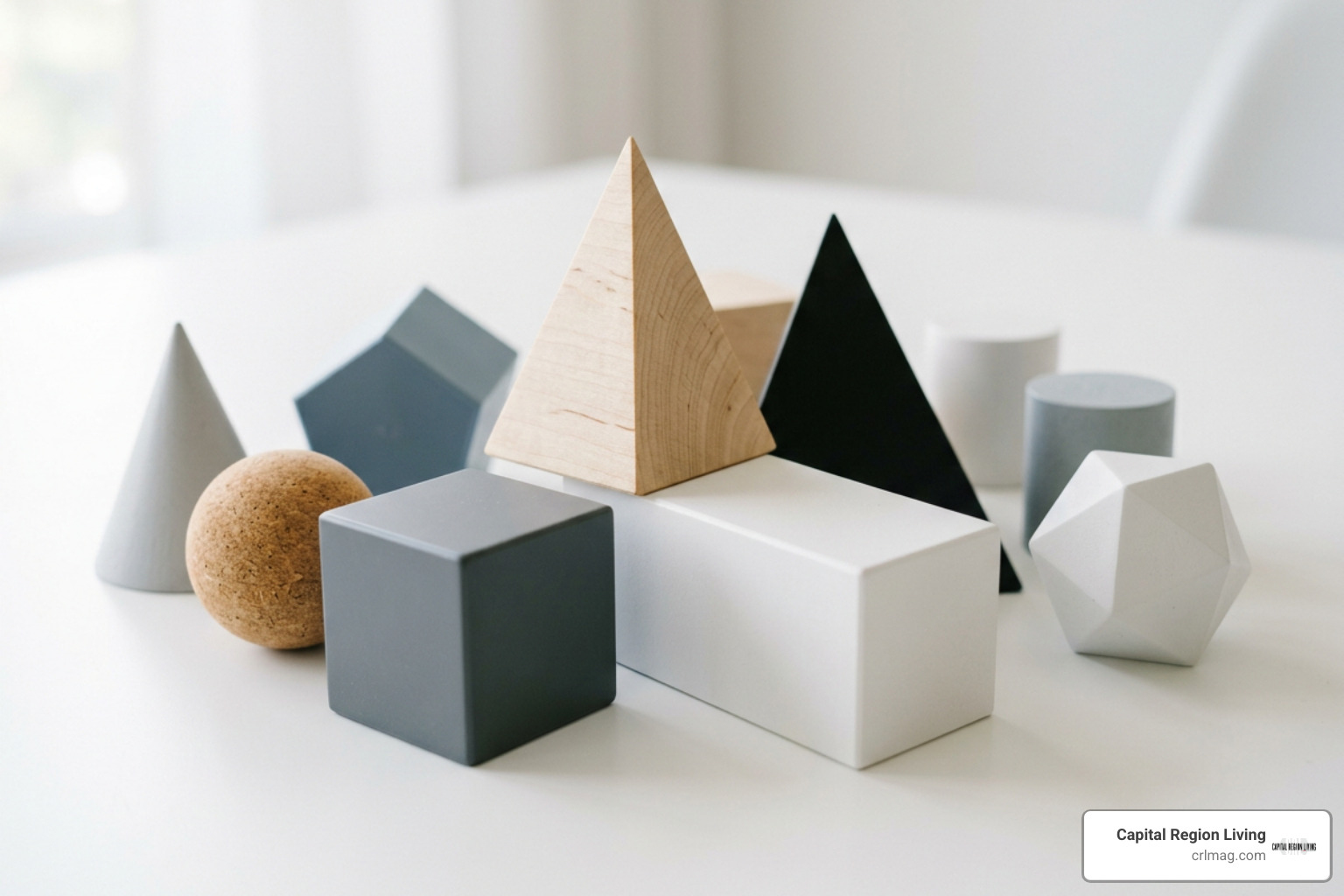
When we look around our everyday environment, we are constantly interacting with three-dimensional objects. In mathematics, a rectangular prism is classified as a three-dimensional closed solid bounded by flat polygonal faces—a category known as polyhedra. More specifically, it is a prism, which means it consists of two congruent, parallel bases connected by lateral faces.
To learn more about the broader family of prisms, check out this comprehensive Prism definition.
What sets the rectangular prism apart from other polyhedra, such as triangular or pentagonal prisms, is that its two bases are rectangles. Furthermore, all four joining side faces are quadrilaterals (specifically rectangles or parallelograms depending on its alignment). Because every face of a standard right rectangular prism is a rectangle, every pair of opposite faces is equal in area and congruent in shape.
Key Properties of a Rectangular Prism
To clearly identify and measure a rectangular prism, we rely on several foundational geometric properties:
- 6 Rectangular Faces: Every rectangular prism has six flat sides. These faces come in three identical pairs of opposite sides: the top and bottom bases, the front and back faces, and the left and right side faces.
- 12 Straight Edges: An edge is the line segment formed where two flat faces meet. A rectangular prism contains 12 edges. These edges can be grouped into three distinct sets of four parallel line segments corresponding to length ($l$), width ($w$), and height ($h$).
- 8 Vertices (Corners): A vertex is the point where three distinct edges intersect. A rectangular prism features exactly 8 vertices. The geometric ratio of vertices (corners) to faces in any cuboid is 8:6, which simplifies neatly to 4:3.
- Right Angles (90 Degrees): In standard rectangular prisms, all adjacent edges intersect at right angles (90°). Every corner where three faces come together creates a three-dimensional orthogonal corner.
- Spatial Tessellation: Because of their uniform right angles and flat faces, rectangular prisms can stack tightly together without leaving gaps or empty spaces, a property known in geometry as spatial tessellation.
Right vs. Oblique Rectangular Prisms
Not all rectangular prisms stand completely straight up! Geometricians classify them into two primary structural categories: right rectangular prisms and oblique rectangular prisms.
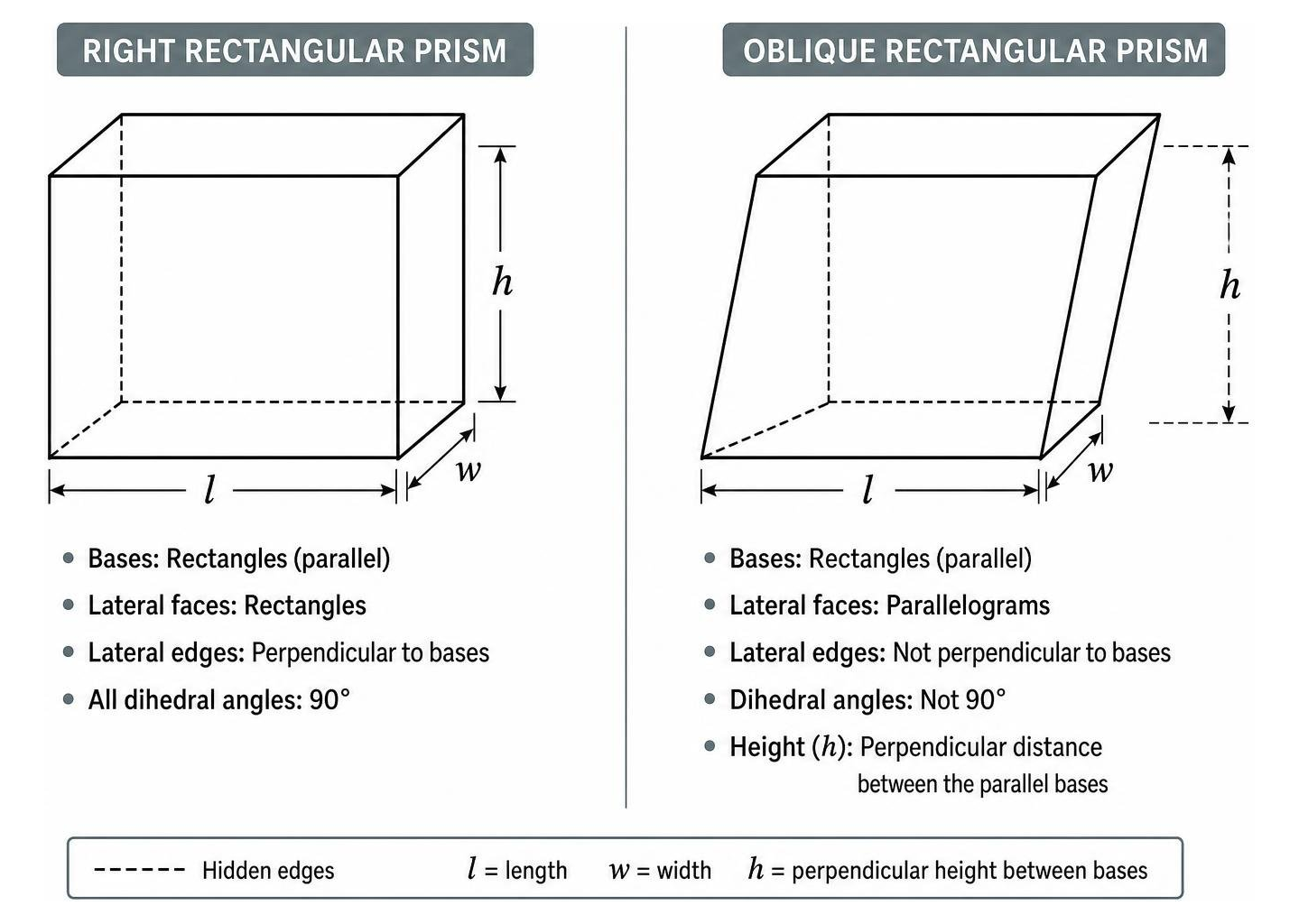
- Right Rectangular Prism: In a right rectangular prism, all vertical edges meet the top and bottom rectangular bases at strict 90-degree right angles. All lateral side faces are rectangles, and all interior dihedral angles between adjacent faces are perpendicular. This is the classic “box shape” we see in daily life.
- Oblique Rectangular Prism: An oblique rectangular prism appears to lean to one side. While its top and bottom bases remain parallel rectangles, its side faces are sloped parallelograms rather than rectangles. The lateral edges do not intersect the base at 90-degree angles.
When calculating the spatial volume of an oblique rectangular prism, we cannot simply use the length of its slanted edge. Instead, we must measure its absolute perpendicular height—the straight vertical distance between the two parallel base planes. You can explore more technical details on Rectangular cuboid properties to deepen your understanding of these geometric variations.
Essential Formulas: Volume, Surface Area, and Diagonals
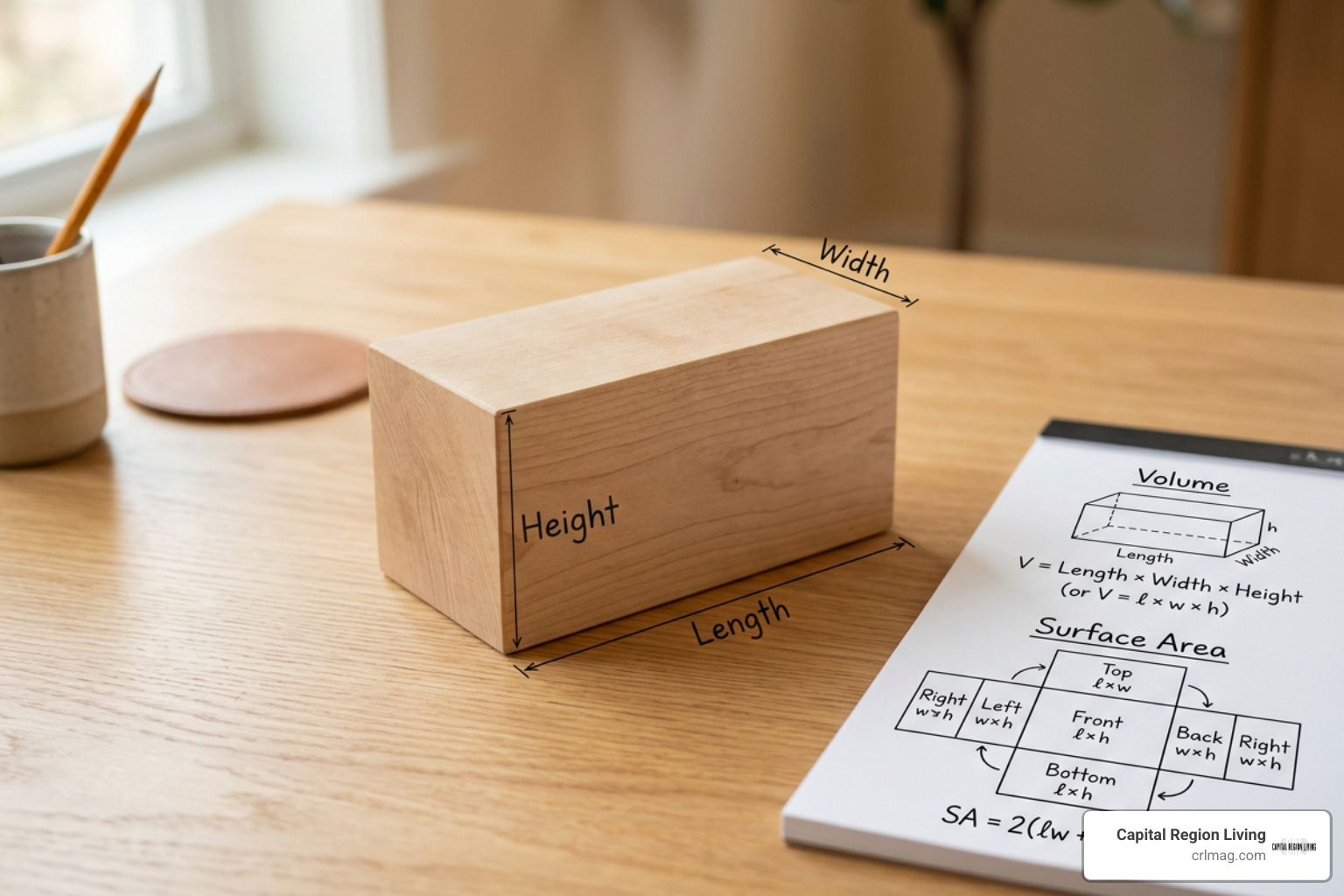
Working with a rectangular prism mathematically involves three primary calculations: finding how much interior space it holds (volume), calculating the total boundary area covering its exterior (surface area), and determining the straight-line distance through its interior center (space diagonal).
Before executing any formula, we always designate three mutually perpendicular dimensions:
- Length ($l$): The horizontal distance across the front base edge.
- Width ($w$): The depth or distance extending from front to back along the base.
- Height ($h$): The vertical distance measuring how tall the prism stands from bottom to top.
Calculating Volume and Surface Area
Understanding the difference between volume and surface area is crucial in real-world applications. Volume tells us how much material a container can hold (expressed in cubic units like $\text{cm}^3$ or $\text{in}^3$), whereas surface area tells us how much material is required to cover or wrap the exterior (expressed in square units like $\text{cm}^2$ or $\text{in}^2$).
For rapid visual reference, we can rely on online tools like this interactive Rectangular Prism Calculator to verify complex dimensional measurements.
| Measurement Type | Mathematical Formula | What It Measures | Example Calculation ($l=5\text{ cm}, w=3\text{ cm}, h=2\text{ cm}$) |
|---|---|---|---|
| Volume ($V$) | $V = l \cdot w \cdot h$ | Total 3D interior capacity | $5 \cdot 3 \cdot 2 = 30\text{ cm}^3$ |
| Total Surface Area (TSA) | $\text{TSA} = 2(lw + wh + hl)$ | Area of all 6 faces combined | $2(15 + 6 + 10) = 62\text{ cm}^2$ |
| Lateral Surface Area (LSA) | $\text{LSA} = 2h(l + w)$ | Area of 4 side faces (excluding top/bottom) | $2 \cdot 2(5 + 3) = 32\text{ cm}^2$ |
| Base Area ($B$) | $B = l \cdot w$ | Area of a single bottom or top face | $5 \cdot 3 = 15\text{ cm}^2$ |
Step-by-Step Derivation of Surface Area
To see why the surface area formula works so reliably, a rectangular prism consists of three pairs of matching faces:
- Top and Bottom faces: $2 \cdot (l \cdot w)$
- Front and Back faces: $2 \cdot (l \cdot h)$
- Left and Right side faces: $2 \cdot (w \cdot h)$
Summing all six faces together gives us $\text{TSA} = 2lw + 2lh + 2wh$, which factors neatly into $\text{TSA} = 2(lw + wh + hl)$.
For example, if we are wrapping a shoe box measuring 18 inches long, 12 inches wide, and 15 inches tall: $$\text{TSA} = 2 \cdot (18 \cdot 12 + 12 \cdot 15 + 15 \cdot 18)$$ $$\text{TSA} = 2 \cdot (216 + 180 + 270) = 2 \cdot (666) = 1,332\text{ sq inches}$$
Calculating Space Diagonals in a Rectangular Prism
While a face diagonal stretches across a single flat rectangular surface (using the standard 2D Pythagorean theorem $a^2 + b^2 = c^2$), an interior space diagonal cuts straight through the hollow center of the 3D solid from one bottom corner to the furthest opposing top corner.
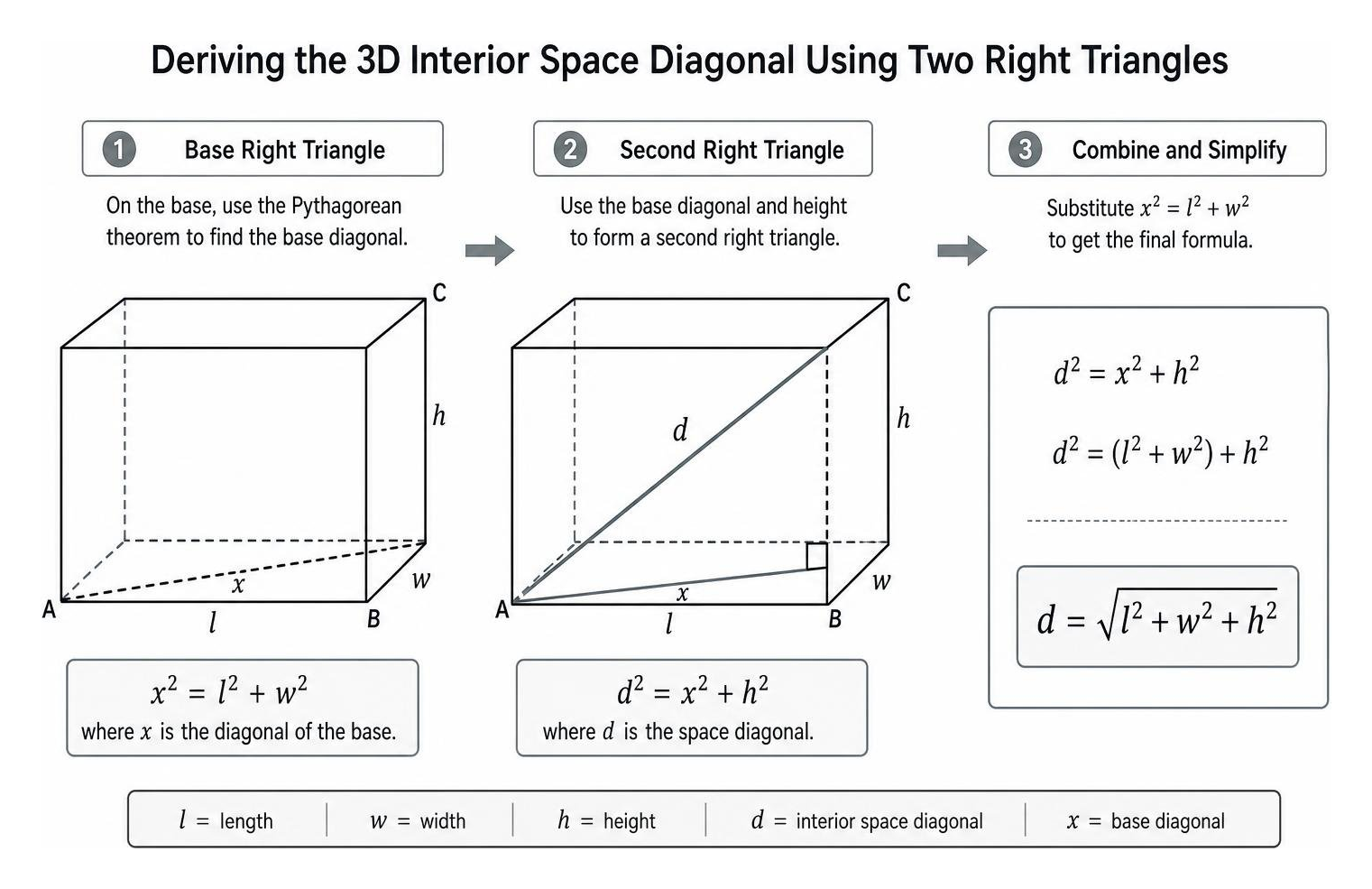
To calculate this corner-to-corner distance ($d$), we extend the Pythagorean theorem into three dimensions:
$$d = \sqrt{l^2 + w^2 + h^2}$$
Step-by-Step Example:
Imagine we want to determine whether a long 20-inch metal rod can fit inside a shipping box with length $l = 16\text{ in}$, width $w = 12\text{ in}$, and height $h = 9\text{ in}$.
- Square each individual dimension: $$l^2 = 16^2 = 256$$ $$w^2 = 12^2 = 144$$ $$h^2 = 9^2 = 81$$
- Sum the squared dimensions together: $$256 + 144 + 81 = 481$$
- Take the square root of the total sum: $$d = \sqrt{481} \approx 21.93\text{ inches}$$
Since the interior space diagonal measures approximately 21.93 inches, the 20-inch metal rod will fit comfortably inside the box when angled diagonally!
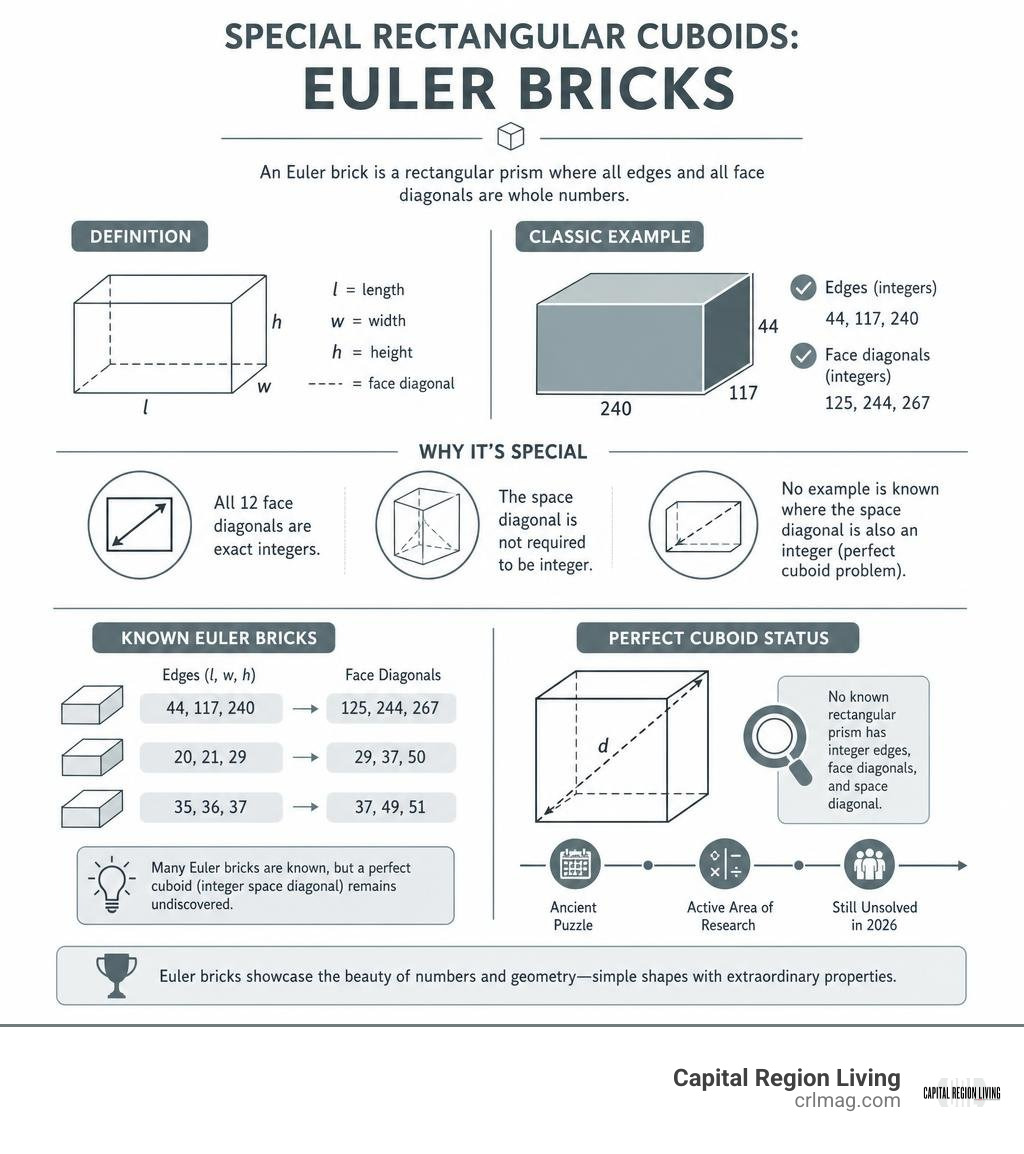
A fascinating advanced mathematical concept involves what mathematicians call an Euler brick—a rectangular prism where all edge lengths and all face diagonals are exact integers. A classic example is a prism with edge dimensions of 44, 117, and 240. Interestingly, mathematicians have yet to discover a “perfect cuboid” where the interior space diagonal is also an exact integer—it remains one of modern geometry’s unsolved puzzles!
Comparing Shapes, Real-World Examples, and Composite Identification
To master 3D spatial geometry, we need to recognize how the rectangular prism relates to other geometric polyhedra, spot it in our day-to-day surroundings, and identify it when it is embedded within complex composite structures.
Rectangular Prisms vs. Cubes
A common question in introductory geometry is whether a cube is different from a rectangular prism. The answer lies in class inclusion: every cube is a rectangular prism, but not every rectangular prism is a cube!
Think of it like rectangles and squares in 2D geometry: a square is simply a special rectangle where all four sides are equal. Similarly, a cube is a special rectangular prism where length, width, and height share the exact same measurement ($l = w = h$).
- Edge Lengths: A general rectangular prism can have three entirely different side lengths ($l \neq w \neq h$). A cube must have six equal side lengths ($l = w = h = s$).
- Face Shapes: A standard rectangular prism has six faces that are rectangles. A cube has six identical square faces.
- Symmetry & Classification: A cube boasts higher degree geometric symmetry and is classified as one of the five regular Platonic Solids.
- Volume Simplification: While a rectangular prism uses $V = lwh$, a cube simplifies to $V = s^3$.
Real-World Examples and 3D Composite Shapes
We interact with rectangular prisms every single day without even realizing it. Because they stack efficiently and maximize internal volume while minimizing wasted footprint space, engineers, architects, and manufacturers heavily rely on this shape.
Common everyday examples include:
- Household Goods: Books, tissue boxes, cereal cartons, shoeboxes, and smartphones.
- Construction & Architecture: Standard red clay bricks, concrete wall foundations, rectangular swimming pools, and skyscrapers.
- Storage & Logistics: Wooden cargo pallets, corrugated shipping boxes, cargo containers, and lunch boxes.
For a detailed review of foundational terms and historical mathematical definitions, explore this Story of Mathematics overview.
Identifying Rectangular Prisms in Composite 3D Shapes
In real-world construction and advanced geometry problems, shapes are frequently combined into composite solids—structures made of two or more distinct 3D shapes joined together.
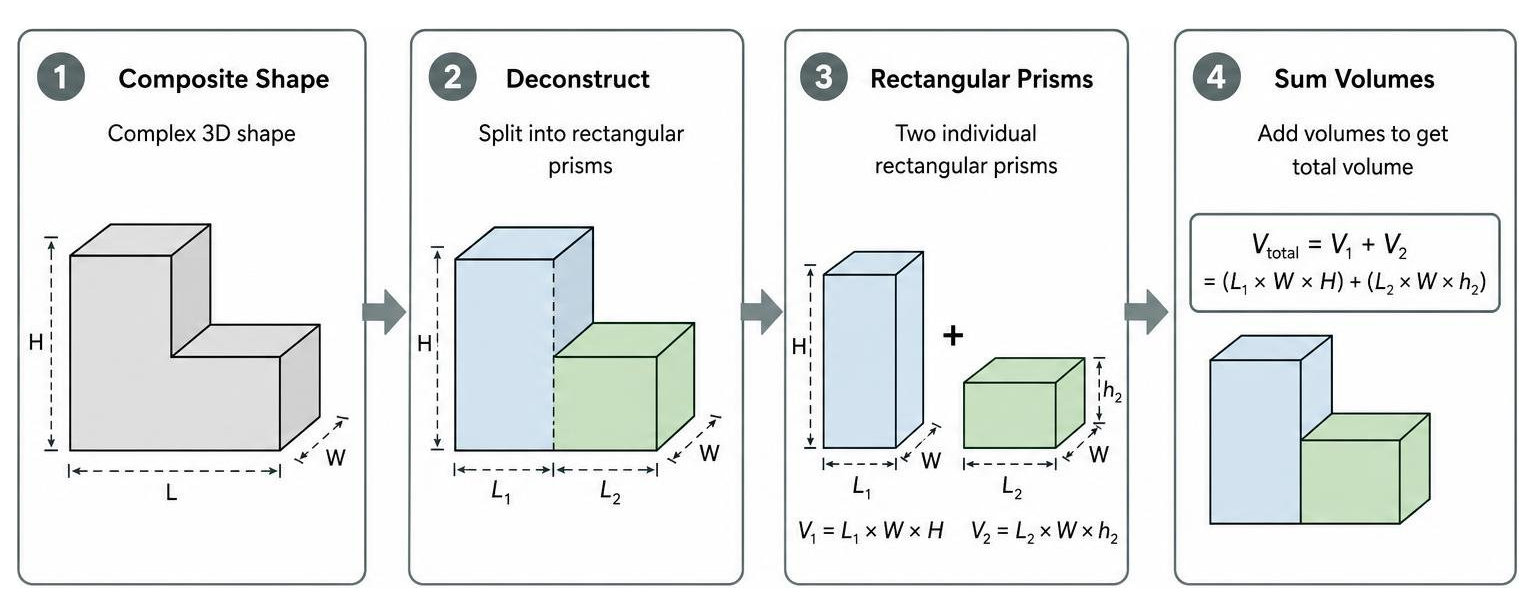
When evaluating a complex composite shape, such as an L-shaped house or a multi-tiered concrete step structure, we can easily calculate total volume by breaking the solid down:
- Deconstruct the Shape: Look for interior plane cuts that separate the complex solid into simpler, individual rectangular prisms.
- Calculate Sub-Volumes: Measure the length, width, and height of each isolated section and calculate its volume ($V1 = l1 \cdot w1 \cdot h1$, $V2 = l2 \cdot w2 \cdot h2$, etc.).
- Sum the Parts: Add all individual volume totals together ($V_{\text{total}} = V1 + V2 + \dots$) to find the total overall capacity.
For instance, if a custom home features a main living section measuring $40\text{ ft} \times 20\text{ ft} \times 10\text{ ft}$ ($8,000\text{ ft}^3$) attached to an entry wing measuring $10\text{ ft} \times 10\text{ ft} \times 8\text{ ft}$ ($800\text{ ft}^3$), the combined structural space totals $8,800\text{ cubic feet}$.
Frequently Asked Questions About Rectangular Prisms
When do students typically learn about rectangular prisms?
In elementary math education aligned with Common Core State Standards (such as standard CCSS.MATH.CONTENT.1.G.A.2), students begin recognizing and naming 3D shapes like rectangular prisms, cubes, cones, and cylinders in Grades 1 through 3. At this early stage, learning focuses on tactile manipulation—using building blocks, tissue boxes, and paper nets to identify faces, edges, and corners.
By Grades 4 and 5, curriculum expectations transition toward formal measurement. Students learn to apply linear measurements (length, width, height) to compute volume using $V = lwh$ and calculate total surface area using unit square grids.
What is the difference between a cuboid and a rectangular prism?
There is no functional mathematical difference! The terms cuboid and rectangular prism are completely interchangeable in geometry.
In general, “rectangular prism” is the standard term taught across primary and secondary school math curricula in North America. Conversely, “cuboid” (or “rectangular cuboid”) is more frequently used in higher-level university mathematics, architectural design literature, and international English curricula (such as in the UK and Australia). Both describe a six-sided polyhedron whose faces are rectangles meeting at right angles.
How many nets can a rectangular prism have?
A net is a two-dimensional flat pattern that can be folded along its edges to construct a complete three-dimensional solid.
While a perfect cube (where all six faces are identical squares) has exactly 11 distinct nets, a general rectangular prism with three different edge dimensions ($l \neq w \neq h$) has at least 54 distinct unfolded nets! Hands-on papercraft exercises where students cut out and fold 2D nets into 3D boxes remain one of the most effective ways to build spatial reasoning skills.
Conclusion
From shipping logistics and product design to home architecture and elementary mathematics classrooms, the rectangular prism is truly one of the most fundamental building blocks of our physical world. Understanding its properties—its 6 faces, 12 edges, 8 right-angle vertices, and simple formulas for volume and surface area—provides an essential foundation for geometry and practical spatial problem-solving.
At Capital Region Living, we love exploring the intersection of practical knowledge, design, and local community culture across New York’s Capital Region. Whether you are helping your children master elementary math homework, planning a home improvement project, or seeking inspiration for local architectural landmarks, mastering basic spatial geometry brings a brand-new appreciation to the shapes all around us.
Looking for more inspiring community insights, family educational guides, and local dining highlights? Explore local community events and lifestyle stories with Capital Region Living today!