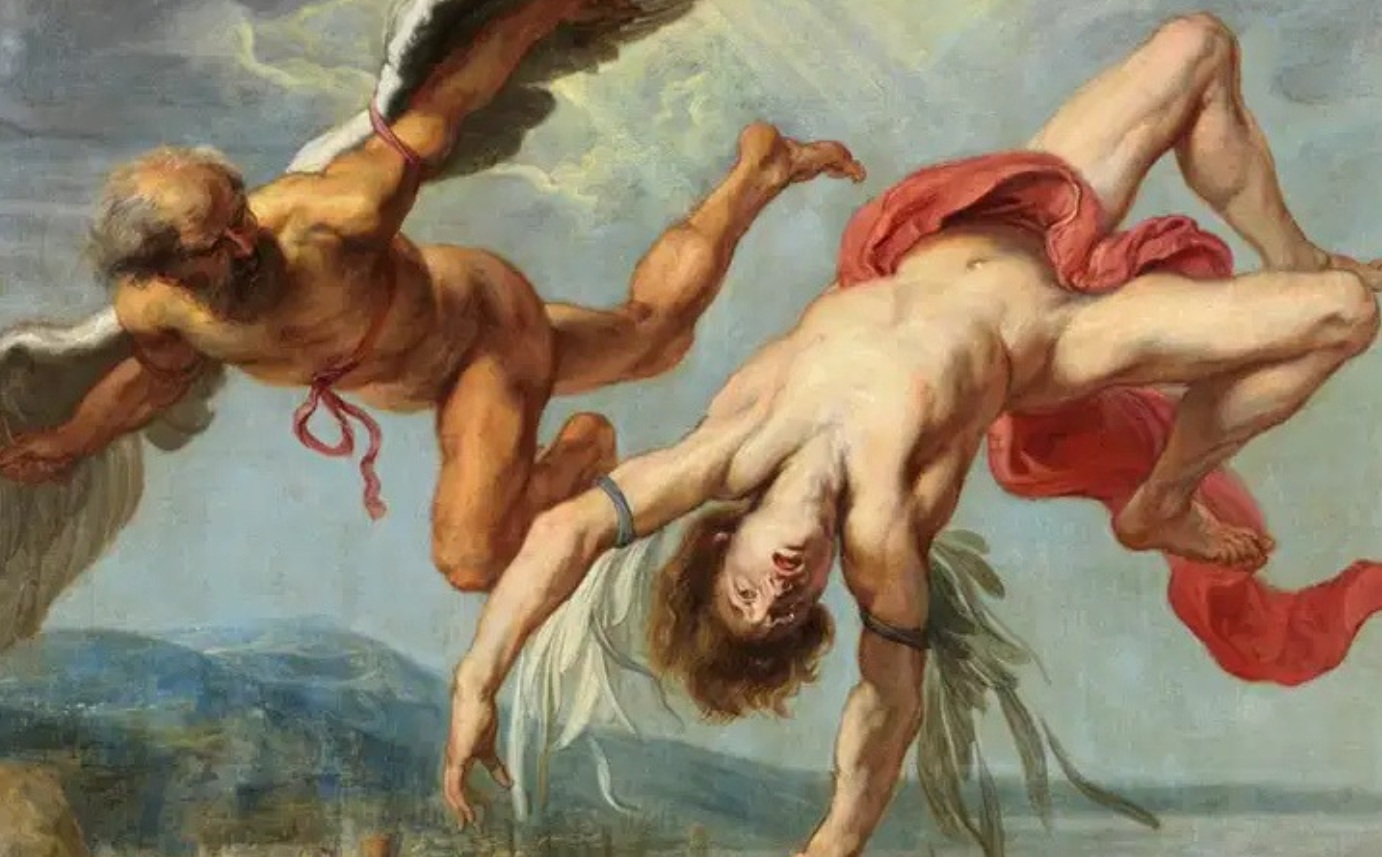
There’s a story in Greek mythology. It tells of an inventor named Deadelus and his son named Icarus, who are imprisoned on a tower on the island of Crete by the ruthless King Minos. Seeking adventure and wishing to explore the world, Icarus begged his father to devise some way of escape. Daedelus responded by inventing two pairs of wings made from wax and feathers that would allow them to fly out of their window and onto the open sea, warning Icarus not to fly too close to the Sun for the heat would melt his wings. They set off, and Icarus immediately ignored his father’s advice and took to the skies, exhilarated by his flight. Blinded by his freedom, he flew closer and closer to the Sun and his wings melted further and further down, until suddenly, there were no more feathers left for him to fly on. And, well, you know the rest.
I keep thinking of this story as I’m reaching the end of my high school senior year. Graduation stands ahead of me like the gates of Olympus, promising opportunity and a view from heights I’ve never seen before. But instead of looking forward, I can’t help but look back to the graduation four years ago, when I stood at the podium of CBA’s moving-up ceremony, middle school diploma in hand, convinced I knew exactly who I was and who I would be would never change.
I was an academic, no more, no less. That was my identity. At the start of high school, I joined my school’s Masterminds team, participating in a series of state-wide competitions answering questions on academics and current events against the buzzer. We placed first in our division, second in the entire Albany league, and qualified for the official Small School National
Championship, an opportunity only given to 150 schools across the country and four schools in the state. I also joined my military department’s JROTC Leadership & Academic Bowl teams, participating in a national competition that tackled academic and military scenarios to earn a spot to compete in Washington, D.C.
But as I stuck to my linear path throughout high school, the world outside the classroom was anything but linear. COVID-19 was ending, and I saw the world through a lens ranging from the January 6th riots to school shootings, and from the rise of artificial intelligence to mass political polarization. The world was rapidly changing, and I felt myself inadvertently changing with it, lest I faced being thrown overboard by these tides of change. For the first time, I began to question not just what I believed in but who I was becoming. This questioning would reach its peak in my junior year.
CBA’s biggest competition was upon us. It was time for our senior rank promotions, with the highest honor bestowed upon whoever would be promoted and elected our military class president, or Cadet Colonel. Similar to other schools, he would be in charge of a student body, but unlike other schools, this student body wasn’t made of 90 but rather more than 500 high school students, 50 staff, hundreds of thousands of dollars in military equipment, and countless clubs including our school’s nationally acclaimed drill, color guard, leadership, academic, and Wansboro rifle teams. He would have the primary responsibility of ensuring our school operated as an honor school with distinction, a status awarded to less than 10% of schools nationwide, and as the 6th best JROTC program in the nation. As our army instructors described the weight of the position, I listened, but not for the reasons I should have. I wasn’t thinking about service. I was thinking about completion. And at that moment, I made a choice to aim for it for the simple reason that I aimed for every other goal in my life. Life was a linear path to be taken, with a
clearly defined start and a clearly defined end. Cadet Colonel would be the end, the last mountain that I was to climb, the last checkbox that I was to fill, the last test that I was to complete, and everything in between were simply steps to be taken up to that point, no more, no less. The final promotion was my grade, and I knew, come the end of my junior year, I would see a 100 on that paper.
Quickly, I learned that academics could only take me so far. Although the promotions were partially based on academics, they were only a small part of the overall process, with other criteria ranging from physical fitness to leadership skills to military interviews. In Greek legend, Hercules faced twelve labors, each one designed to push him further than the last. These were my twelve labors, and I pushed myself. I went to bed everyday, promising to myself that when I woke up, I would do more than what I did yesterday. Using the bike trail next to my house, I ran until I couldn’t run anymore. And the next day, I ran again, taking a few steps further. To the squad of cadets that I would be taking my squad marching test with, I learned how to work together with a team instead of just working by myself. I stepped up, making sure that I was seen as more than a high school junior but a leader.
I also stepped outside of my comfort zone. I joined the CBA indoor and outdoor track teams as a pole vaulter, despite having no experience. I’ll be real with you, the sport terrified me. I mean, who wouldn’t be scared of running full speed into a pit, planting a pole, and trusting that as you swing your body upside down, you won’t faceplant into the hanging metal bar? I practiced for hours, traveled to countless competitions across the state, and had my fair share of faceplants, ultimately placing 156th in the state. Not first, not second, but 156th. And somewhere between the bruises and the missed clearances, the number started to matter less than the fact that I kept getting back on the runway.
Promotions took place in the school gymnasium that year. The lower ranks were promoted first, from Sergeant First Class to Major. These were high school students that would have responsibilities ranging from commanding small to medium-sized groups, such as platoons of 20 to 40 or companies of 60 to 80, to serving as lower-level staff for the brigade, such as the military photographers, information specialists, and historians. Then, the higher ranks were promoted. Fourteen of us, including myself, were called to the center of the gym. These high school juniors were granted the rank of lieutenant colonel, the second-highest rank in the JROTC, and would have responsibilities ranging from managing hundreds of thousands of dollars worth of military equipment to commanding larger groups, such as battalions of 120 to even 160 students. The army instructors explained how the process would go to our parents. As we stood in a line in front of hundreds of people, standing at attention, one by one we would be called out in order, knocked out of line, and our parents would come out to the center, promote us, and congratulate us. The last person standing would be the Cadet Colonel.
Time slowed as they started calling out names, and I saw students walking out beside me, with less and less standing in the center of the gym. Then my name was called. I wasn’t the last one standing. My parents pinned the lieutenant colonel rank on my epaulettes, and I smiled for photos, but inside, I felt for the first time in my life, I had really failed. Afterwards, I stood alone in the bathroom and paused after I washed my hands, staring into the mirror. I didn’t recognize who stared back, despite the person looking physically the exact same. That person was Jameson, sure, but a different Jameson. A Jameson who had come in as a high school junior looking for a title but left as a pole vaulter, an athlete, a leader, and now a lieutenant colonel. I finally dried my hands, turning off the lights as I left.
Now I’m in my senior year, and I’ve fully embraced the rank I have in CBA’s JROTC. I serve as the S3 or chief operations officer, and I’m responsible for planning drill and ceremony for the entire school. Ironically, I’m now also in charge of organizing and spearheading the very promotion tests that once defined my junior year. Outside of JROTC, a different beast awaits: college admissions. Some days it feels like I’m standing before Cerberus, the mythical hound of Hades who guards the Underworld’s gates, hoping to pass through without being chewed up. Other days it feels like Atlas has shifted the weight of the sky onto my shoulders, with transcripts, test scores, and expectations pressing down on me at once.
I plan to study aerospace engineering alongside in public policy, and I’m still waiting on some decisions to come out. Everyone I talk to offers advice, but the one phrase shared is that at the end of the day, it’s a “numbers game”. That no matter the grades I’ve received, the competitions I’ve won, and the leadership roles I’ve taken on, I could still be rejected and fail. Junior-year me would’ve hated that, and the linear path that I charted out prior would’ve rejected that. Cadet Colonel would’ve served as proof. I wanted to be the one left alone out of the fourteen in that gymnasium. But standing alone is just that—alone. The night of the promotion results, I didn’t end up by myself, and that was the lesson. The drive to be Cadet Colonel had pushed me to grow, but the relationships, the communities, and the shared effort were what actually mattered. The point was to never outlast everyone else but build something alongside them.
Since then, I’ve learned that no matter if you’re trying to apply to college, become Cadet Colonel, or achieve any goal in life, you will be faced with failure, even if you give it your best effort. But if you don’t embrace failure, you’ll never learn to change. Throughout history, there have been multiple retellings of Icarus, the constant being that he always dies as a result of his own flight and his own behavior. But I like to think that in his final moments before he touched down to the ocean, Icarus smiled and laughed as he fell. He grew as a person in those fleeting seconds more than he ever could in the countless days he spent locked up in prison because he tried, dared, and dreamed. For the only way to fall is to have once soared.