Anne Heche’s Death: What Happened and Why Her Story Still Matters
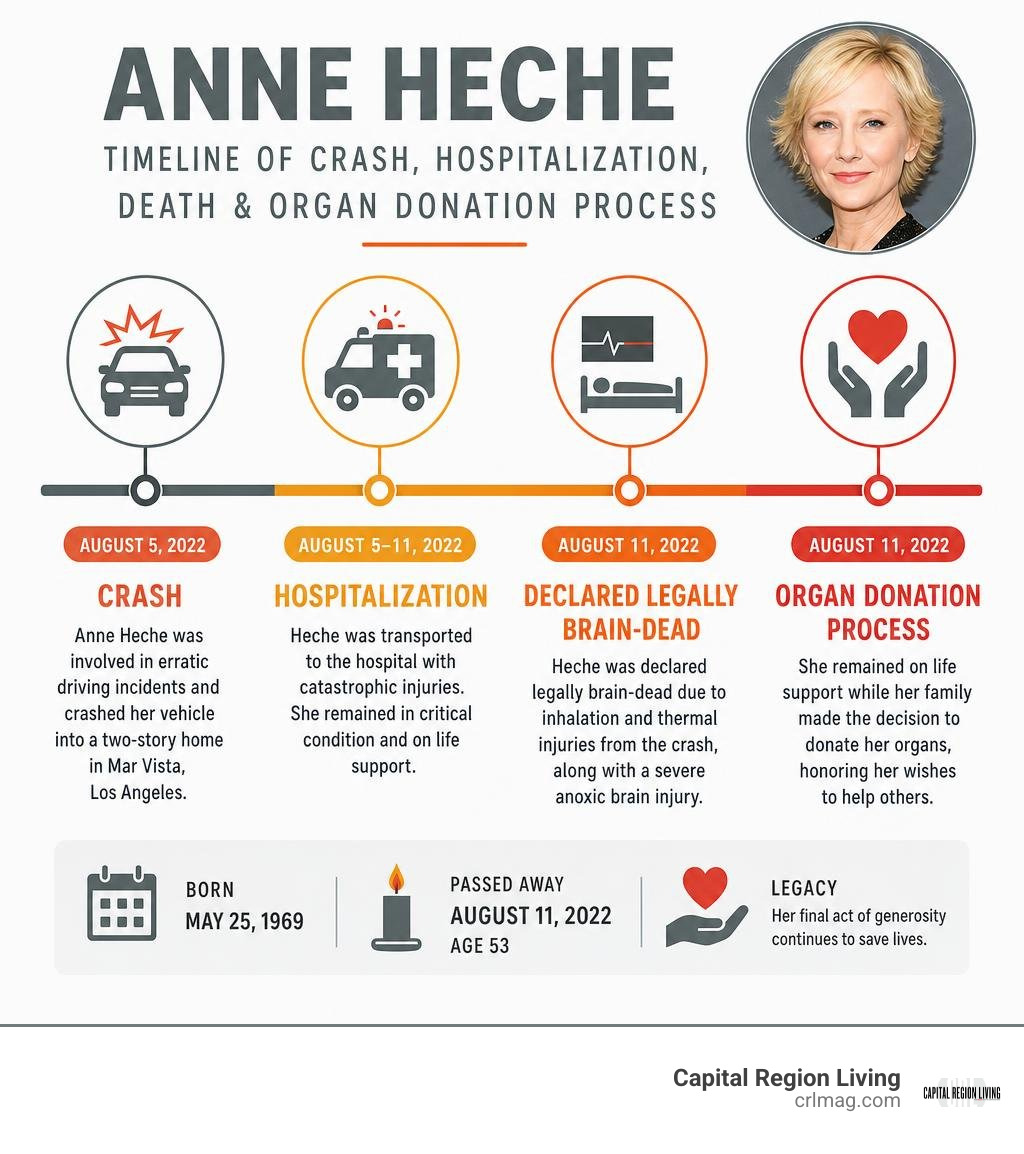
Anne Heche was an Emmy-winning actor known for Another World, Donnie Brasco, Volcano, and Six Days, Seven Nights. She died at age 53 on August 11, 2022, after suffering catastrophic injuries in a fiery Los Angeles car crash six days earlier.
- Crash date: August 5, 2022, in Mar Vista, Los Angeles
- Cause of death: Inhalation and thermal injuries from the crash, along with a severe anoxic brain injury
- Final days: Heche was declared legally brain-dead on August 11 and remained on life support while organ donation was considered
- Why she remains widely discussed: Her career, relationship with Ellen DeGeneres, public mental-health struggles, and estate disputes all made her life a major part of Hollywood history
Her death ended a career that moved from daytime TV to hit films, Broadway, and later television work. It also renewed attention on the difficult public chapters of her life, including the intense reaction to her relationship with DeGeneres in the late 1990s and claims Heche made about childhood trauma.
This guide separates established facts from the speculation and headlines that followed the crash.
The Circumstances Surrounding Anne Heche’s Fatal 2022 Crash
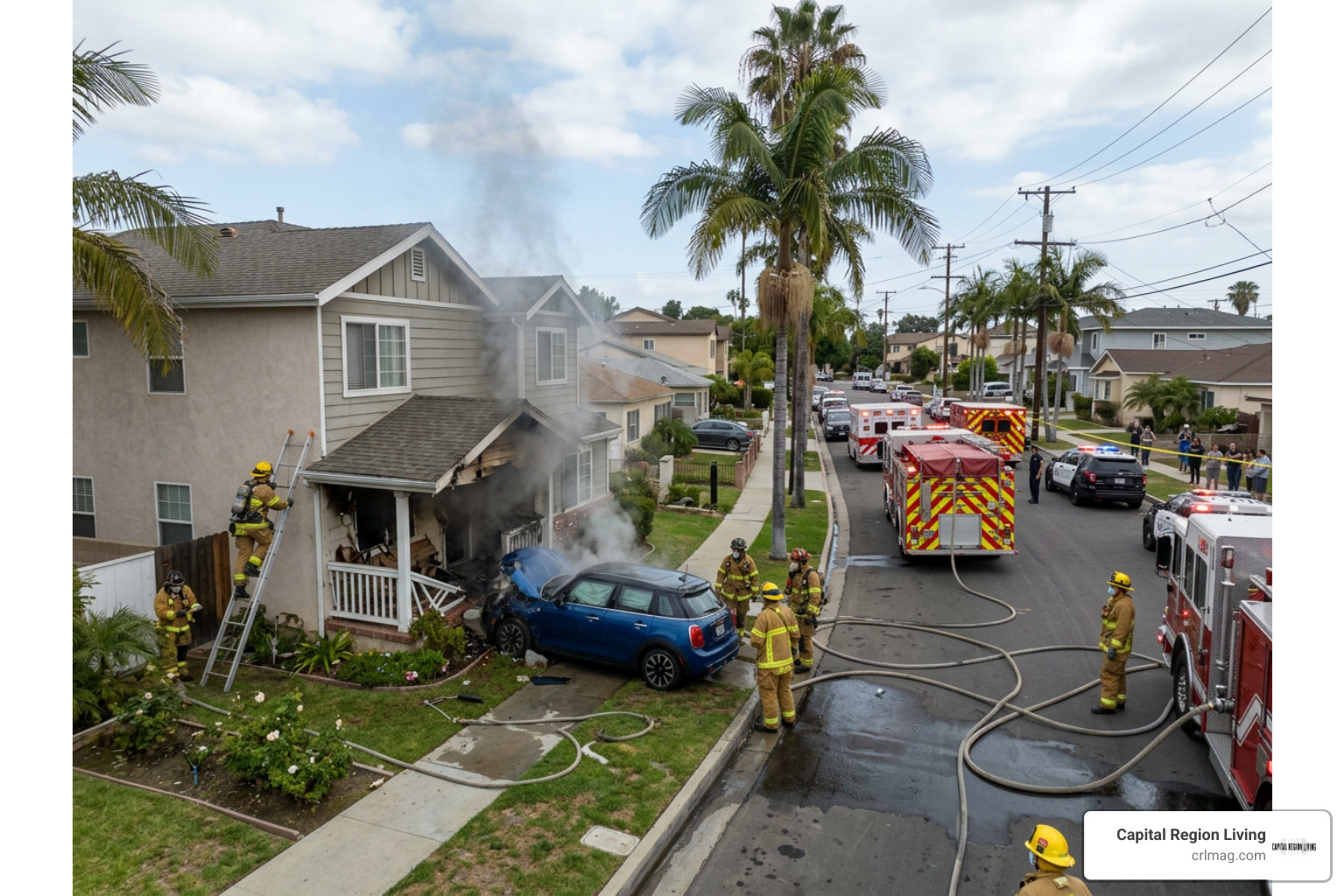
The tragic sequence of events surrounding the death of Anne Heche began on the morning of Friday, August 5, 2022. Operating her blue Mini Cooper in the quiet residential neighborhood of Mar Vista on the west side of Los Angeles, Heche was involved in a series of erratic driving incidents before her vehicle crashed at high speed into a two-story home.
The impact tore through the structural wall of the residence, pushing the vehicle nearly 30 feet inside the property and rupturing internal structures. The collision ignited an intense structure fire, trapping Heche inside the burning automobile. According to reports covered by outlets such as AP News, the accident immediately triggered a massive emergency medical and firefighting response across Los Angeles.
The Incident in Mar Vista and Firefighting Response
When emergency dispatch received calls reporting a vehicle inside a burning structure, the Los Angeles Fire Department (LAFD) dispatched heavy resources to the Mar Vista address. A total of 59 firefighters responded to the scene, facing dense smoke and localized structural collapse.
Because the Mini Cooper was deeply embedded within the structural wreckage of the home, firefighters faced extreme difficulties reaching Heche. It took rescue crews more than 60 minutes of heavy firefighting effort to fully suppress the flames, access the vehicle, and pull Heche from the wreckage.
By the time she was extricated, Heche had suffered extensive thermal burns requiring immediate surgical intervention. Furthermore, the thick smoke generated by the fire resulted in severe inhalation injuries, depriving her oxygen supply for a prolonged period while she was trapped.

Medical Timeline, Toxicology Findings, and Organ Donation
Following her rescue from the Mar Vista property, Heche was rushed to the Grossman Burn Center at West Hills Hospital. Emergency physicians stabilized her initial vital signs, placing her on mechanical ventilation. However, the prolonged lack of oxygen to her brain—known medically as an anoxic brain injury—proved irreversible.
Over the next several days, medical teams evaluated her neurological function while public speculation mounted regarding the cause of the crash. On August 11, 2022, doctors officially declared Anne Heche legally brain-dead under California law.
Despite brain death, her body was kept on life support systems for three additional days. As an advocate for organ donation, Heche had expressed her desire to give her organs to those in need. Surgeons required extra time to determine organ viability and find suitable recipients. On August 14, 2022, after organ donation matching was finalized, her life support was officially removed.
Months later, in December 2022, the Los Angeles County Department of Medical Examiner released its official toxicology and autopsy report. The findings cleared up significant rumors surrounding her death:
- Primary Cause of Death: Inhalation and thermal injuries, with a significant sternal fracture due to blunt trauma that compromised her breathing.
- Brain Injury: Anoxic brain injury caused by prolonged oxygen deprivation during the fire.
- Toxicology Findings: Initial blood screenings at the hospital showed traces of cocaine metabolites and cannabinoids. However, the final toxicology investigation confirmed there was no evidence of active illicit drug or alcohol impairment at the time of the crash.
- Therapeutic Medications: Traces of fentanyl detected in her system were determined to have been therapeutically administered by hospital personnel after she arrived for medical treatment.
Career Legacy and Critical Accomplishments
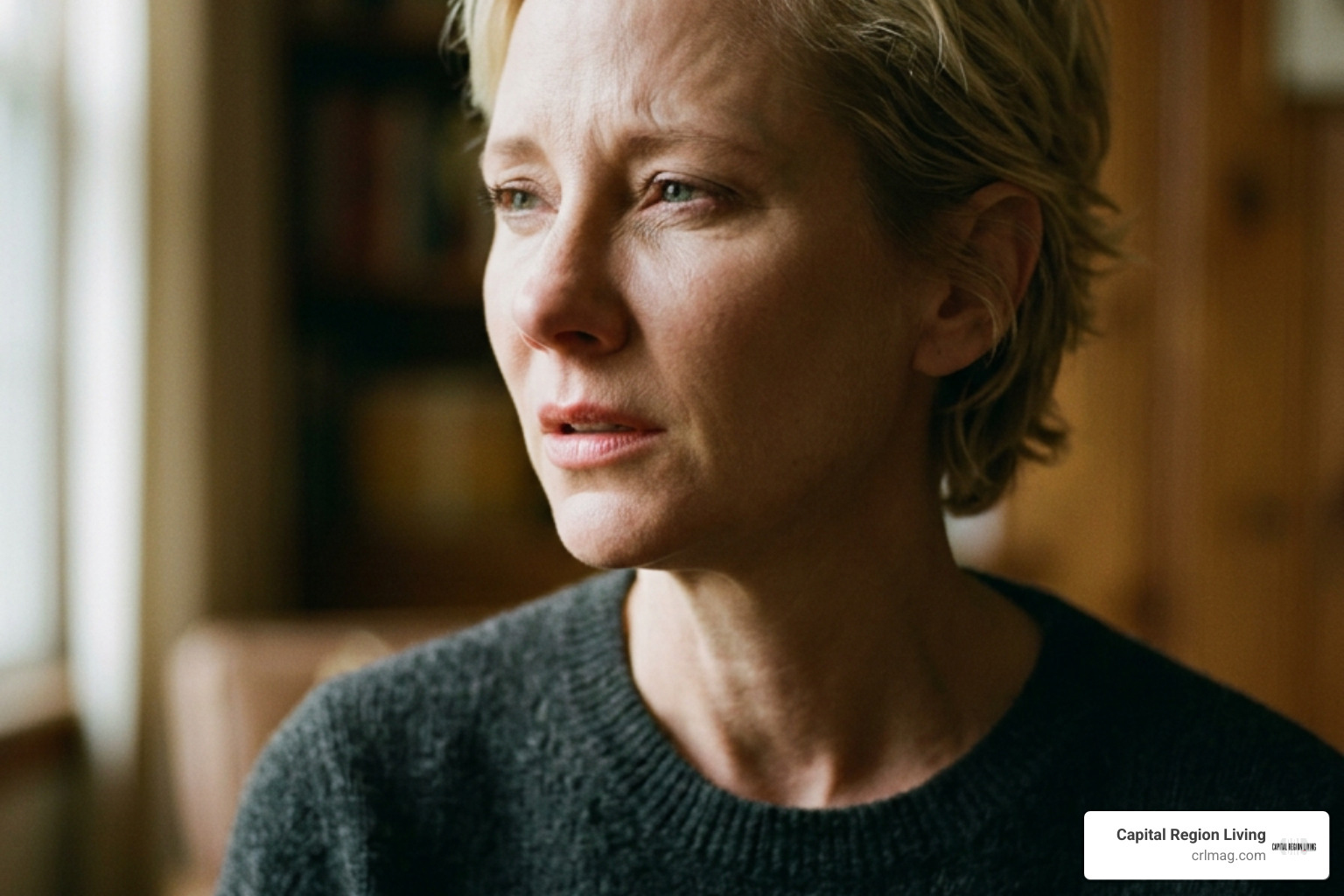
While the circumstances of her death dominated news cycles, Anne Heche left behind a extraordinary body of work spanning nearly four decades. She was recognized across Hollywood as a fierce, highly flexible performer who could jump effortlessly between daytime soap operas, blockbuster action films, dark comedies, and Broadway plays.
Over her career, Heche secured 9 award wins out of 11 total nominations. Her work achieved both critical accolades and commercial box office milestones across multiple entertainment mediums:
- Daytime Drama: Won a Daytime Emmy Award in 1991 for her dual role on Another World.
- Mainstream Cinema: Starred in global hits including Volcano ($122 million worldwide) and Six Days, Seven Nights ($164.8 million worldwide).
- Broadway: Received a prestigious Tony Award nomination for Best Actress in a Play in 2004 for Twentieth Century.
- Primetime Television: Received a Primetime Emmy nomination for her role in the TV movie Gracie’s Choice.
- Industry Profile: Reached a top 5,000 IMDbPro Starmeter ranking at #292.
Anne Heche’s Breakout Roles and Award-Winning Legacy
Heche’s professional path began in her youth out of financial necessity. At just 12 years old, she worked at a New Jersey dinner theater making $100 per week to help support her family. After high school, she skipped formal university training to take on a complex double role as twin sisters Vicky Hudson and Marley Love on NBC’s soap opera Another World from 1987 to 1991. Her dual performance won her critical acclaim, two Soap Opera Digest Awards, and a Daytime Emmy Award for Outstanding Younger Actress in a Drama Series.
Her victory on daytime television opened doors in mainstream feature films. As detailed on IMDb’s biography page for Anne Heche, she transitioned smoothly into critically acclaimed 1990s projects:
- Walking and Talking (1996): An indie darling performance that established her comedic and dramatic range.
- Donnie Brasco (1997): Starred alongside Johnny Depp and Al Pacino as Maggie Pistone, earning praise for her grounded, emotional depth.
- Volcano (1997): Co-starred with Tommy Lee Jones in a big-budget disaster movie that grossed $122 million internationally.
- Wag the Dog (1997): Appeared alongside Dustin Hoffman and Robert De Niro in a political satire that earned $64 million on a $15 million budget.
- I Know What You Did Last Summer (1997): Showcased her versatile horror acting in a hit slasher film.
- Six Days, Seven Nights (1998): Paired with Harrison Ford in a romantic action-comedy that achieved $164.8 million in global box office earnings.
- Psycho (1998): Played Marion Crane in Gus Van Sant’s shot-for-shot remake of the classic Hitchcock thriller.
In the 2000s, Heche expanded into live theater and television series. She made her Broadway debut in Proof (2002) and received her Tony Award nomination opposite Alec Baldwin in the 2004 revival of Twentieth Century. On television, she led the fan-favorite ABC drama Men in Trees (earning $80,000 per episode) and co-starred in HBO’s Hung.
Public Perception, Relationships, and Personal Struggles
Throughout her life, Heche’s public image was frequently shaped as much by her personal life as her acting achievements. In 1997, she made international headlines when she began a high-profile romantic relationship with comedian and television host Ellen DeGeneres.
Labeled by publications like The Advocate as the first major gay supercouple in Hollywood, their relationship placed Heche directly into the center of a cultural firestorm at a time when Hollywood was far less accepting of LGBTQ+ individuals.
The Complex Life and Personal Struggles of Anne Heche
Heche maintained throughout her career that her choice to go public with DeGeneres severely damaged her mainstream studio trajectory. As documented in a detailed Telegraph obituary, major studios warned her against bringing DeGeneres to the premiere of Volcano.
When she proceeded anyway, Heche stated she was dropped from a multi-million-dollar studio picture deal and effectively blacklisted from major studio films for nearly a decade. Even during the release of Six Days, Seven Nights, public polling showed around 68% of cinemagoers felt her real-life relationship adversely impacted their perception of her romantic pairing with Harrison Ford—though Ford himself steadfastly defended her casting.
Her personal life was also marked by deep childhood hardships and mental health struggles:
- Family Traumas: Born in Ohio, Heche’s family moved 12 times before she reached adolescence. Her father, who hid his closeted sexuality and late-stage AIDS diagnosis from the family, died in 1983. Three months later, her brother died in a tragic car crash.
- Childhood Abuse Allegations: In her 2001 memoir Call Me Crazy, Heche alleged that her father had sexually abused her during childhood—claims that created deep feuds and public denials from her surviving mother and sister.
- Public Mental Health Incident: Shortly after her breakup with DeGeneres in 2001, Heche experienced a high-profile mental breakdown in Cantua Creek, California. She wandered to a rural home, telling deputies she was looking for a spaceship to take her to heaven under an alter-ego named “Celestia.”
- Media Reaction: In a famous 20/20 television interview, legendary journalist Barbara Walters questioned Heche about her mental health. Walters later described it as the single most unusual interview of her long broadcast career.
Despite these hurdles, Heche remained fiercely independent. She published two memoirs (Call Me Crazy in 2001 and the posthumously released Call Me Anne in 2023), directed short films, and spoke openly about mental health, sexual identity, and recovering from trauma.
Legal Aftermath, Creditor Claims, and Estate Settlement
Following her unexpected death in August 2022, Anne Heche left behind no formal will, initiating a complex legal battle in California probate court. Her eldest son, Homer Laffoon (born in 2002 from her marriage to Coleman Laffoon), filed to manage her estate. He faced opposition from James Tupper, Heche’s former partner and father of her second son, Atlas Heche Tupper (born in 2009).
After months of court proceedings, the Los Angeles Superior Court designated Homer Laffoon as the permanent administrator of the estate. However, the legal team quickly discovered that the estate faced severe financial challenges.
Estate Insolvency and California Probate Law
While total creditor claims against Heche’s estate mounted rapidly to over $4.1 million, court filings revealed the estate possessed roughly $290,000 in gross liquid assets—rendering the estate functionally insolvent.
| Claim Category | Claimant / Description | Estimated Claim Amount |
|---|---|---|
| Property & Displacement | Lynne Mishele (Tenant of destroyed home) | $2,000,000+ |
| Property Damage | Homeowners of Mar Vista residence | $2,000,000+ |
| Personal Credit | Credit card issuers & minor creditors | $100,000+ |
| Total Creditor Claims | Combined total filed in probate court | ~$4.1 Million |
| Total Located Assets | Total gross estate assets identified | ~$290,000 |
This severe gap created significant legal hurdles under California probate statutes:
- Limits on Punitive Damages: Under California Code of Civil Procedure (CCP) Section 377.42, punitive or exemplary damages cannot be awarded against a deceased defendant’s estate, regardless of how extreme their conduct was prior to death.
- Statute of Limitations: California law (CCP Section 366.2) imposes a strict one-year statute of limitations from the driver’s date of death for creditors to settle claims directly against an estate.
- Insurance Recovery Routes: Because estate assets were practically non-existent, injured victims were forced to seek recovery primarily through auto insurance liability limits under California Probate Code Sections 550 through 555, which allow claims against insurance without depleting personal estate funds.
The displaced tenant, Lynne Mishele—who lost all her personal belongings in the structure fire—eventually received support through community crowdfunding campaigns that raised over $180,000, alongside first-party insurance claims.
Frequently Asked Questions
What caused her fatal car crash?
Anne Heche died primarily from severe inhalation injuries and thermal burns sustained when her car caught fire inside a Mar Vista residence. The collision also caused a sternal fracture that impaired her breathing and led to a critical anoxic brain injury due to prolonged oxygen deprivation.
Was she impaired at the time of the accident?
No. The final Los Angeles County Coroner toxicology report released in December 2022 confirmed that Heche was not under the influence of active illicit substances or alcohol at the time of the crash. While inactive cocaine metabolites were present, medical examiners proved there was no active impairment. Fentanyl found in her system was medically administered by hospital staff during emergency treatment.
How did her high-profile relationship impact her career?
Heche publicly stated that coming out with Ellen DeGeneres in 1997 adversely affected her Hollywood career. She noted that studio executives stopped casting her in major studio productions, resulting in a 10-year absence from top-tier film roles, despite starring in box-office hits like Six Days, Seven Nights.
Conclusion
The death of Anne Heche brought a sudden, tragic end to a vibrant and unconventional life. She was an actor of extraordinary talent who brought intensity and honesty to every performance—from daytime television to major studio movies and Broadway revivals. Despite facing deep childhood trauma, intense media scrutiny, and studio backlash during pivotal moments of her life, she consistently redefined herself as an artist, author, and director.
Her artistic legacy remains preserved through dozens of memorable screen performances. If you enjoyed reading this retrospective profile, we invite you to explore our coverage of regional culture, lifestyle stories, and community events on our site. Be sure to check out our local guide to explore local culture and community events across the region.