Who Was Chadwick Boseman?
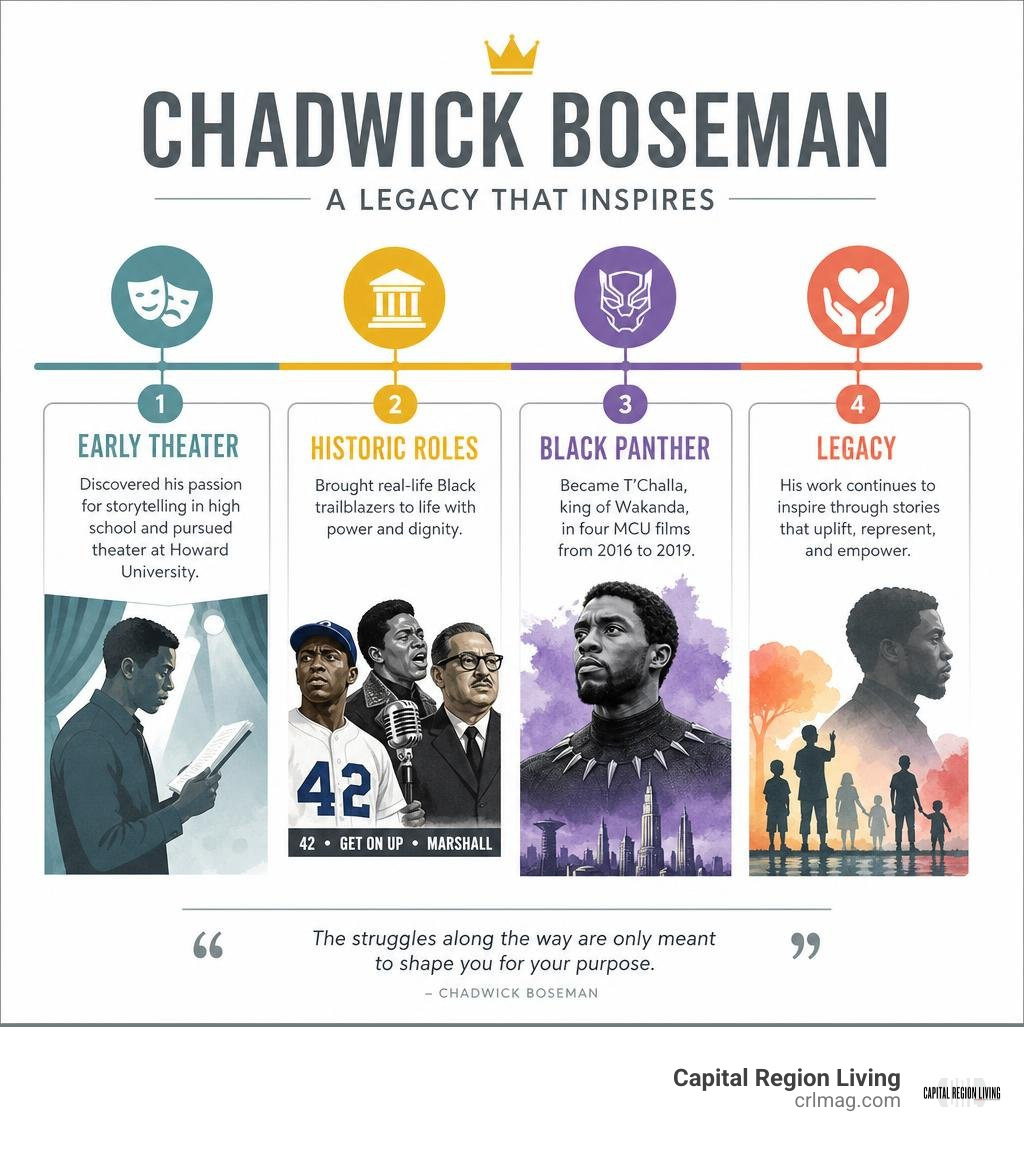
Chadwick Boseman was an American actor, playwright, and filmmaker best known for portraying real-life Black trailblazers and T’Challa, the king of Wakanda, in Marvel’s Black Panther. Born in South Carolina in 1976, he built a powerful career rooted in theater, historical storytelling, and a firm belief that Black characters deserved depth, dignity, and leading roles.
| Quick fact | Answer |
|---|---|
| Known for | 42, Get on Up, Marshall, and Marvel’s Black Panther |
| Breakthrough role | Jackie Robinson in 42 (2013) |
| Marvel role | T’Challa / Black Panther in four MCU films from 2016 to 2019 |
| Education | Howard University, where he earned a BFA in directing in 2000 |
| Died | August 28, 2020, at age 43, after a private battle with colon cancer |
Boseman brought Jackie Robinson, James Brown, and Thurgood Marshall to life before becoming a global symbol of possibility through Black Panther. His work reached far beyond movie theaters: it helped many viewers see Black history, African culture, and superhero stories represented on a scale Hollywood had rarely delivered.
His death shocked audiences around the world, especially after his family revealed that he had continued working through treatment for colon cancer. Yet his influence remains visible in film, education, community giving, and the artists he continues to inspire.
Early Life, Education, and the Formative Years of Chadwick Boseman
Chadwick Aaron Boseman was born on November 29, 1976, in Anderson, South Carolina, to Carolyn and Leroy Boseman. His mother worked as a nurse, while his father worked at a textile factory and ran an upholstery business. Growing up in the American South, young Chadwick developed a strong spiritual foundation and a keen artistic eye. Long before he ever thought about walking Hollywood red carpets, he actually wanted to become an architect! (If you ask us, designing physical structures isn’t too different from building unforgettable characters from the ground up.)
During his junior year at T.L. Hanna High School, a tragic event changed the course of his life. After a classmate and basketball teammate was shot and killed, Boseman processed his grief by writing his very first play, titled Crossroads, and staging it at school. That experience sparked a passion for storytelling that guided the rest of his career. He also excelled in public speaking, placing eighth in Original Oratory at the 1995 National Speech and Debate Association Tournament.
After graduating high school, Boseman attended Howard University in Washington, D.C., where he earned a Bachelor of Fine Arts (B.F.A.) degree in directing in 2000. He originally focused on directing and writing because he wanted to know how to relate to actors when helming productions. At Howard, he was deeply involved in campus life, serving as president of the Howard Players and campaigning to preserve the university’s College of Fine Arts.
While at Howard, Boseman found an invaluable mentor in legendary actress and professor Phylicia Rashad. Recognizing his exceptional raw talent, Rashad helped guide his craft. When Boseman and several classmates were accepted into the prestigious Oxford Summer Program at the British American Drama Academy in London, they faced a daunting hurdle: they couldn’t afford the tuition. Rashad stepped in, rallying her celebrity friends—including iconic actor Denzel Washington—to quietly cover the students’ fees. Boseman only learned later that Washington had paid his way, creating a bond between two generations of acting royalty. To round out his education, Boseman also studied at the Digital Film Academy in New York City. You can read a detailed overview of his upbringing on Chadwick Boseman – Biography, Actor, Black Panther, Death.
Early Playwriting and Stage Beginnings
Before he became a marquee movie star, Boseman was a cornerstone of the Black theater and hip-hop theater movements. Living in Brooklyn, New York, during the early 2000s, he taught drama to young aspiring artists at the Schomburg Center for Research in Black Culture in Harlem while writing and directing original plays.
His theatrical works included Hieroglyphic Graffiti, Rhyme Deferred, and his acclaimed full-length play Deep Azure. Staged by the Congo Square Theatre Company in Chicago, Deep Azure tackled themes of police brutality, identity, and hip-hop culture. The play was nominated for a 2006 Joseph Jefferson Award for New Work, cementing his reputation as a serious playwright. In 2002, Boseman won an AUDELCO Award for his performance in the stage play Urban Transitions: Loose Blossoms.
In the mid-2000s, Boseman began transitioning into television, landing guest roles on series like Third Watch, Law & Order, ER, and CSI: NY. In 2003, he was cast as Reggie Montgomery in the daytime soap opera All My Children. However, after only a few episodes, Boseman expressed deep concerns to the producers regarding how his character reinforced negative racial stereotypes. His principled stand got him fired from the role—which was subsequently recast with a young actor named Michael B. Jordan, who would later become Boseman’s primary antagonist, Erik Killmonger, in Black Panther.
Boseman refused to compromise his values for a steady paycheck. He relocated to Los Angeles in 2008 to pursue directing full-time, but acting opportunities quickly came knocking. He landed recurring and starring roles on television shows like Lincoln Heights (2008–2009) and the mystery series Persons Unknown (2010), setting the stage for his cinematic breakthrough.
Major Film Roles: Biopics and Beyond
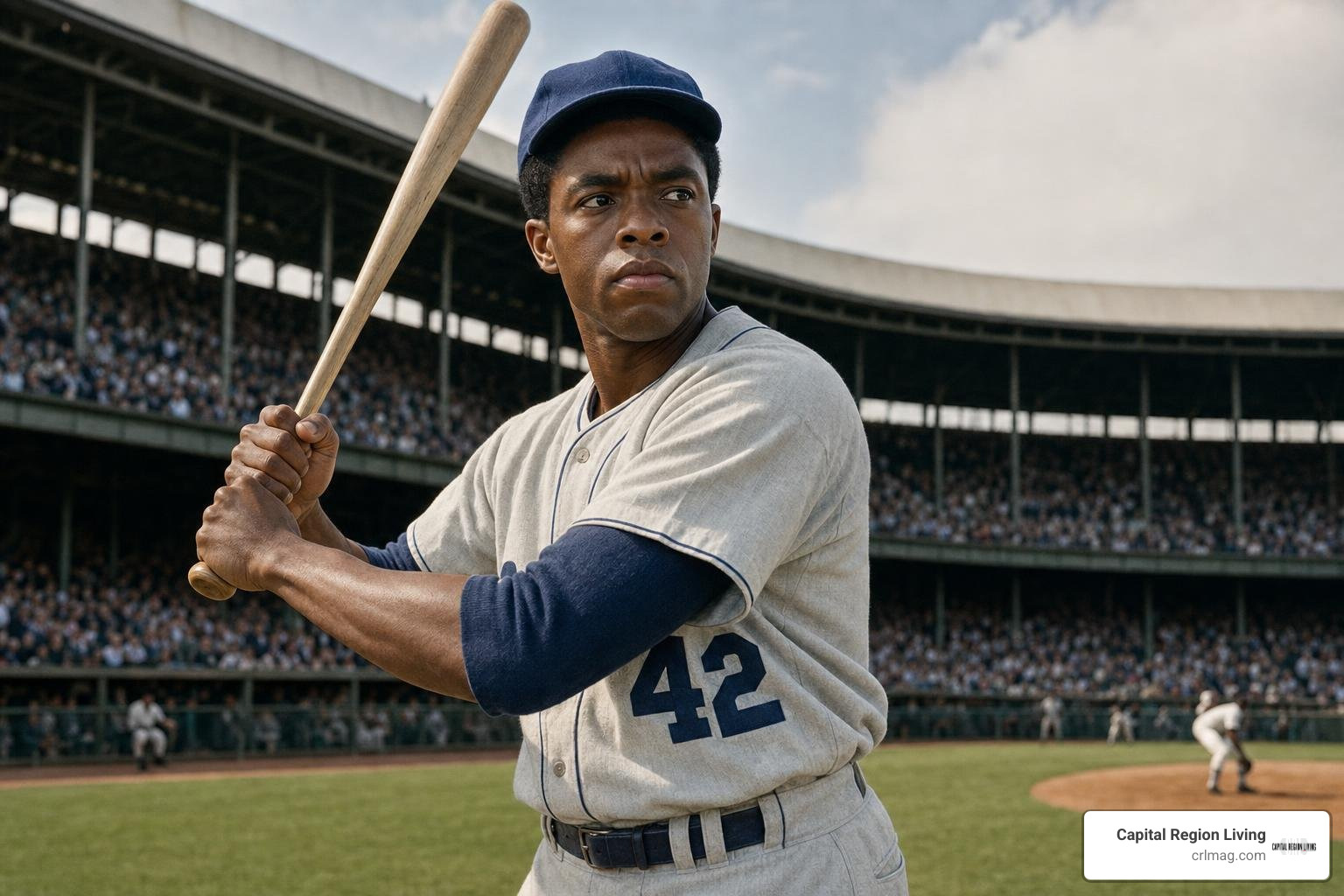
Chadwick Boseman’s career entered a new stratosphere in 2013 when director Brian Helgeland cast him as baseball legend Jackie Robinson in the biopic 42. Up until that point, Boseman had primarily considered himself a theater writer and director who acted on the side. Landing the lead role in a major studio film was a massive leap, and Boseman treated the responsibility with immense dedication.
To portray the man who broke Major League Baseball’s color barrier, Boseman underwent an grueling training regimen:
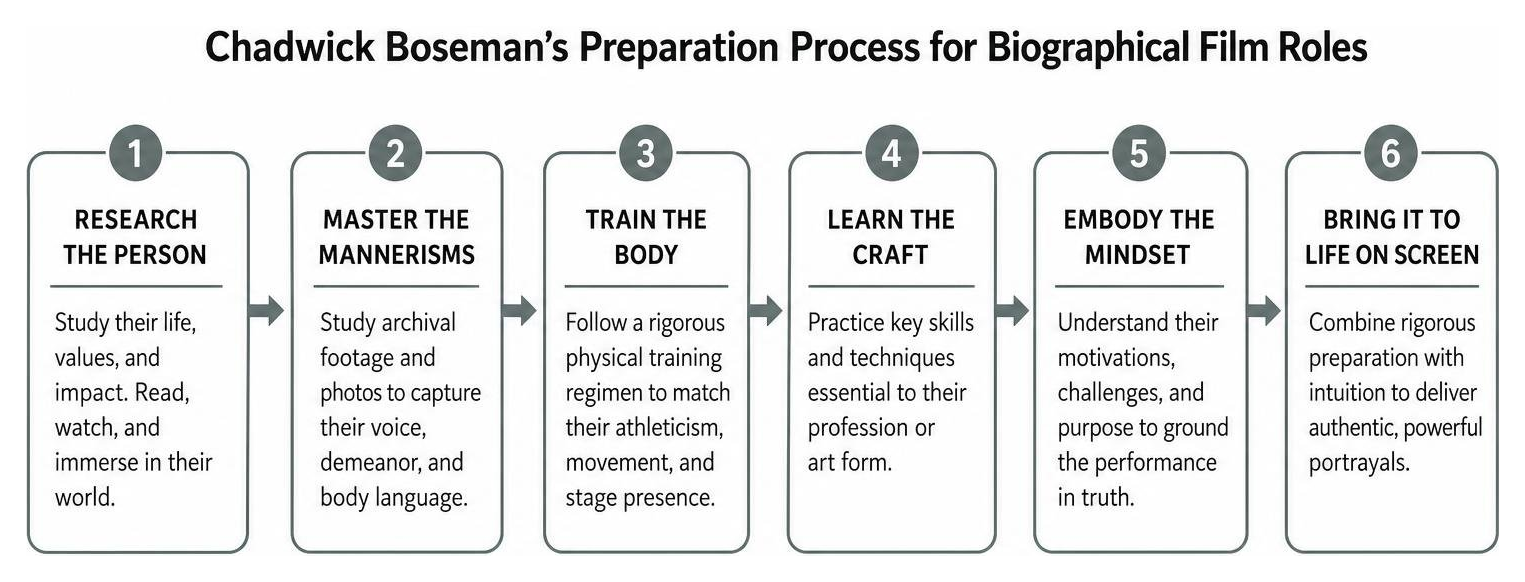
Boseman spent five months training for up to five hours a day with professional baseball coaches to perfect Robinson’s distinct swing, base-running stance, and athletic mannerisms. He also spent hours studying archival footage each morning to mirror Robinson’s vocal patterns and demeanor. The film was a critical and commercial hit, earning over $95 million and proving that Boseman could anchor a major film.
In 2014, Boseman tackled another giant of American culture: “The Godfather of Soul,” James Brown, in Get on Up. Directed by Tate Taylor, the role demanded extraordinary physical transformation. Boseman spent two months before production training five to eight hours daily with choreographer Aakomon Jones, learning Brown’s famous dance moves, footwork, and energetic stage presence. He even consulted directly with Mick Jagger (a producer on the film) to understand the pressures of performing in front of stadium crowds. Time critic Richard Corliss famously wrote that Boseman’s electrifying performance deserved a Pulitzer, a Nobel, and instant election to the Rock and Roll Hall of Fame!
In 2017, Boseman starred in Marshall, playing a young Thurgood Marshall—the brilliant attorney who would eventually become the first African American Supreme Court Justice. Rather than depicting Marshall’s famous elder years, the film focused on a pivotal 1941 criminal trial in Connecticut. Boseman co-produced the film and brought sharp intellect and swagger to the young lawyer fighting systemic injustice in Northern courtrooms.
Beyond historical biopics, Boseman expanded his versatility into thrillers and action dramas. He executive produced and starred in Message from the King (2016), co-produced and starred in the action-thriller 21 Bridges (2019), and delivered a haunting supporting role in Spike Lee’s Vietnam War drama Da 5 Bloods (2020) as the revered fallen squad leader Norman Earl “Stormin’ Norman” Holloway.
How Chadwick Boseman Transformed Biographical Cinema
Boseman did not just play famous historical figures; he revolutionized how Hollywood approached biographical drama. Before Boseman’s run of iconic biopics, studios frequently relegated Black history to background narratives or subservient roles. Boseman insisted on portraying real-life heroes as complex, fully realized human beings filled with passion, flaws, humor, and immense dignity. You can explore a quick breakdown of his historic roles on Chadwick Boseman | Britannica.
He brought a rare intelligence and gravity to the screen, showing that historical figures like Jackie Robinson, James Brown, and Thurgood Marshall were not passive symbols of progress, but active agents who changed the world through sheer grit and talent. His commitment to historical representation helped reshape how major film studios evaluate and finance stories centered on Black historical figures.
| Film | Character | Release Year | Key Training / Preparation | Box Office / Recognition |
|---|---|---|---|---|
| 42 | Jackie Robinson | 2013 | 5 months of daily baseball training & archival research | $95M worldwide box office |
| Get on Up | James Brown | 2014 | 2 months of dance & vocal training, 5–8 hours daily | Widespread critical acclaim |
| Marshall | Thurgood Marshall | 2017 | Intensive legal research & vocal dialect work | Co-produced by Boseman |
| 21 Bridges | Andre Davis | 2019 | Weapons training & ride-alongs with NYPD detectives | Produced by Boseman |
| Da 5 Bloods | “Stormin’ Norman” | 2020 | Military tactical training & historical research | Directed by Spike Lee |
The Marvel Cinematic Universe and Cultural Impact
In 2014, Marvel Studios announced that Chadwick Boseman would portray T’Challa / Black Panther in the Marvel Cinematic Universe (MCU). The character made his spectacular debut in Captain America: Civil War (2016). Boseman brought a regal presence, accent work rooted in Xhosa culture, and flawless martial arts execution to the role.
Then came 2018’s Black Panther, directed by Ryan Coogler. The standalone film became an international cultural phenomenon. Set in the fictional, technologically advanced African nation of Wakanda, Black Panther shattered box office records, earning $218 million domestically over its four-day opening weekend and ultimately grossing over $1.34 billion worldwide.
Black Panther was far more than a blockbuster movie; it was a watershed moment for representation in global cinema. It showed Hollywood that a film with a predominantly Black cast, an African director, and a Black superhero could achieve unparalleled commercial and critical success. The movie made history as the first superhero film ever nominated for the Academy Award for Best Picture, ultimately winning three Oscars for Costume Design, Production Design, and Original Score.
Boseman reprised his legendary role as T’Challa in two of the highest-grossing films of all time: Avengers: Infinity War (2018) and Avengers: Endgame (2019). Through his regal posture, quiet strength, and signature “Wakanda Forever” cross-armed salute, Boseman provided millions of children around the globe with a superhero who looked like them and embodied nobility, courage, and leadership.
Legacy of the Chadwick Boseman Superhero Epoch
The superhero era led by Boseman helped bring Afrofuturism—a cultural aesthetic that combines science fiction, history, and African culture—into mainstream global consciousness. Readers curious about his complete credits and catalog can review Chadwick Boseman — The Movie Database (TMDB).
Boseman understood the weight of his platform and used his platform to lift others up. When Black Panther was released in theaters, Boseman personally donated $10,000 to the Boys and Girls Club of Harlem to ensure that underprivileged local kids could buy tickets and watch the film on the big screen.
Even as his health declined, Boseman voiced T’Challa in the animated Marvel series What If…? (2021). His voice performance as Star-Lord T’Challa earned him a posthumous Primetime Emmy Award for Outstanding Character Voice-Over Performance in 2022. Today, costume artifacts from Black Panther, including Boseman’s original costume, production photos, and annotated script pages, are preserved at the Smithsonian’s National Museum of African American History and Culture in Washington, D.C.
Private Cancer Battle, Passing, and Posthumous Honors
In 2016, Chadwick Boseman received a devastating medical diagnosis: stage III colon cancer. For the next four years, as the disease progressed to stage IV, Boseman chose to keep his battle entirely private, sharing the diagnosis with only his immediate family and a handful of close personal associates.
What makes Boseman’s artistic legacy so staggering is that his most physically demanding roles were filmed while he was undergoing countless surgeries, grueling chemotherapy treatments, and strict recovery cycles. Between hospital visits and treatments, he filmed:
- Marshall (2017)
- Black Panther (2018)
- Avengers: Infinity War (2018)
- Avengers: Endgame (2019)
- 21 Bridges (2019)
- Da 5 Bloods (2020)
- Ma Rainey’s Black Bottom (2020)
In April 2020, during the height of the COVID-19 pandemic, Boseman donated $4.2 million worth of personal protective equipment (PPE) to hospitals serving Black communities severely impacted by the virus. Furthermore, while producing 21 Bridges, Boseman voluntarily donated a portion of his own salary to co-star Sienna Miller so that the studio could match her requested pay, standing firmly against gender pay disparities in Hollywood.
Boseman married his long-time love, singer Taylor Simone Ledward, in a private ceremony before his death. On August 28, 2020, Chadwick Boseman passed away at his home in Los Angeles at the age of 43, surrounded by his wife and family.
The announcement of his death posted to his official Twitter account became the most-liked tweet in history at the time, generating over 7 million likes within days as millions expressed grief. Tributes poured in from former U.S. Presidents, fellow actors, civil rights leaders, and fans worldwide.
Posthumously, Boseman’s performance as ambitious trumpeter Levee Green in August Wilson’s Ma Rainey’s Black Bottom earned sweeping critical praise. He won the Golden Globe Award and Screen Actors Guild Award for Best Actor, and received an Academy Award nomination for Best Actor, becoming only the eighth actor in Oscar history to receive a posthumous acting nomination. Additional entries and structured metadata regarding his career can be explored via Chadwick Boseman – Wikidata and Chadwick Boseman.
In May 2021, Howard University officially renamed its College of Fine Arts as the Chadwick A. Boseman College of Fine Arts, honoring the alumnus who fought so passionately for the school as a student. Howard University and Boseman’s widow, Simone Ledward-Boseman, also established the Chadwick A. Boseman Memorial Scholarship—funded in part by Netflix—which provides a full four-year tuition scholarship to one incoming fine arts student every year.
Frequently Asked Questions
What was his breakthrough role?
Chadwick Boseman’s breakout movie role came in 2013 when he played Major League Baseball hero Jackie Robinson in the biopic 42. Before this film, Boseman was primarily known for his work in theater and television drama. His magnetic portrayal of Robinson established him as one of Hollywood’s premier biographical actors.
How did he handle his illness while filming?
Boseman managed his stage III and stage IV colon cancer with extreme privacy and discipline. Between 2016 and 2020, he scheduled surgeries and chemotherapy cycles around demanding film production schedules. He maintained an intense physical regimen for action films like Black Panther and 21 Bridges without publicly disclosing his illness, earning him a reputation among colleagues as a true real-life superhero.
What awards were presented posthumously?
Following his passing in August 2020, Boseman received numerous major accolades for his work in Ma Rainey’s Black Bottom, What If…?, and his broader career:
- Golden Globe Award for Best Actor in a Motion Picture – Drama (Ma Rainey’s Black Bottom)
- Screen Actors Guild (SAG) Award for Outstanding Performance by a Male Actor in a Leading Role (Ma Rainey’s Black Bottom)
- Academy Award Nomination for Best Actor (Ma Rainey’s Black Bottom)
- Primetime Emmy Award for Outstanding Character Voice-Over Performance (What If…?)
- NAACP Image Awards and special honors commemorating his historic contributions to Black culture and arts education.
Conclusion
Chadwick Boseman left an indelible mark on cinema, theater, and modern culture. From his roots as a gifted high school playwright in South Carolina to his transformation into a global cultural icon, he consistently chose roles that elevated Black history, challenged stereotypes, and inspired future generations. His Quiet courage during his private health battle, along with his extraordinary generosity to charities and aspiring students, proved that he was just as noble off-screen as he was on-screen.
Here at Capital Region Living, we love celebrating arts, culture, and inspiring stories that bring communities together. Whether you are exploring cinematic history or looking for uplifting local cultural events right here in New York’s Capital Region, living fully and supporting the arts remains a timeless mission. Explore Capital Region events to discover great local theater, music, and community arts happenings near you!