The Early Life and Rise of Rebecca Gayheart
For readers of Capital Region Living Magazine, this quick-start guide looks at rebecca gayheart through a culture-and-entertainment lens: how a small-town performer became a familiar face in 1990s television, advertising, and teen film. Her story also has a New York arts-training connection, since her early professional path took her to New York City for school, auditions, and acting study. For Capital Region readers who follow film, TV nostalgia, local theater, youth arts programs, and entertainment history, Gayheart’s career offers a useful snapshot of how performers moved from commercials to network television and studio films during the 1990s.
Before rebecca gayheart became a staple of American pop culture in the late 1990s, she spent her early childhood far away from red carpets, paparazzi, and high-profile movie sets. Raised in the small mountain community of Pine Top, located near Hazard, Kentucky, her upbringing was grounded in rural Appalachian life. Her mother worked as a cosmetics distributor while her father worked as a miner and truck driver. Growing up in rural Kentucky, her interest in creative performance developed early in life; during her freshman year of high school, she took her first steps onto the stage by portraying Lizzie Borden in a local youth theater production.
Her life trajectory changed dramatically at age 15 when she entered and won a local modeling contest. Recognizing her distinct potential for commercial print and broadcast media, she relocated to New York City to pursue modeling while enrolling in formal acting training. Balancing demanding high school studies at the prestigious Professional Children’s School with rigorous artistic coursework at the Lee Strasberg Theatre and Film Institute, she quickly adapted to urban life and began auditioning for major commercial and print campaigns across Manhattan. That New York chapter is especially relevant for a regional lifestyle audience because it reflects the broader pipeline from youth performance opportunities to professional arts careers.
Early Modeling and How Rebecca Gayheart Became The Noxzema Girl
Gayheart’s initial commercial success came through print work for major national retailers like J.C. Penney, as well as high-visibility television commercials for prominent household brands such as Burger King and Campbell’s Soup. However, her true breakout moment occurred in 1991 when the renowned skin care brand Noxzema signed her as their primary national spokesmodel.
As “The Noxzema Girl,” her fresh-faced look, signature voluminous curls, and bright smile appeared in commercials that became part of the shared pop-culture memory of the era. For readers interested in media history, the campaign is a reminder of how national advertising shaped celebrity before social media, streaming platforms, and influencer marketing. The nationwide visibility helped her bridge the gap between commercial modeling and mainstream screen acting. For additional background on her early transition from print modeling to television stardom, see the Rebecca Gayheart – Biography – IMDb profile.
Major Television Breakthroughs and 1990s Film Roles
Transitioning smoothly out of commercial work, Gayheart landed her first major acting role on the daytime soap opera Loving (1992-1993) as Hannah Mayberry. She followed this television success with a starring role in the short-lived sci-fi series Earth 2 (1994-1995), where she gained valuable experience on a prime-time television set.
Her national profile rose significantly when she landed a high-profile 10-episode arc on Beverly Hills, 90210 in 1995 as Antonia “Toni” Marchette. Her storyline as the gentle daughter of a mobster who ultimately marries series lead Dylan McKay, played by Luke Perry, captured widespread audience attention. The emotional arc concluded in a dramatic tragedy designed to facilitate Perry’s departure from the series, solidifying Gayheart’s standing as a dramatic television actress.
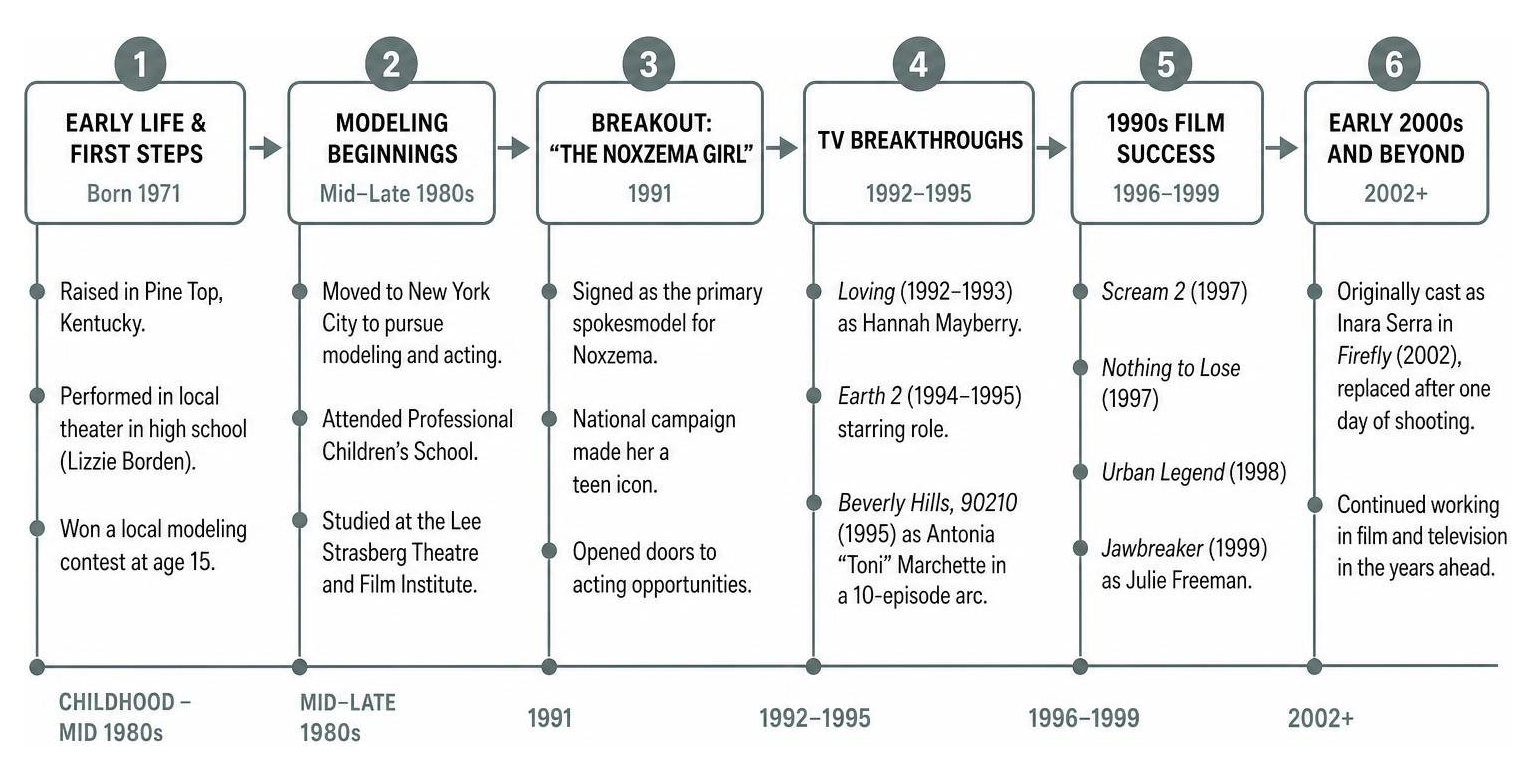
By the late 1990s, rebecca gayheart successfully transitioned to feature films, becoming a prominent face in the era’s popular teen horror and dark comedy genres. She made a memorable appearance in Scream 2 (1997), co-starred alongside Martin Lawrence and Tim Robbins in the comedy Nothing to Lose (1997), and led the ensemble horror hit Urban Legend (1998) as Brenda Bates. In 1999, she starred as Satan in High School herself, Julie Freeman, in the dark comedy Jawbreaker, a film that developed a massive cult following over subsequent decades.
Her dynamic career was not without industry recasting moments. In 2002, she was originally cast as Inara Serra in Joss Whedon’s sci-fi series Firefly, but was replaced by Morena Baccarin after a single day of shooting due to ensemble chemistry adjustments during initial production.
For Capital Region readers planning a nostalgia movie night, film-club discussion, or 1990s pop-culture trivia theme, the following credits offer a quick viewing guide. To see how her film credits hold up with critics, here is a breakdown of key movie roles, scores, and descriptions according to consensus metrics available on her Rebecca Gayheart Movies & TV Shows List | Rotten Tomatoes | Rotten Tomatoes profile:
| Film Title | Release Year | Character Name | Rotten Tomatoes Score | Film Genre |
|---|---|---|---|---|
| G.B.F. | 2013 | Mrs. Daniels | 80% | Teen Comedy |
| Once Upon a Time… in Hollywood | 2019 | Billie Booth | 85% | Period Drama / Comedy |
| Urban Legend | 1998 | Brenda Bates | 29% | Slasher / Horror |
| Jawbreaker | 1999 | Julie Freeman | 13% | Dark Comedy |
| Shadow Hours | 2000 | Chloe Holloway | 13% | Drama / Thriller |
| Nothing to Lose | 1997 | Danielle | 28% | Comedy |
The 2001 Vehicular Manslaughter Incident and Legal Outcome
A complete overview of Gayheart’s public life also includes the 2001 traffic tragedy that reshaped her personal and professional reputation. For a community-focused publication like Capital Region Living Magazine, this part of the story is included not for sensationalism, but because it connects to broader conversations about accountability, pedestrian safety, and the lasting effects of one moment on families and communities.
In mid-2001, Gayheart was involved in a tragic fatal auto accident in Los Angeles that dramatically altered her life, personal perspective, and public image. On June 13, 2001, while driving a vehicle owned by her then-boyfriend, director Brett Ratner, she swerved into a center left-turn lane around stopped vehicles on Wilshire Boulevard and struck 9-year-old Jorge Cruz Jr. as he was crossing the street. The young boy sustained severe injuries and died the following day at a local hospital.
The criminal case moved through the judicial process and concluded on November 27, 2001, when rebecca gayheart entered a plea of no contest to misdemeanor vehicular manslaughter. The final legal outcome included the following mandatory requirements:
- 3 years of probation
- 1-year driver’s license suspension
- A $2,800 criminal fine
- 750 hours of community service
Additionally, she settled a civil lawsuit filed by the young boy’s parents out of court for an undisclosed financial sum and agreed to participate in public safety announcements addressing traffic awareness and pedestrian safety.
The tragic event led to intense public scrutiny and aggressive tabloid criticism, with various media outlets voicing frustration over her sentence. Gayheart expressed deep remorse throughout the proceedings and in later years reflected openly in intimate interviews about the immense grief, haunting guilt, and lingering psychological trauma the heartbreaking accident caused for everyone involved. For readers in walkable downtowns and neighborhood corridors across the Capital Region, the incident remains a sobering reminder of why safe driving, careful street design, and pedestrian awareness matter.
Relationships, Family Life, and Eric Dane’s Passing
Celebrity profiles often focus on screen credits, but Gayheart’s personal life also speaks to themes that matter to a regional lifestyle audience: marriage, parenting, co-parenting, caregiving, illness, and family resilience. Before settling down into family life, Gayheart was in a high-profile 13-year relationship with Hollywood director Brett Ratner, to whom she was engaged before their amicable breakup in 1999.
In 2004, she met actor Eric Dane, known for his roles on television dramas like Grey’s Anatomy. Their romance moved remarkably fast: after about nine months of dating, the couple impulsively traveled to Las Vegas and got married on October 29, 2004, even spontaneously recruiting a local taxi driver to act as their best man during the ceremony.
Together, they built a home and family in Los Angeles, welcoming two daughters:
- Billie Beatrice Dane (born March 3, 2010)
- Georgia Geraldine Dane (born December 28, 2011)
Key Milestones in Rebecca Gayheart’s Personal Life
While their marriage endured for over a decade, Gayheart filed for divorce from Dane in February 2018, citing irreconcilable differences after 14 years together. Despite the formal legal filing, the divorce was never finalized in court. Over the following years, they maintained an exceptionally close co-parenting partnership, frequently vacationing together as a family and speaking warmly and respectfully of each other in public appearances.
Throughout her career spanning over 48 acting credits across television and film, as well as various creative endeavors, Gayheart accumulated an estimated net worth of $5 million. For more background on her personal life and relationship timeline, you can consult the Rebecca Gayheart page or the detailed overview on the Rebecca Gayheart Bio, Married, Husband, Relationship, Net Worth hub.
Supporting Her Family Through Eric Dane’s Battle with ALS
The family faced severe emotional challenges when Eric Dane was diagnosed with Amyotrophic Lateral Sclerosis (ALS), a progressive neurodegenerative disease affecting motor neurons. Gayheart stepped up as a central source of emotional and logistical support for Dane and their teenage daughters throughout his difficult medical journey.
Tragically, Eric Dane passed away on February 19, 2026, at the age of 53. Following his passing, Gayheart focused heavily on guiding Billie and Georgia through acute grief, emphasizing that deep emotional connections and family bonds endure beyond physical loss.
In a forward-looking effort to preserve his legacy, the family actively participated in developing an AI voice clone created from audio recordings made before Dane lost his vocal capabilities to ALS. This innovative technology initiative aimed to assist other families dealing with degenerative illnesses while keeping Dane’s voice accessible to his children. For Capital Region families navigating caregiving, grief, or serious illness, this chapter of Gayheart’s life may feel less like a Hollywood story and more like a human one.
Frequently Asked Questions
What is Rebecca Gayheart best known for?
Rebecca Gayheart is best known as “The Noxzema Girl” from iconic 1990s television commercial campaigns, her recurring television role as Antonia “Toni” Marchette on Beverly Hills, 90210, and her starring roles in hit 1990s movies including Urban Legend, Jawbreaker, Scream 2, and Nothing to Lose. For Capital Region readers, those credits make her a recognizable figure in 1990s pop-culture history and a useful reference point for film nights, retro TV discussions, and entertainment features.
What were the legal terms of Rebecca Gayheart’s 2001 court case?
Following her no-contest plea to misdemeanor vehicular manslaughter in November 2001, she received three years of probation, a one-year driver’s license suspension, a $2,800 fine, and 750 hours of community service, alongside a confidential civil settlement with the victim’s family. The case is often discussed in connection with public accountability and pedestrian safety.
How is Rebecca Gayheart navigating her life and career today?
As of 2026, at 54 years old, she is primarily focused on supporting her teenage daughters through grief after the passing of Eric Dane, advocating for family grief support, and engaging in selective acting and directorial projects. Additional career summaries are indexed at Rebecca Gayheart and her main entry on Rebecca Gayheart – IMDb .
Conclusion
From a teenager leaving small-town Kentucky to national stardom as the face of major advertisement campaigns and defining 1990s cinema, rebecca gayheart has lived a life marked by high artistic achievement, severe personal trial, and maternal resilience.
For Capital Region Living Magazine, her story fits within the larger cultural conversations our readers follow: the influence of 1990s media, the importance of arts education, the responsibility that comes with public life, and the ways families navigate grief and change. Her career also offers a reminder that national entertainment stories often connect back to local interests, from community theater and film programming to conversations about caregiving, safety, and resilience.
Through career recasting, public legal accountability, complex personal relationships, and profound family tragedy, she has consistently shown grace and strength in navigating adversity. Today, her enduring legacy lives on not only through classic roles in American pop culture history, but also in her steadfast dedication as a resilient mother supporting her family.
At Capital Region Living Magazine, we take pride in celebrating inspiring stories of community, perseverance, and cultural impacts across entertainment and regional life. Explore local culture and community events on our calendar to stay connected with regional arts, local stories, and upcoming activities.