Naomi Osaka: A Champion Who Changed Tennis
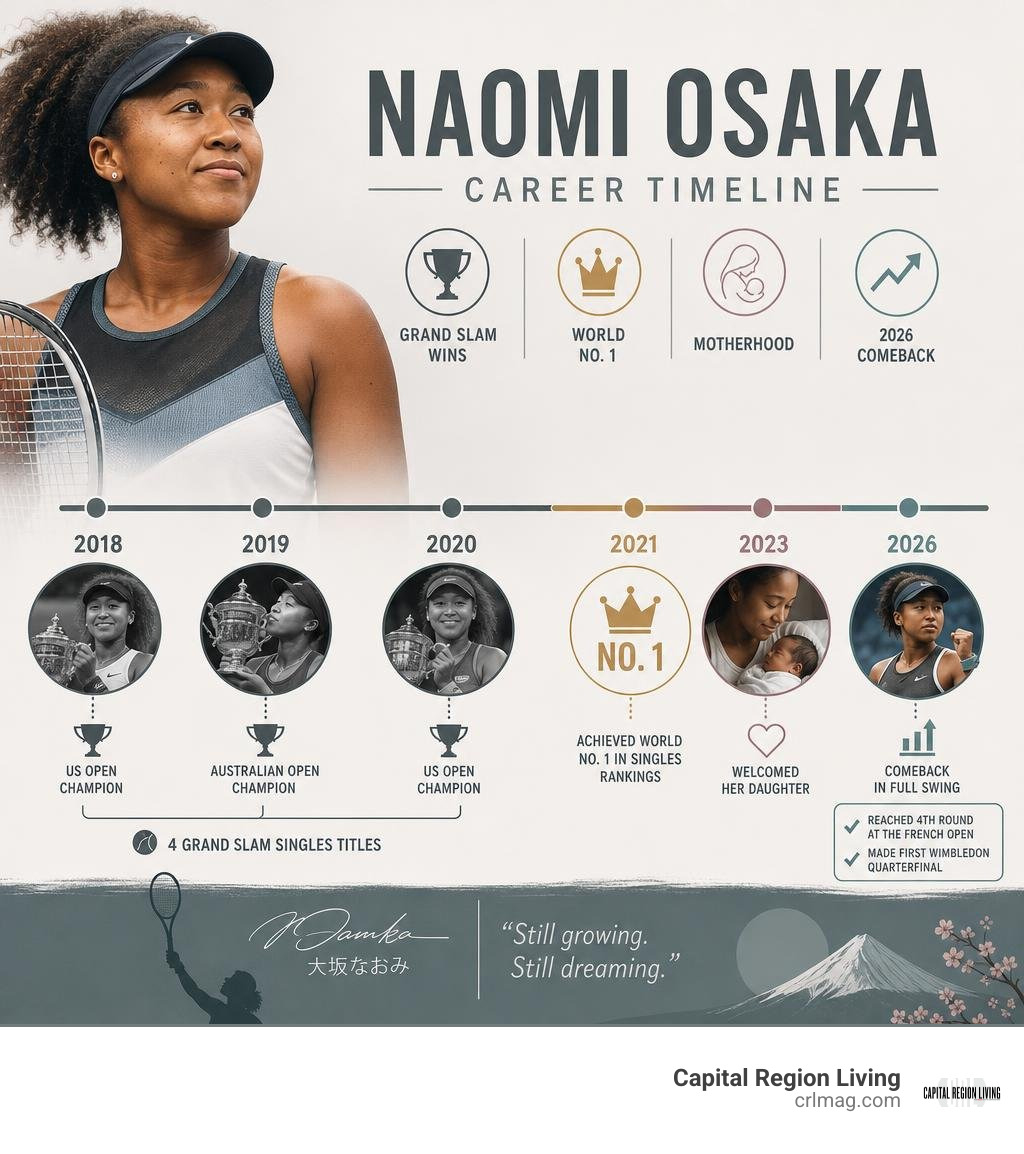
Naomi Osaka is a Japanese tennis star, four-time Grand Slam singles champion, former world No. 1, and a leading voice for mental health and social justice. She won the US Open in 2018 and 2020, the Australian Open in 2019 and 2021, and became the first Asian player to reach No. 1 in the singles rankings.
In 2026, Osaka has shown that her comeback after motherhood is real. She reached the fourth round of the French Open and made her first Wimbledon quarterfinal, highlighted by a straight-set win over world No. 1 Aryna Sabalenka.
Born in Osaka, Japan, and raised partly on Long Island before training in Florida, Osaka brings Japanese, Haitian, and American influences to a career that reaches well beyond the court. Her powerful serve and bold baseline game made her a major champion. Her openness about depression, anxiety, and the strain of constant public attention helped push athlete mental health into a wider public conversation.
This guide covers Osaka’s tennis milestones, 2026 form, family roots, activism, business work, and the resilience behind one of modern sports’ most influential figures.
Naomi osaka terms made easy:
Early Life, Family Roots, and Rise to Stardom
Few athletic origins match the unconventional, multicultural path that brought Naomi Osaka to the forefront of global tennis. Born in Osaka, Japan, on October 16, 1997, to a Japanese mother, Tamaki Osaka, and a Haitian father, Leonard François, she grew up in an environment rich with diverse cultural traditions, languages, and perspectives.
Naomi Osaka: Early Life and New York Roots
When Naomi was three years old, the family relocated from Japan to Elmont, Long Island, moving in with her paternal grandparents. For those of us here in New York, her early days on Long Island represent a proud local connection. It was during this pivotal period that her father watched the 1999 French Open and was inspired by the story of Richard Williams coaching his daughters, Venus and Serena, from public park courts to global domination.
Despite having no professional tennis coaching background himself, François adopted that developmental blueprint. He dedicated himself to teaching Naomi and her older sister, Mari, using instructional videos and hours of daily drills on public neighborhood courts. The family later moved to Florida to pursue full-time athletic development. Naomi and Mari practiced on local public courts by day and completed their homeschooling lessons by night. Her mother worked tireless overtime shifts—sometimes sleeping in her car between shifts in the import/export sector—to finance their tournament equipment and court time. Understanding her family background and multicultural upbringing helps explain the deep grounding and emotional resilience that define her career today.
Pro Debut and WTA Breakthrough
Rather than following the traditional junior competition pathway, Osaka bypassed the premier junior circuit entirely. On her 14th birthday, she entered the senior ITF Women’s Circuit directly to compete against seasoned adults.
In 2014, Osaka made her main-draw WTA debut at the Bank of the West Classic in Stanford as a 16-year-old alternate ranked No. 406. She shocked the tennis world by saving match points to defeat world No. 19 and former US Open champion Samantha Stosur. Her explosive baseline groundstrokes and natural poise announced a future superstar. By 2016, she had broken into the WTA top 50, earned WTA Newcomer of the Year honors, and reached her first Premier final in Tokyo.

Her breakout reached new heights in March 2018 when she claimed her maiden WTA title at the prestigious Indian Wells tournament, overpowering multiple top-10 players and signaling that a major breakthrough was imminent.
The Historic Tennis Career of Naomi Osaka
From 2018 onward, Osaka cemented herself as one of the most clutch big-stage performers in the modern Open Era, amassing over $26 million in career prize money and claiming 7 WTA singles titles.
Grand Slam Triumphs and World No. 1 Milestone
Osaka’s maiden Grand Slam crown arrived at the 2018 US Open, where she defeated her childhood idol Serena Williams in straight sets. Just months later, she triumphed at the 2019 Australian Open in Melbourne, outlasting Petra Kvitová in a thrilling three-set final. With that victory, Osaka ascended to WTA World No. 1, becoming the first Asian singles player in tennis history to hold the top ranking, a position she held for 25 weeks.
She repeated this remarkable hard-court double by winning the 2020 US Open—battling back from a set down against Victoria Azarenka—and dominating the field at the 2021 Australian Open. In doing so, she became one of only three players in the Open Era (alongside Roger Federer and Monica Seles) to win each of their first four Grand Slam singles finals.
| Tournament & Year | Opponent in Final | Final Match Score | Career Significance |
|---|---|---|---|
| 2018 US Open | Serena Williams | 6–2, 6–4 | First Grand Slam singles title; broke into Top 10 |
| 2019 Australian Open | Petra Kvitová | 7–6(2), 5–7, 6–4 | Became first Asian World No. 1 in singles |
| 2020 US Open | Victoria Azarenka | 1–6, 6–3, 6–3 | Third Major title; spotlighted social justice campaign |
| 2021 Australian Open | Jennifer Brady | 6–4, 6–3 | Fourth Major title; cemented hard-court dominance |
Hiatus, Motherhood, and the 2026 Resurgence
Following the 2022 season, Osaka stepped away from the tour on maternity leave. In July 2023, she welcomed her daughter, Shai, with partner Cordae. Motherhood brought a refreshed perspective on her athletic ambitions, leading to her return to professional competition in 2024.
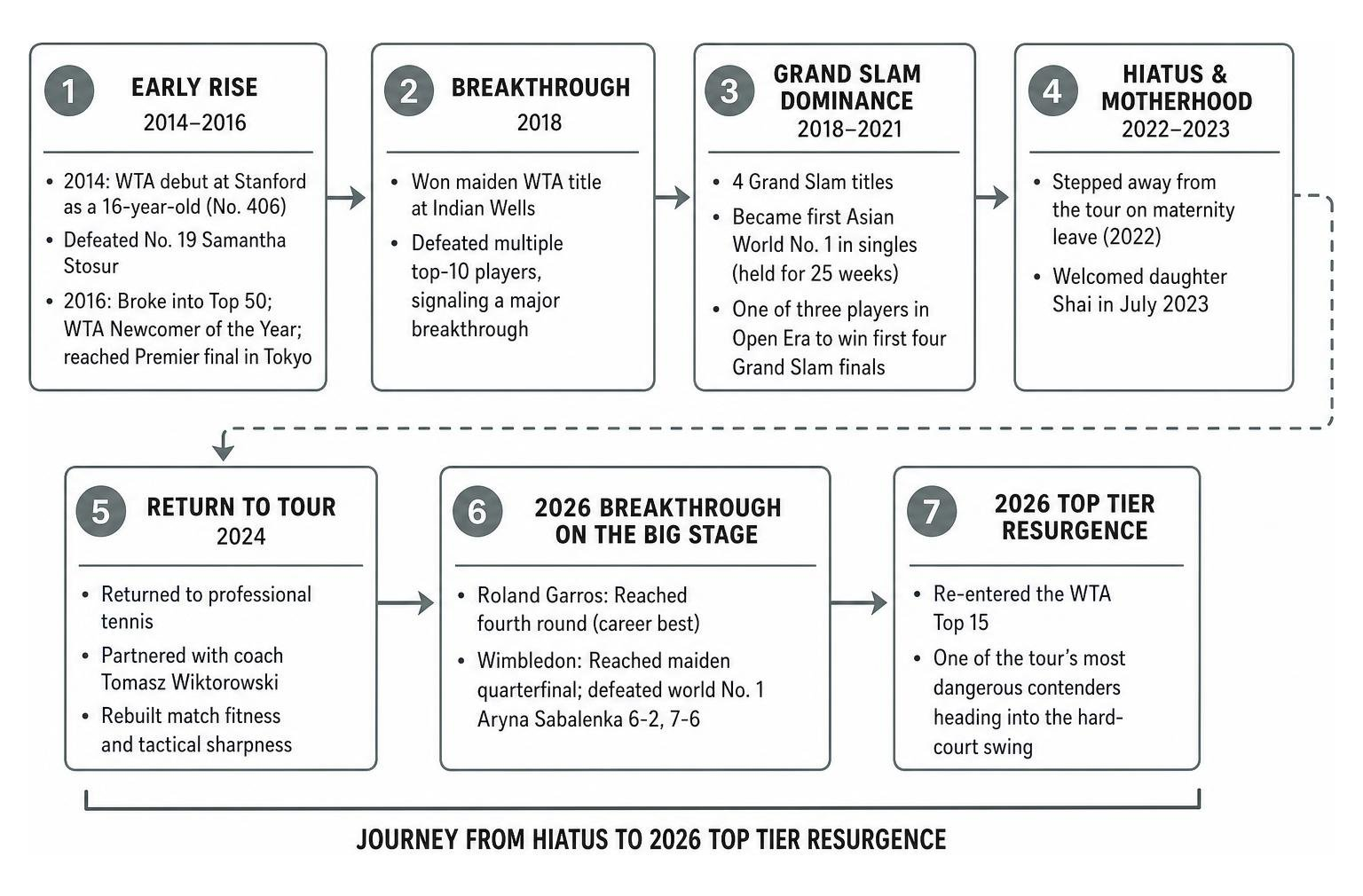
Teaming up with premier coach Tomasz Wiktorowski, Osaka steadily rebuilt her match fitness and tactical sharpness. The 2026 season has marked her complete resurgence among the world’s elite:
- Roland Garros Progress: Reached the fourth round of the French Open for the first time in her career, showing significant tactical improvement on clay.
- Wimbledon Milestone: Advanced to her maiden Wimbledon quarterfinal, headlined by a commanding straight-set victory (6-2, 7-6) over world No. 1 Aryna Sabalenka.
- Top 15 Return: Re-entered the WTA Top 15 rankings as one of the tour’s most dangerous contenders heading into the hard-court swing.
For fans following her statistical climb, you can view her official WTA career records and milestones to see her year-by-year points breakdown.

Mental Health Advocacy, Activism, and Cultural Impact
While Osaka’s athletic records are legendary, her willingness to step outside traditional sporting boundaries has altered how athletes interact with institutions, media, and public expectations.
How Naomi Osaka Redefined Athlete Mental Health
At the 2021 French Open, Osaka announced she would decline mandatory post-match press conferences to safeguard her emotional well-being, noting that repetitive, adversarial questions after difficult losses took a severe toll on players’ mental states. When tournament organizers levied a $15,000 fine and threatened escalating penalties, she took the bold step of withdrawing from the tournament altogether.
Her candid disclosures about experiencing long bouts of depression and performance anxiety since the 2018 US Open opened a worldwide conversation across professional athletics. Her actions pushed major sports governing bodies to reexamine mandatory press guidelines and modernize mental health resources for touring athletes. For an extensive look at this turning point, explore this comprehensive Naomi Osaka career overview and mental health advocacy record.
Social Justice, Fashion, and Business Ventures
Osaka has consistently leveraged her global platform to champion civil rights and racial justice. During her championship run at the 2020 US Open, she walked onto Arthur Ashe Stadium for each of her seven matches wearing a customized face mask bearing the name of a Black American killed by police violence—including Breonna Taylor, George Floyd, and Elijah McClain.
Her cultural reach spans numerous innovative industries:
- Olympics: Selected as the final torchbearer to light the Olympic cauldron at the Tokyo 2020 Opening Ceremony.
- Entrepreneurship: Founded the production company Hana Kuma and developed Kinlò, a suncare and skincare line formulated specifically for skin rich in melanin.
- Fashion Icon: Co-designed custom looks for New York Fashion Week and served as a global ambassador for luxury fashion houses like Louis Vuitton.
- Commercial Powerhouse: Became the highest-earning female athlete in sports history, generating over $37 million in a single calendar year in 2020.
Naomi Osaka’s Playing Style and Technical Mastery
Osaka’s on-court success relies on an aggressive, power-baseline style built around rapid point construction and pure ball-striking power:
- First Serve Velocity: Clocked at speeds up to 125 mph (201 km/h), her serve is one of the premier weapons on the WTA Tour, generating easy service holds and high ace totals.
- Heavy Forehand: Hits with heavy topspin and flat pace, allowing her to dictate rallies from well behind the baseline.
- Deep Returns: Takes aggressive positioning inside the baseline on second-serve returns to put immediate pressure on opponents.
- Tactical Movement: Under the guidance of coach Tomasz Wiktorowski, she has refined her lateral sliding and recovery footwork on slower clay and grass surfaces.
Detailed match tracking and head-to-head records are documented in the career performance breakdown and match statistics archive.
Frequently Asked Questions About Naomi Osaka
How many Grand Slam titles has Naomi Osaka won?
Osaka has won four Grand Slam singles titles: the US Open twice (2018, 2020) and the Australian Open twice (2019, 2021). She won each of her first four Major finals, joining Monica Seles and Roger Federer as the only Open Era players to accomplish that feat.
Why did Naomi Osaka choose to represent Japan?
Osaka was born in Osaka, Japan, to a Japanese mother and Haitian father. Her parents decided early in her career that she and her sister Mari would represent Japan. Osaka has shared that she feels deeply connected to her Japanese heritage, and representing Japan honors the country of her birth.
What is Naomi Osaka’s current ranking and form in 2026?
As of August 2026, Osaka is ranked inside the WTA Top 15 (No. 13/14). Her 2026 season has been highlighted by a fourth-round showing at the French Open, a quarterfinal appearance at Wimbledon (featuring a straight-sets win over world No. 1 Aryna Sabalenka), and over $26.6 million in total career prize earnings.
Conclusion
Naomi Osaka has redefined what it means to be an elite global athlete in the modern era. Her blend of ferocious on-court dominance, cultural authenticity, and moral courage has inspired fans far beyond the tennis baseline. Whether powering serves past top seeds, raising awareness for social justice, or modeling healthy personal boundaries, she leads by example.
Here at Capital Region Living, we love celebrating inspiring stories of perseverance, cultural innovation, and leaders who make a genuine impact. If you want to connect with community leaders, cultural events, and premier local businesses across our region, be sure to explore regional New York culture and community throughout our directory.