Why Farrah Fawcett Still Matters
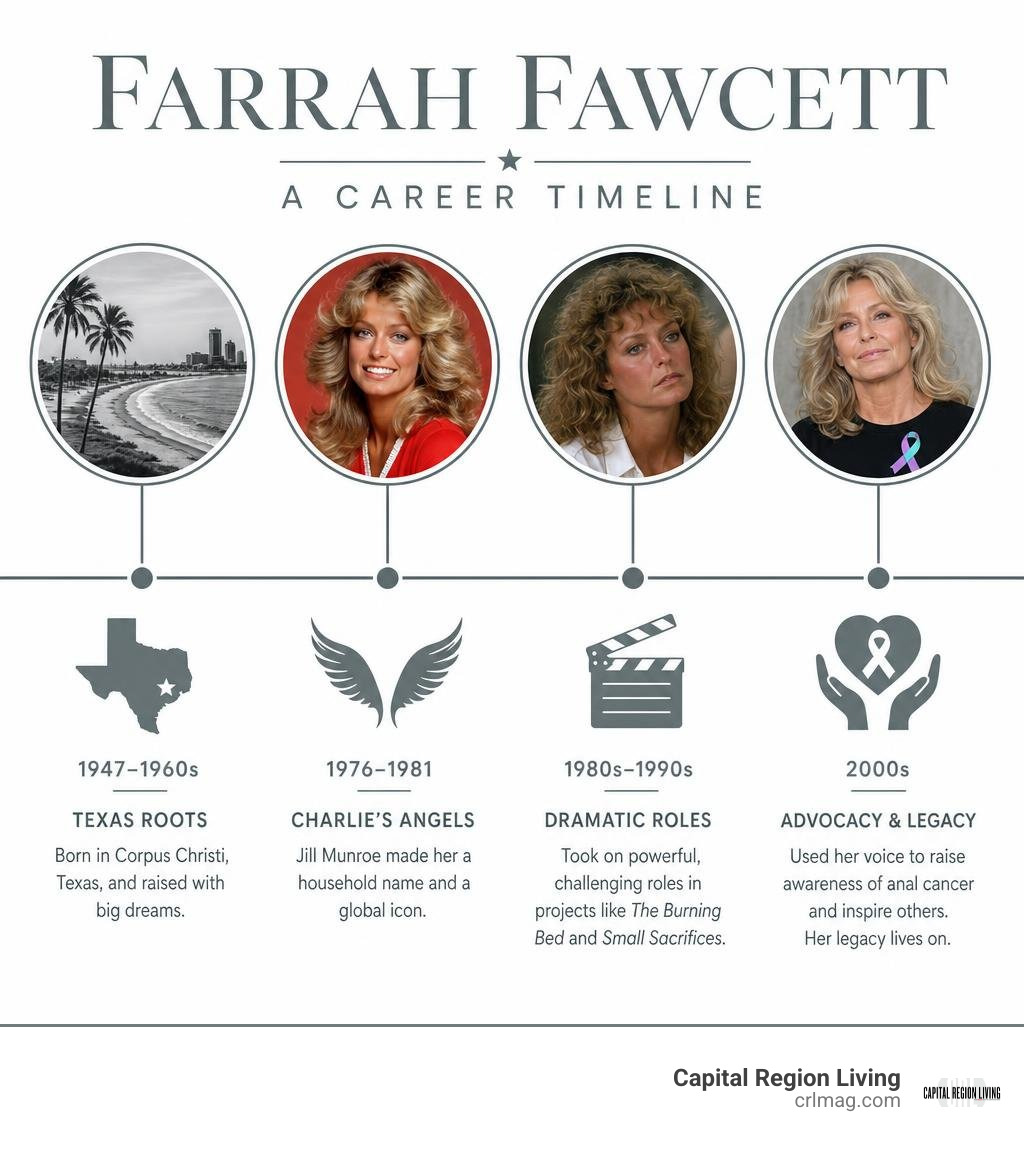
Farrah Fawcett was an American actress, model, and cultural icon best known as Jill Munroe in Charlie’s Angels, the star of the famous 1976 red swimsuit poster, and a later Emmy-nominated dramatic performer. She turned worldwide 1970s fame into serious work in projects such as The Burning Bed and Small Sacrifices, then used her public platform to raise awareness of anal cancer.
Her red swimsuit poster sold more than 6 million copies in its first year and roughly 12 million overall. Her feathered hairstyle became one of the most copied looks of its era. Yet her career was much bigger than a poster or a TV hit: Fawcett pushed against typecasting, took difficult dramatic roles, and openly documented her final illness in Farrah’s Story.
She died from anal cancer on June 25, 2009, at age 62. Her legacy continues through the Farrah Fawcett Foundation, which supports cancer research, prevention, education, and patient assistance.
This guide follows her journey from Corpus Christi, Texas, to Hollywood superstardom, artistic reinvention, and lasting advocacy.
Quick farrah fawcett definitions:
Early Life, Breakthrough, and 1970s Stardom
Born Mary Ferrah Leni Fawcett on February 2, 1947, in the coastal city of Corpus Christi, Texas, Farrah was the younger daughter of Pauline, a homemaker, and James Fawcett, an oilfield contractor. Her mother originally devised the name “Ferrah” simply because it paired melodiously with their last name, though Farrah later adjusted the spelling.
Athletic, outgoing, and effortlessly charismatic, she attended Pershing Middle School and W.B. Ray High School, where her classmates voted her “Most Beautiful Student” all four consecutive years. In the fall of 1965, Fawcett enrolled at the University of Texas at Austin. She initially set her sights on a demanding science curriculum, majoring in microbiology, before shifting her academic focus toward fine arts, where she developed a lifelong dedication to painting and sculpting under the mentorship of renowned sculptor Charles Umlauf.
During her freshman year at UT Austin, Fawcett became the first freshman ever voted one of the “ten most beautiful coeds on campus.” A photograph from that contest circulated among talent management agencies in Los Angeles. Hollywood publicist David Mirisch reached out repeatedly, urging her to move west. While her protective parents initially forbade the leap in 1966, they accompanied her to California during the summer of 1968. Within two weeks, she secured commercial representation and signed a $350-a-week contract with Screen Gems, launching a transformative journey chronicled in Farrah Fawcett’s biographical profile.
Hollywood Discovery and Early Commercials
Upon arriving in Los Angeles, Fawcett quickly became a favorite of casting directors. Her glowing smile, sun-kissed blonde locks, and undeniable Texas charm made her an instant commercial star. She appeared in high-profile television spots for brands like Ultra Brite toothpaste, Noxzema, and Wella Balsam shampoo.
These commercials led to guest spots on popular episodic series throughout the late 1960s and early 1970s, including I Dream of Jeannie, The Flying Nun, The Partridge Family, and Marcus Welby, M.D. In 1973, she married actor Lee Majors, star of The Six Million Dollar Man, and was often billed professionally as Farrah Fawcett-Majors. She made recurring guest appearances alongside Majors on his hit sci-fi adventure series, quickly establishing herself as a familiar face in American households.
Charlie’s Angels and the Poster Phenomenon
In 1976, legendary television producer Aaron Spelling cast Fawcett as Jill Munroe in a brand-new ABC detective pilot titled Charlie’s Angels, co-starring Kate Jackson and Jaclyn Smith. Debuting in September 1976, the series became an overnight ratings sensation. Critics colloquially labeled it “jiggle TV,” but audiences could not get enough of the glamorous, athletic crime-fighting trio. Fawcett, reflecting on the show’s instant popularity with her trademark candor, once quipped: “When the show was number three, I thought it was our acting. When we got to be number one, I decided it could only be because none of us wears a bra.”
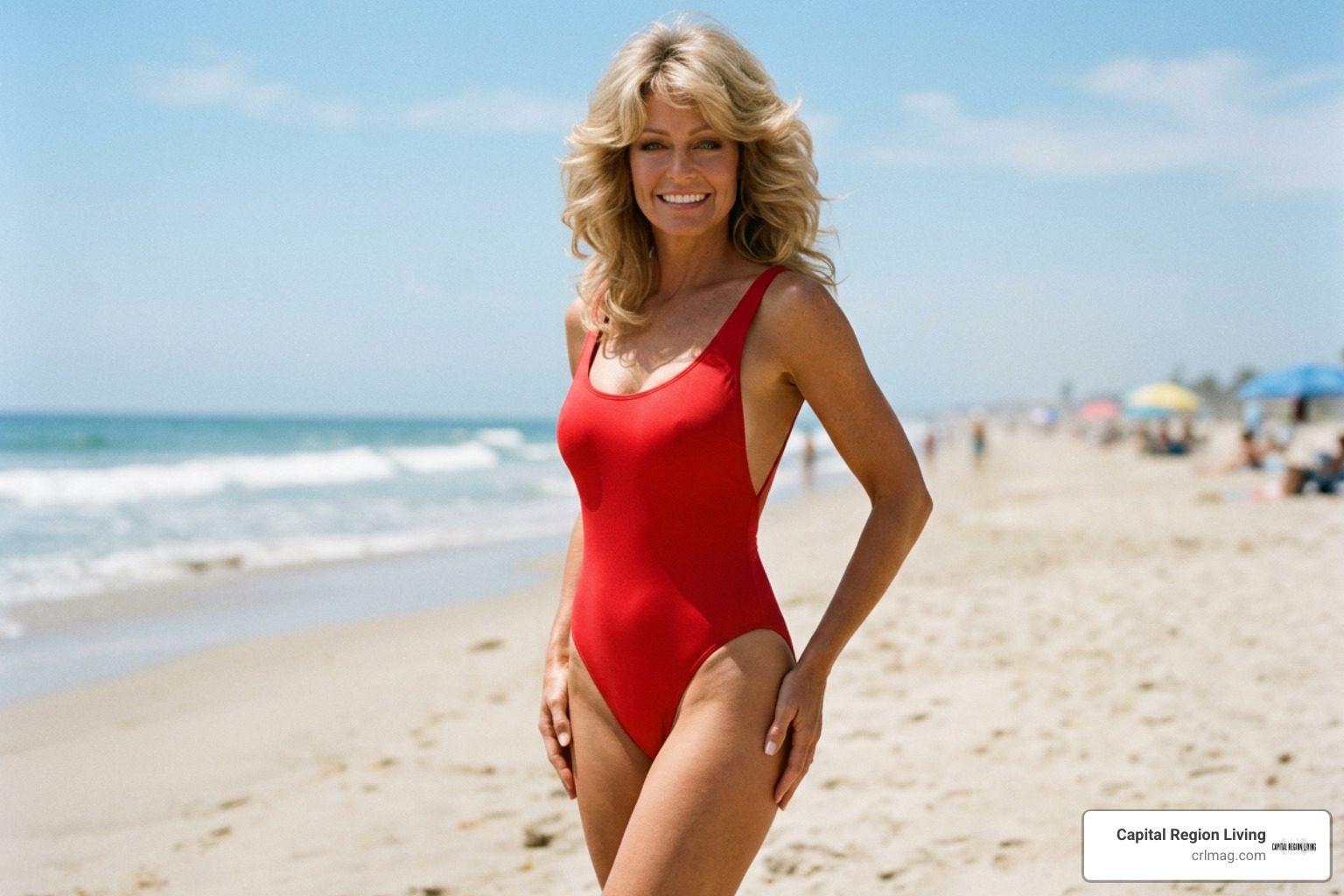
That same year, Fawcett collaborated with independent poster distributor Pro Arts Inc. and photographer Bruce McBroom for an impromptu photo shoot at her Bel Air home. Unlike lavish studio productions, Fawcett styled her own hair, applied her makeup without a mirror, and used lemon juice to accentuate her natural blonde highlights. Draped in an unpretentious burnt-orange/red one-piece designed by Norma Kamali, leaning against an Indian blanket draped over a Chevrolet seat, Fawcett produced an image that redefined American pin-up culture.
The poster sold an unprecedented 6 million copies during its first year in print and eventually surpassed 12 million copies worldwide—making it the best-selling commercial poster in history. Astutely, Fawcett had negotiated a 10% royalty on sales, which earned her far more than her network episodic salary.
Despite the monumental success of Charlie’s Angels, Fawcett made the shocking decision to leave the show in the spring of 1977 after just one season (29 episodes). The grueling 14-hour daily filming schedule had strained her marriage, and she felt creatively constrained by the lighthearted scripts. Her departure triggered a $7 million breach-of-contract lawsuit from Aaron Spelling and Leonard Goldberg. The dispute was ultimately resolved out of court: Fawcett agreed to make six guest appearances across seasons three and four, clearing the way for Cheryl Ladd to join the cast as Jill’s younger sister, Kris Munroe.
Dramatic Acting Breakthroughs and Critical Acclaim
Stepping away from the biggest show on television carried immense professional risk. Hollywood studios initially viewed Fawcett purely as a pin-up star rather than a serious theatrical talent. Early cinematic outings like Somebody Killed Her Husband (1978), Sunburn (1979), and the sci-fi thriller Saturn 3 (1980) faced lukewarm box office and critical skepticism, though she enjoyed commercial success alongside Burt Reynolds in the ensemble hit The Cannonball Run (1981).
Determined to redefine her career on her own terms, Fawcett turned to live theater and gritty, character-driven scripts. Exploring the detailed TMDB career retrospective reveals how systematically she dismantled expectations.
| Project Title | Year | Role / Format | Key Accolades & Impact |
|---|---|---|---|
| Extremities | 1983 / 1986 | Marjorie (Off-Broadway Play & Feature Film) | Critical acclaim; Golden Globe Nomination |
| The Burning Bed | 1984 | Francine Hughes (NBC Television Movie) | Primetime Emmy & Golden Globe Nominations |
| Small Sacrifices | 1989 | Diane Downs (ABC Miniseries) | Peabody Award; Emmy & Golden Globe Nominations |
| The Apostle | 1997 | Jessie Dewey (Independent Feature Film) | Independent Spirit Award Nomination |
| The Guardian | 2002–2003 | Mary Gressler (CBS Dramatic Series) | Primetime Emmy Nomination (Outstanding Guest Actress) |
| Farrah’s Story | 2009 | Self / Producer (NBC Documentary) | Primetime Emmy Nomination (Outstanding Nonfiction Special) |
Critical Acclaim: Farrah Fawcett’s Dramatic Pivot
Fawcett’s true dramatic turning point came in 1983 when she replaced Susan Sarandon in the demanding Off-Broadway production of Willy Mastrosimone’s Extremities. Playing Marjorie, an assault survivor who turns the tables on her attacker, Fawcett delivered a raw, physically bruising performance that left theater critics stunned. During one live performance, she famously maintained character even when an obsessed stalker interrupted the show from the audience. She reprised the role in the 1986 feature film adaptation, earning a Golden Globe nomination and firmly shedding the “poster girl” label.
In 1984, Fawcett delivered the most transformative performance of her career in NBC’s made-for-television movie The Burning Bed. Stripped of glamorous makeup and high-fashion styling, she portrayed Francine Hughes, a real-life battered Michigan housewife driven to set fire to her abusive husband’s bed after years of severe domestic violence.
The television film became a landmark cultural event, drawing massive ratings and earning Fawcett her first Primetime Emmy Award nomination. Crucially, The Burning Bed made history as the first television movie to display a nationwide toll-free 800 helpline for domestic abuse victims during its broadcast, prompting tens of thousands of women to seek shelter and sparking nationwide legal reforms concerning domestic violence defense.
Prestigious Television Roles and Feature Films
Throughout the late 1980s and 1990s, Fawcett continued to select challenging, non-glamorous roles. In 1989, she starred in the ABC miniseries Small Sacrifices, playing Diane Downs, an Oregon mother convicted of shooting her three young children. The Peabody Award committee lauded her chilling performance, noting that she brought a rare sense of emotional realism and depth to television docudrama. The role garnered Fawcett both Emmy and Golden Globe nominations.
In 1997, Fawcett earned universal praise opposite Robert Duvall in the critically celebrated indie drama The Apostle, portraying the estranged wife of a troubled Pentecostal preacher. Duvall remarked that Fawcett possessed raw acting instincts that surpassed many top feature-film stars. Later notable roles included working with director Robert Altman on Dr. T & the Women (2000) and earning a 2004 Emmy nomination for her recurring guest arc on the CBS legal drama The Guardian.
Beyond dramatic scripts, Fawcett maintained control over her image. In December 1995, at age 48, she posed for Playboy magazine, producing an issue that sold over 4 million copies to become the best-selling issue of the 1990s. She returned to the magazine in 1997 at age 50 for an artistic spread where she used her own body as a brush to paint large abstract canvases—reaffirming her lifelong identity as a visual artist.
Personal Life, Advocacy, and Cancer Journey
Fawcett’s personal life was subjected to intense media scrutiny throughout her four decades in the public eye. Following her 1979 separation and 1982 divorce from Lee Majors, she entered a passionate, tumultuous, and deeply devoted partnership with actor Ryan O’Neal. In 1985, the couple welcomed their son, Redmond O’Neal.

High-Profile Relationships and Family Dynamics
While Fawcett and O’Neal never married, their connection spanned nearly three decades. Together, they navigated the highs of creative collaboration—such as co-starring in the 1991 CBS sitcom Good Sports—and the painful lows of family turbulence, substance abuse challenges surrounding their son Redmond, and persistent tabloid intrusions.
Despite a media frenzy that often magnified every public appearance, including a famously scattered 1997 interview on The Late Show with David Letterman, Fawcett remained fiercely private about her inner circle and dedicated to protecting her son. In her final trust, she bequeathed the vast majority of her $4.5 million personal estate directly to Redmond, placed in a protected trust overseen by independent fiduciaries.
Cancer Battle, Farrah’s Story, and Foundation Work
In September 2006, Fawcett was diagnosed with anal cancer, a rare and heavily stigmatized malignancy. Approaching the disease with characteristic resilience, she underwent aggressive chemotherapy and radiation treatments at UCLA Medical Center. On February 2, 2007, her 60th birthday, doctors declared her cancer-free.
However, during a routine follow-up in May 2007, Fawcett learned the cancer had returned and metastasized to her liver (Stage IV). Refusing to surrender, she traveled to specialized medical centers in Bad Wiessee and Frankfurt, Germany, to pursue advanced systemic treatments, radiofrequency ablation, and targeted therapies alongside traditional chemotherapy.
Determined to de-stigmatize the disease and provide transparency for other patients, Fawcett enlisted her longtime friend Alana Stewart to grab a handheld camcorder and document every stage of her treatments, medical consultations, and emotional valleys. This footage formed the foundation of the two-hour documentary Farrah’s Story.
When Farrah’s Story premiered on NBC on May 15, 2009, it drew nearly 9 million viewers (reaching over 15 million across broadcasts) and earned Fawcett a posthumous Primetime Emmy nomination as executive producer.
Prior to her passing, she established the Farrah Fawcett Foundation, directing that her remaining resources support HPV-related cancer research, clinical prevention trials, and direct patient assistance funds. Fawcett died peacefully at St. John’s Health Center in Santa Monica on June 25, 2009, at 9:28 a.m., surrounded by Ryan O’Neal and Alana Stewart. Her final spoken word was the name of her beloved son, Redmond.
The Enduring Cultural Legacy of Farrah Fawcett
Farrah Fawcett’s passing on June 25, 2009, coincided with the sudden death of music superstar Michael Jackson just hours later. While the ensuing media storm momentarily eclipsed regular coverage, the long-term historical appreciation of Fawcett’s life has only grown deeper.
The Enduring Impact of Farrah Fawcett’s Style and Advocacy
The aesthetic influence of Farrah Fawcett remains one of the defining cultural touchstones of the 20th century:
- The Hair: “The Farrah-do” or “Farrah-flip”—characterized by dynamic, feathered layers swept outward from the face—was requested by millions of women in salons across the globe. It transformed hair styling throughout the late 1970s and 1980s and even spawned an official Farrah Fawcett shampoo and hair-care product line.
- The Swimsuit: In 2011, Fawcett’s executors and Ryan O’Neal officially donated her historic 1976 Norma Kamali red swimsuit and original poster prints to the Smithsonian’s National Museum of American History in Washington, D.C., preserving it alongside iconic treasures of American material culture.
- Fine Art: A gifted sculptor who exhibited work at major institutions, Fawcett sat for two famous 1980 silkscreen portraits by Pop Art master Andy Warhol. Following a high-profile legal dispute in 2013 between her foundation and Ryan O’Neal, the artwork was formally cataloged as a tribute to her enduring status as an American muse.
- Medical Philanthropy: Under the leadership of Alana Stewart, the Farrah Fawcett Foundation continues to fund cutting-edge research through partnerships with Stand Up To Cancer, Massachusetts General Hospital, and UCLA Health, providing vital financial relief grants to cover non-medical living costs for cancer patients undergoing treatment.
Frequently Asked Questions
Why did she leave Charlie’s Angels after only one season?
Fawcett departed Charlie’s Angels in 1977 primarily because the demanding 14-hour workday schedule conflicted with her personal life and strained her marriage to Lee Majors. Furthermore, she found the scripts creatively limiting and wished to pursue serious dramatic feature films. The departure resulted in a $7 million breach-of-contract lawsuit from producer Aaron Spelling, which was resolved when Fawcett agreed to make six guest appearances across subsequent seasons.
Which dramatic roles earned her Emmy nominations?
Throughout her career, Farrah Fawcett earned four Primetime Emmy Award nominations across diverse categories:
- 1985: Outstanding Lead Actress in a Limited Series or Special for The Burning Bed (playing Francine Hughes)
- 1990: Outstanding Lead Actress in a Miniseries or Special for Small Sacrifices (playing Diane Downs)
- 2003: Outstanding Guest Actress in a Drama Series for CBS’s The Guardian (playing Mary Gressler)
- 2009: Outstanding Nonfiction Special for producing the medical documentary Farrah’s Story
How is her cancer foundation continuing her mission?
The Farrah Fawcett Foundation operates as a major non-profit organization dedicated to funding cancer research, education, and prevention—specifically focusing on HPV-related cancers and anal cancer awareness. In addition to funding scientific research endowments at institutions like Massachusetts General Hospital and UCLA, the foundation manages direct patient assistance funds that provide emergency grants to cover daily living expenses (housing, groceries, and transportation) for cancer patients experiencing severe financial hardship during treatment.
Conclusion
Farrah Fawcett was far more than an iconic blonde pin-up or a television phenomenon. She was an ambitious artist, a fearless dramatic talent who broke free from industry stereotyping, and a brave advocate who turned her most vulnerable personal health battle into an enduring public service. Her journey from Texas coed to international trailblazer remains an inspiring masterclass in artistic autonomy and courage.
Here at Capital Region Living, we celebrate cultural trailblazers who shape the arts, support community well-being, and inspire future generations. To discover local cultural organizations, arts venues, and independent businesses across our vibrant upstate community, explore the Capital Region business directory to support regional culture.