Rebbie Jackson: The Eldest Voice in the Jackson Family
Rebbie Jackson is an American R&B singer and the eldest of the 10 Jackson children. Born Maureen Reillette Jackson on May 29, 1950, she helped care for her younger siblings long before the family became a global music dynasty. She later built a solo career around 1980s R&B, led by her Gold-certified 1984 hit, “Centipede.”
Unlike several of her younger siblings, Rebbie put marriage and raising her children first. She released her debut album at age 34, then recorded four studio albums in total: Centipede, Reaction, R U Tuff Enuff, and Yours Faithfully.
Her place in Jackson family history is both personal and professional. She was Michael Jackson’s older sister, and he wrote and produced “Centipede,” which reached No. 4 on Billboard’s Black Singles chart. Rebbie has also remained associated with family support and mental-health advocacy in later years.
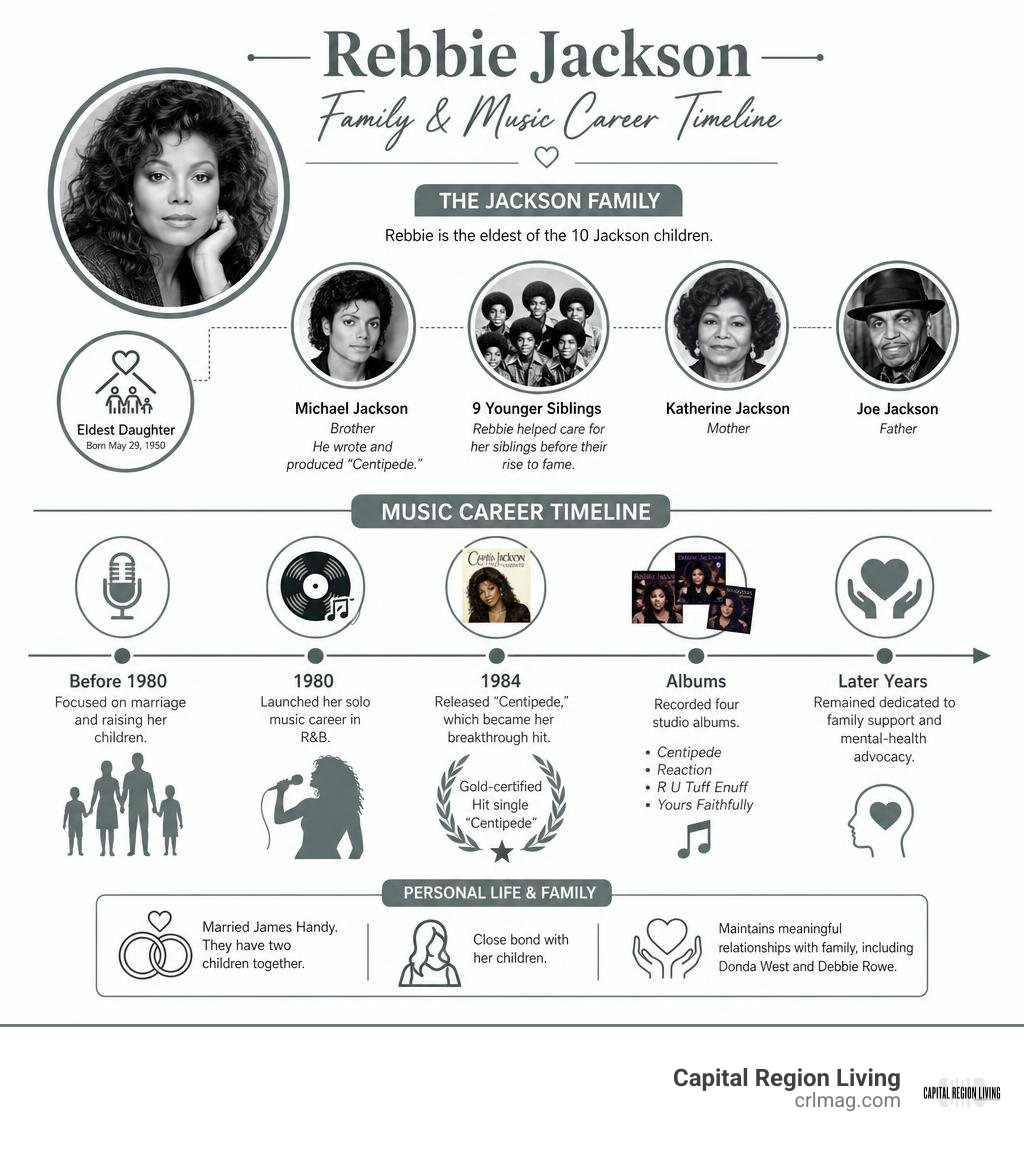
Key terms for ** rebbie jackson**:
Early Life and the Jackson Family Foundation
Growing up in the tight quarters of 2300 Jackson Street in Gary, Indiana, Rebbie Jackson learned early on what it meant to put family first. As the firstborn of Joseph and Katherine Jackson’s ten children, she naturally stepped into the role of a “second mother.” While her father worked grueling hours at the local steel mill and played guitar with his rhythm and blues group, Rebbie partnered with her mother and her younger brother Jackie to keep the bustling household grounded.
Music surrounded the children from their earliest days. Katherine Jackson, a devout Jehovah’s Witness, filled the home with spiritual harmonies and country music, teaching Rebbie the fundamentals of piano and clarinet. Rebbie also shared a childhood love of movement, frequently entering and winning local dance contests alongside Jackie.
Unlike the Jackson 5, who were thrust into commercial spotlights at extraordinarily young ages, Rebbie lived a more insulated, traditional childhood during the group’s meteoric Motown rise. She sang in church alongside her mother and her sister La Toya (who, in a remarkable family coincidence, was born on Rebbie’s exact sixth birthday). This foundation instilled in her a deep sense of personal faith, moral responsibility, and emotional stability that would define her entire public life.
Marriage and Joe Jackson’s Opposition
By the late 1960s, the Jackson family was on the precipice of global superstardom. Yet, at age 18, Rebbie made a decision that stood in stark contrast to her father’s hyper-ambitious entertainment plans: she decided to get married.
Her childhood sweetheart was Nathaniel Brown, a fellow Jehovah’s Witness whom she loved deeply. Joe Jackson fiercely opposed the union. In his view, marriage and family life would instantly derail any potential musical career he envisioned for his eldest daughter. Heated arguments echoed through the household for weeks. Joe wanted Rebbie focused strictly on show business, but Rebbie remained steadfast, insisting that a happy, stable home offered far more security than the volatile entertainment industry.
When the wedding took place on November 30, 1968, Joe Jackson refused to walk his daughter down the aisle. Despite the initial tension, the union proved to be an anchor. Rebbie and Nathaniel built a quiet life together, welcoming three children:
- Stacee Brown (born May 5, 1971)
- Yashi Brown (born January 18, 1977)
- Austin Brown (born November 22, 1985)
Nathaniel became deeply integrated into the extended family, even co-writing tracks like “Come Alive Saturday Night” with his brothers-in-law Tito and Randy. Rebbie prioritized raising her children during their formative years, deliberately staying off the touring circuit until she felt her domestic life was firmly established.
Early Television and Las Vegas Performances
Though Rebbie delayed her solo recording ambitions, she never abandoned performing entirely. Her formal step onto the professional stage came in 1974 during the Jackson family’s celebrated residency in Las Vegas. Her debut at the MGM Grand was originally slated for April, but after a sprained ankle temporarily sidelined her, she stepped under the lights in June.

In 1976, the family achieved a historic milestone with CBS’s summer variety series The Jacksons. The program marked the first time an African-American family starred in their own network television show. Rebbie appeared prominently alongside her sisters, showcasing her vocal range, comedic timing, and dance skills to millions of living rooms across America.
During this era, Rebbie also honed her craft behind the scenes as a versatile background vocalist. She provided backing harmonies for prominent recording artists such as Sonny Bono, Betty Wright, and The Emotions, earning professional respect within the recording industry as a reliable, soulful studio presence.
The Solo Music Career of Rebbie Jackson
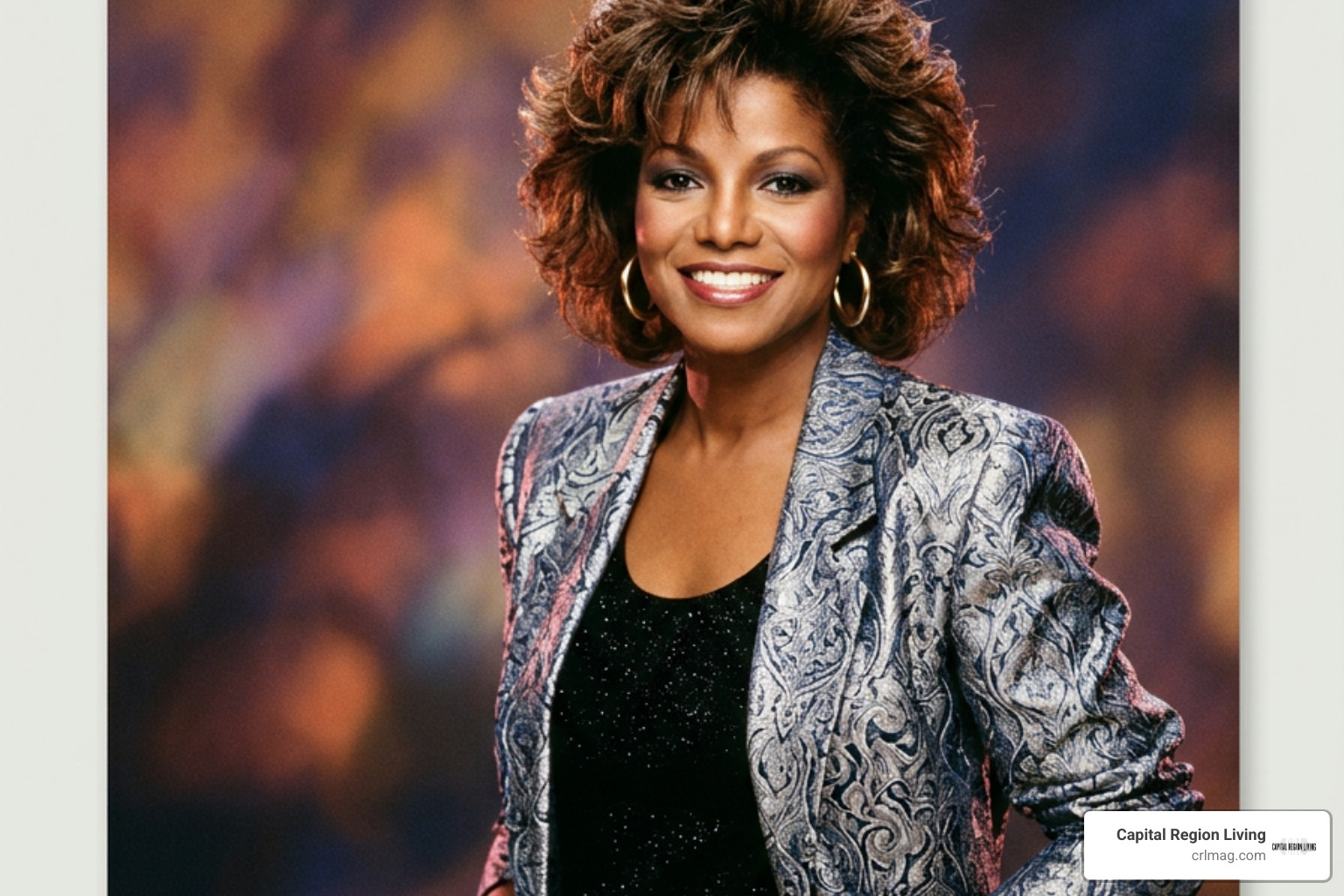
By 1984, with her older children growing up and her youngest on the way, Rebbie Jackson felt the timing was finally right to step into the recording studio as a solo artist. At 34 years old, she was the last Jackson sibling to launch a major solo career.
Signing with Columbia Records, she faced a unique dilemma: navigating the immense expectations attached to her last name. In contemporary interviews, Rebbie often referred to the family moniker as a “double-edged sword.” It offered instant recognition, but it invited intense public scrutiny. As detailed across Rebbie Jackson, she negotiated a creative compromise for her debut album packaging: printing “REBBIE” in large, prominent typography while keeping “Jackson” distinctly smaller.
Breakout Hit: The Story Behind Centipede by Rebbie Jackson
Rebbie’s debut solo release was spearheaded by none other than her brother Michael Jackson. Fresh off the earth-shattering global triumph of his 1982 album Thriller, Michael took on his very first external writing and producing project specifically for his big sister.
The result was the infectious, synth-driven dance track “Centipede.”
Recorded with high-energy funk rhythms, layered harmonies, and backing vocals from The Weather Girls, the song became an overnight smash. It surged to No. 4 on the Billboard Black Singles Chart and crossed over to reach No. 24 on the Billboard Hot 100. The single earned an official Gold certification from the RIAA, selling over one million copies worldwide.
The parent album, Centipede (1984), climbed to No. 13 on Billboard’s Top R&B/Hip-Hop Albums chart and No. 63 on the Billboard 200. Critics at Jet magazine praised the project, observing that Rebbie possessed a distinct vocal identity that proved her talent independently of her famous family name. For comprehensive discographical credits, listeners often explore Rebbie Jackson — Biography, Discography, Albums & Expert Reviews | AllMusic .
Follow-up Albums: Reaction and R U Tuff Enuff
Rather than sticking strictly to dance-pop formulas, Rebbie used her follow-up projects to explore dynamic collaborations across funk, rock, and quiet storm R&B.
In 1986, she released Reaction, produced in part by members of the R&B group Surface. The title track peaked at No. 16 on the R&B charts. The album was notable for its eclectic duets, including “You Send the Rain Away,” a cross-genre collaboration with Cheap Trick lead vocalist Robin Zander that hit No. 50 on the R&B chart, and “Tonight I’m Yours,” a sultry track featuring soul icon Isaac Hayes that enjoyed extensive radio airplay.
Two years later, Rebbie delivered R U Tuff Enuff (1988). The album generated significant commercial momentum behind the single “Plaything,” which climbed into the R&B Top Ten. By mid-June 1988, R U Tuff Enuff had moved approximately 300,000 copies, proving her enduring viability as a late-1980s charting artist.
| Album Title | Release Year | Peak R&B Chart | Peak Billboard 200 | Key Singles / Collaborations |
|---|---|---|---|---|
| Centipede | 1984 | #13 | #63 | “Centipede” (Written/Produced by Michael Jackson; RIAA Gold) |
| Reaction | 1986 | #61 | — | “Reaction”, “You Send the Rain Away” (ft. Robin Zander) |
| R U Tuff Enuff | 1988 | #58 | — | “Plaything” (Top 10 R&B), “R U Tuff Enuff” |
| Yours Faithfully | 1998 | #38 | #50 | “Yours Faithfully”, “Fly Away”, “Centipede (Remix)” |
Return to the Spotlight: Yours Faithfully and MJJ Music
Following the promotional run for R U Tuff Enuff, Rebbie stepped back from the music industry to focus on her family, temporarily relocating to Virginia. During this quiet decade, she contributed occasionally to multimedia projects, including recording the track “Forever Young” for the 1995 soundtrack of Free Willy 2: The Adventure Home.
In 1998, Rebbie made a formal return to recording by signing with Michael’s boutique label imprint, MJJ Music. Her fourth studio release, Yours Faithfully, showcased a refined contemporary R&B sound. The album featured a re-recorded version of Michael’s track “Fly Away” as well as a family-centered remix of “Centipede,” featuring a rap verse performed by her son Austin Brown.
The album achieved critical attention and reached No. 38 on the Top R&B/Hip-Hop Albums chart and No. 50 on the Billboard 200, eventually selling roughly 285,000 copies worldwide. While critics like Vibe’s Quohnos Mitchell viewed the production as a blend of classic R&B grooves framed by late-90s sampling, fans embraced the record as a heartfelt testament to Rebbie’s vocal stamina and artistic longevity.
Personal Life, Challenges, and Family Leadership

Throughout the triumphs and turbulent headlines surrounding the Jackson family, Rebbie has remained the quiet, stabilizing pillar. Her 44-year marriage to Nathaniel Brown provided a private oasis away from public scrutiny until his passing from cancer on January 6, 2013. The loss was a deep personal tragedy, but Rebbie channeled her grief into caring for her extended family, including her beloved grandson, London Blue.
In the years following, Rebbie assumed an essential caretaking role for her mother, Katherine Jackson, managing household needs and providing daily physical and emotional support.
Supporting the Family After Michael Jackson’s Passing
When Michael Jackson tragically passed away in June 2009, the Jackson family was thrust into global mourning. During the chaotic aftermath and ongoing media interest surrounding All About How Michael Jackson Died Cause Of Death, Rebbie stepped in immediately to shield Michael’s children—Prince, Paris, and Bigi (Blanket).
Alongside Katherine, Rebbie provided hands-on maternal guidance, ensuring the children experienced structure, safety, and privacy in their daily routines. Her lifelong experience as the eldest sibling allowed her to serve as an emotional bridge during one of the most agonizing chapters in modern pop culture history.
Mental Health Advocacy and Recent Years
In recent years, Rebbie has directed her platform toward mental health awareness. Her daughter, Yashi Brown, was diagnosed with bipolar disorder and schizophrenia in her early twenties. Rather than keeping the diagnosis hidden, mother and daughter formed a united front to combat mental health stigma.
In 2011, Rebbie headlined the Pick Up the Phone Tour, an initiative dedicated to teen suicide prevention and mental wellness education across high schools and universities. By sharing their personal family journey through public speaking, television panels, and community outreach, Rebbie and Yashi have helped countless families navigate psychiatric recovery.
Now in August 2026, Rebbie Jackson continues to enjoy a quiet, respected elder-stateswoman status, revered by fans and peers for balancing family devotion with creative integrity.
Enduring Impact and Artistry
Rebbie Jackson’s contributions to modern entertainment are often eclipsed by the massive global reach of Michael and Janet, yet her historical imprint remains undeniable. She helped pioneer African-American family representation on network television in the 1970s and delivered one of the defining R&B electro-funk tracks of the mid-1980s.
Her legacy also lives on across digital platforms. Today, Rebbie maintains over 42,360 monthly listeners on Spotify, where her flagship single “Centipede” has accumulated more than 2.38 million streams. Her appearances in retrospective music videos, such as the Jackson family’s nostalgic 1989 release “2300 Jackson Street,” continue to draw millions of views from audiences celebrating the history of twentieth-century soul music.
Vocal Profile and Musical Style of Rebbie Jackson
Musically, Rebbie is classified as a rich contralto. Boasting an impressive three-octave vocal range, she possesses a warm lower register alongside a powerful belting technique capable of reaching up to F#5 and G#5.
Her musical catalog bridges several classic genres:
- Synth-Funk & Electro-Pop: Driven by hard-hitting basslines, synth horns, and snappy percussion (notably in “Centipede” and “Plaything”).
- Quiet Storm Soul: Lush, slow-tempo ballads highlighting her smooth phrasing and lower vocal textures (such as “Tonight I’m Yours” and “A Fork in the Road”).
- Adult Contemporary R&B: Smooth 1990s urban grooves layered with delicate backing harmonies and modern samples (exemplified throughout Yours Faithfully).
Frequently Asked Questions About Rebbie Jackson
Why did Rebbie Jackson start her solo music career later than her siblings?
Rebbie chose to prioritize domestic stability, her marriage to Nathaniel Brown, and raising her young children before entering the music industry full-time. She did not release her debut album, Centipede, until 1984, when she was 34 years old.
What was Rebbie Jackson’s most successful song?
Her biggest hit was the 1984 title track “Centipede,” which was written and produced by Michael Jackson. The track reached No. 4 on Billboard’s Black Singles Chart, peaked at No. 24 on the Hot 100, earned an RIAA Gold certification, and has gathered over 2.38 million streams on modern streaming platforms.
Who was Rebbie Jackson married to?
Rebbie was married to Nathaniel Brown from November 30, 1968, until his death on January 6, 2013. The couple shared a devoted 44-year marriage and raised three children together: Stacee, Yashi, and Austin.
Conclusion
Maureen Reillette “Rebbie” Jackson represents the heart of the Jackson dynasty. By choosing family stability first and charting her own musical trajectory on her own terms, she demonstrated that artistic success does not require sacrificing personal principles. From the chart-topping energy of “Centipede” to her tireless work supporting mental health education and family unity, Rebbie Jackson’s life is a remarkable study in grace, resilience, and quiet strength.
At Capital Region Living Magazine, we take pride in celebrating cultural stories, extraordinary music histories, and community leadership. Whether you are exploring musical retrospectives or discovering community businesses, explore our Capital Region business directory to connect with local community events and cultural resources today.