Do Curtain Bangs Suit You?
Curtain bangs are soft, center- or off-center-parted fringe that is shorter near the middle and longer toward the cheekbones. They suit many face shapes and hair textures because the length, thickness, and layers can be adjusted to frame your features. They are a good choice if you want a noticeable change without committing to a short, straight-across fringe.
Before booking a cut, consider three things:
- Your natural part and cowlicks. These affect how easily the bangs will fall open.
- Your styling routine. A quick blow-dry or roller set usually gives the best shape.
- Your preferred length. Longer, softer pieces are easier to tuck back and grow out.
Inspired by the relaxed volume of 1970s hair, curtain bangs remain one of the most requested fringe styles in 2026. They can make a ponytail feel polished, add movement to long layers, or soften a sharp bob. The tradeoff: bangs sit against your forehead, so they may need more frequent refreshing than the rest of your hair.
This guide explains how to tell whether the cut fits your face and texture, style it without frustration, and handle trims and grow-out periods with less regret.
What Are Curtain Bangs and How Do They Compare to Other Fringes?
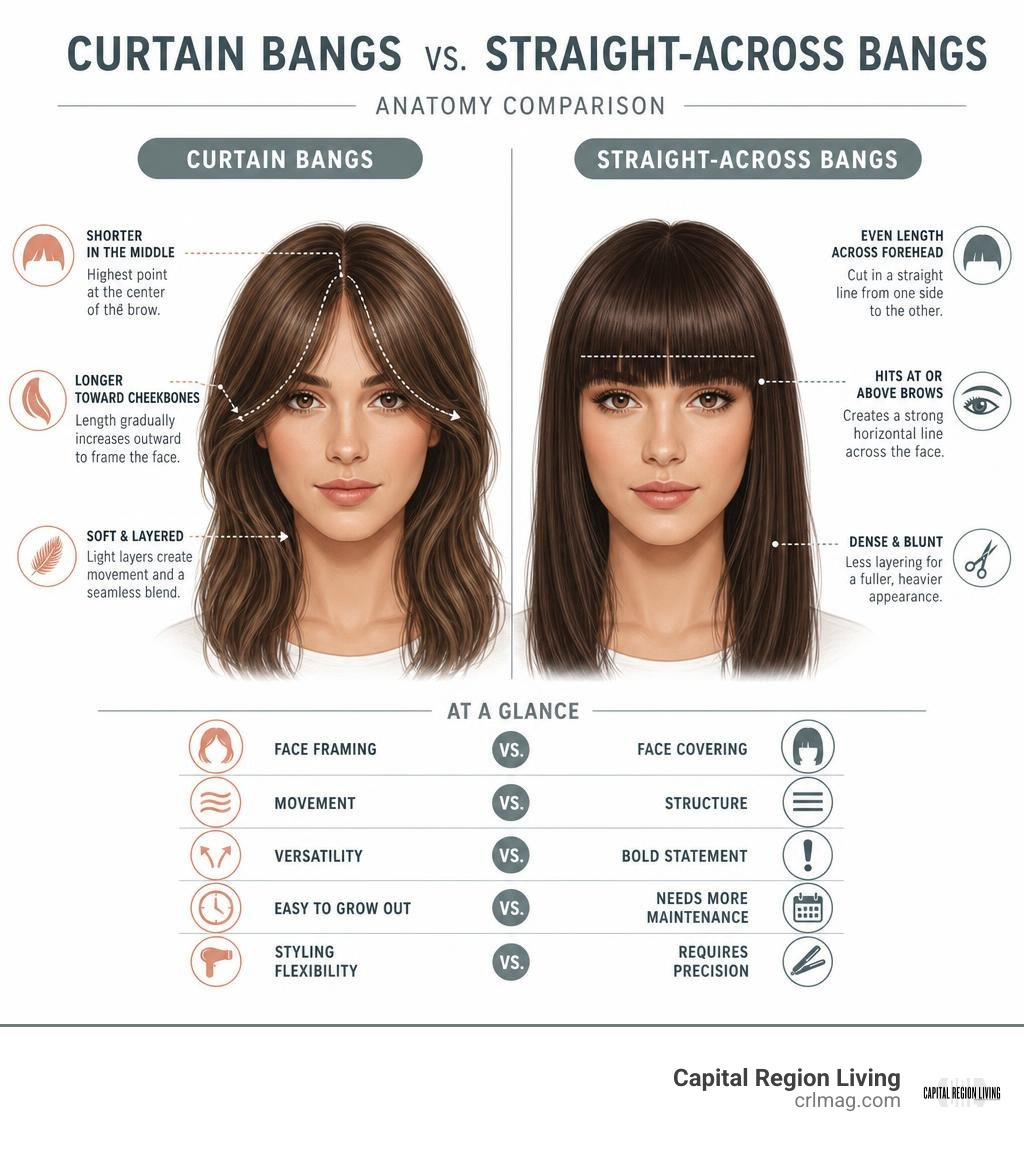
Curtain bangs get their name from how they frame your face: parted down the middle or slightly off-center, they cascade open like velvet drapes flanking a window. This style features a signature graduated taper, starting shorter across the center of the brow and lengthening outward toward the cheekbones or jawline. The design creates a delicate diagonal swoop that draws the eye directly to your facial high points.
The look first achieved iconic status in the late 1960s and 1970s, worn by European stars like Brigitte Bardot and highlighted in the breezy, layered aesthetic seen in The Ultimate Guide to Farrah Fawcett. Today, modern iterations combine retro fullness with effortless movement, proving that face-framing fringe is far more adaptable than severe, traditional bangs.
Understanding how curtain fringes contrast with other popular styles helps clarify why they are so versatile:
- Curtain Bangs vs. Blunt Bangs: Blunt bangs are cut straight across the forehead at a single length, creating a dense horizontal line that demands high maintenance and frequent visits to the salon. Curtain bangs use soft, tapered edges that part in the middle, creating vertical space that opens up the face.
- Curtain Bangs vs. Wispy Bangs: Wispy bangs are light and airy, designed with minimal density so your forehead remains visible underneath. Curtain bangs possess more structured body and weight, though they can be texturized for a softer effect.
- Curtain Bangs vs. Drape Bangs: The main difference lies in starting length. Standard curtain bangs typically begin near the brow or nose bridge and taper down to the tops of the cheekbones. Drape bangs start significantly longer—beginning at the cheekbone and ending at the jawline or chin—acting as long, flowing front layers.
| Fringe Style | Center Starting Point | Outer Edge Length | Ideal Maintenance Cycle | Best Suited For |
|---|---|---|---|---|
| Curtain Bangs | Eyebrow or nose bridge | Cheekbone to mid-jaw | 4–6 Weeks | Universal face shapes; versatile styling |
| Blunt Bangs | Above or at the brow | Flat horizontal line | 2–3 Weeks | Oval and long faces; bold look |
| Wispy Fringe | Eyelash to brow line | Lightly feathered edges | 3–4 Weeks | Fine hair; delicate, low-density styling |
| Drape Bangs | Cheekbone | Jawline to collarbone | 6–8 Weeks | Low-commitment styling; growing out layers |
Matching the Cut to Your Face Shape and Hair Texture
The secret behind why this cut works on almost everyone is intentional customization. Rather than bringing a single reference photo and expecting identical results, your stylist can adjust the starting point, thickness, and graduation angle to complement your unique anatomy.
Customizing Curtain Bangs for Your Face Shape
Every facial structure features distinct proportions. Altering the angle of your fringe can balance, elongate, or soften those features:
- Round Faces: To create the illusion of added length and contour, request longer curtain bangs that start around the bridge of the nose and sweep down past the cheekbones. The visible skin in the center part creates vertical height, while the diagonal edges slim the cheeks.
- Square Faces: Strong, angular jawlines benefit from soft, feathered curtain fringes. Opt for textured pieces that flick outward right at the cheekbones, breaking up square angles and softening the hairline.
- Heart Faces: Heart-shaped faces are wider at the forehead and taper down to a pointed chin. A brow-skimming center that widens and thickens toward the cheekbones adds balanced width around the lower half of the face.
- Oval Faces: Considered the most adaptable shape, oval faces can wear almost any length—from cropped, retro-inspired bangs to elongated drape layers.
- Oblong or Long Faces: A wider, fuller curtain bang that starts closer to the brow line helps shorten the appearance of the forehead while adding horizontal balance across the mid-face.
Adapting the Look for Straight, Wavy, Curly, and Coily Hair
Natural hair texture dictates how the cut behaves once washed and air-dried. Factoring in bounce, density, and natural movement ensures you get a cut that falls into place without daily battles.

- Straight Hair: Straight textures need gentle internal layering to prevent the pieces from hanging flat. Texturizing shears eliminate bulk at the perimeter, encouraging the hair to flick outward rather than falling straight downward.
- Wavy Hair: Wavy hair is exceptionally well suited for this style. The natural bend allows the fringe to sweep away from the eyes with minimal styling effort.
- Curly Hair: Curly textures experience significant bounce-back and shrinkage when drying. To avoid a fringe that snaps up too high on the forehead, curls must be cut dry in their natural, unstretched pattern. Leaving extra length ensures the curls rest gracefully across the cheekbones.
- Coily and Kinky Hair: Coily hair provides exceptional structural volume. Customizing length on stretched or dry-styled coils prevents unexpected shrinkage and allows you to wear your fringe in defined twists, finger coils, or picked out for retro fullness.
- Fine vs. Thick Hair: Fine hair needs a narrower triangular parting so you don’t pull too much density away from your perimeter lengths. Conversely, thick hair requires weight removal through slide cutting to prevent the fringe from feeling heavy or bulky.
Step-by-Step Guide to Styling and Daily Maintenance
Getting your bangs to sweep outward like a salon blowout is simpler than it appears once you understand the underlying mechanics of hair styling.
Heat Styling with Round Brushes, Rollers, and Flat Irons
When you apply heat and moisture to hair, you temporarily soften its internal hydrogen bonds. As the hair cools or dries into a new position, those bonds reset, locking in the shape. To achieve a smooth finish with lasting bounce, you can Try the Trend: Curtain Bangs – L’Oréal Paris styling technique:

- Prep Damp Hair: Start with bangs that are roughly 80% dry. Apply a lightweight heat protectant spray to shield strands from temperatures up to 450°F without weighing down the roots.
- The Forward Pull: Place a 1.5- to 2-inch boar-bristle round brush underneath your fringe. Direct airflow from your dryer downward over the top of the brush, pulling the hair straight forward toward your nose. This resets natural cowlicks and establishes root lift.
- The Outward Sweep: Split the fringe along your center part. Take one side, wrap it around the round brush rolling backward and away from your temple, and apply warm airflow.
- Lock with a Cool Blast: Switch your dryer to the cold-shot setting for 5–10 seconds before releasing the brush. The sudden drop in temperature resets the hydrogen bonds, locking in the curved shape.
- The Roller Option: For voluminous ’90s bounce, roll your warm, freshly dried fringe forward onto a medium Velcro roller. Let it sit for 10 minutes while applying your makeup, then unwind and shake out with your fingers.
- Flat Iron Polishing: If using a straightener, clamp the hair at the root, curve the iron downward, and rotate the plates outward at a 45-degree angle as you reach the ends for a gentle, natural flick.
Heatless Methods and Daily Oil Control Routines
You don’t need heat tools every morning to keep your fringe looking intentional. Heatless techniques and smart oil-control habits protect your hair from thermal damage while saving time.

- Cross-Drying Air Technique: If you are air-drying, comb your damp fringe forward. Pull the left side across your forehead toward your right temple and the right side toward your left temple, securing each side with flat, creaseless clips. Once dry, remove the clips and part down the middle; your bangs will open outward naturally.
- Preventative Dry Shampoo: Bangs absorb facial oils, sweat, moisturizer, and sunscreen quickly because they rest directly against your forehead skin. Apply a light mist of dry shampoo to the roots of your bangs immediately after washing and styling. Proactively absorbing sebum before it appears keeps your fringe lightweight and bouncy all day.
- The Sink Refresh: If the rest of your hair looks fresh but your bangs are flat from sleeping, isolate your fringe with a clip, wash only the front pieces in the sink with a nickel-sized drop of shampoo, and blow-dry them in under two minutes.
Cutting, Upkeep, and How to Grow Out Curtain Bangs Gracefully
Whether you prefer salon appointments or need to make minor adjustments at home, maintaining your cut keeps the silhouette looking intentional rather than unkempt.
Trimming Curtain Bangs at Home Between Salon Visits
While major restyling should always be entrusted to a professional—such as the talented team where Choices Hair Studio Dominates the 2024 Beauty Besties—you can manage subtle maintenance trims at home if you follow proper safety protocols:
- Always Cut on Dry Hair: Wet hair stretches significantly and appears longer than it is. Cutting dry ensures what you see is the true resting length, eliminating accidental shrinkage surprises.
- Use Professional Hair Shears: Never cut hair with dull kitchen or paper scissors. Dull blades bend and crush the hair shaft, leaving jagged ends and split cuticles. Use sharp stainless steel shears.
- Section a Triangle: Use a fine-tooth tail comb to isolate a triangular section from the center part back toward the crown, ending at your outer brow arches. Secure all other hair behind your ears with clips.
- The Inverted “V” Technique: Bring one side across your face to the opposite eyebrow to create a natural graduated angle. Hold your shears vertically and use point cutting (tiny snips into the ends rather than a straight horizontal cut) to create a soft, tapered edge that runs from nose level down to the cheekbone.
The Effortless Transition: Growing Out Your Fringe
One of the greatest advantages of curtain bangs is their seamless grow-out phase. Unlike blunt bangs that create an awkward, eye-poking straight line, curtain bangs evolve naturally into face-framing layers over a 3- to 6-month period.
- Months 1 to 2: The center pieces reach the tip of the nose, while the outer corners hit the mid-jawline. Style them with a wider outward flick to keep them out of your eyes, or use a texturizing sea salt spray for a lived-in, tousled look.
- Months 3 to 4: The fringe reaches chin length, transforming into drape bangs. At this stage, you can seamlessly tuck them behind your ears, integrate them into high ponytails, or part your hair slightly off-center.
- Months 5 to 6: The shortest layers merge entirely with the rest of your haircut, serving as built-in face-framing layers that require zero special styling.
Frequently Asked Questions About Curtain Bangs
Are curtain bangs high maintenance for everyday styling?
Curtain bangs are far less demanding than straight-across fringe, but they do require roughly 2 to 5 minutes of focused attention on styling mornings. Because they sit against facial skin, they collect natural sebum and skincare products faster than the rest of your hair. A quick morning pass with a round brush, a light spritz of dry shampoo, or a 10-minute Velcro roller set is usually all it takes to revive their bounce.
Should curtain bangs be cut on wet or dry hair?
For initial salon shaping on straight or wavy textures, cutting damp hair is acceptable as long as your stylist accounts for natural tension and drying lift. However, for at-home trims or on naturally curly and coily hair, cutting dry hair is essential. Dry cutting shows your true hair pattern, avoids unexpected shrinkage, and prevents you from cutting the bangs too short.
How often do curtain bangs need a trim?
To maintain a classic, cheekbone-grazing silhouette, schedule a trim every 4 to 6 weeks. If you prefer a longer, lived-in drape style, you can comfortably extend salon visits to 8 weeks. Many salons offer complimentary or discounted quick fringe trims between full haircut appointments to keep your shape looking sharp.
Conclusion
Curtain bangs continue to dominate hair trends across New York’s Capital Region and beyond because they offer the perfect balance of vintage glamour, effortless styling, and forgiving upkeep. Whether you are looking to soften strong facial angles, add fullness to fine strands, or refresh your everyday look without sacrificing hair length, this adaptable fringe provides a low-risk, high-reward transformation.
When you are ready to update your look, book a consultation with a local stylist who can tailor the length, density, and graduation to your natural features. To find top-rated regional stylists and beauty experts right in your neighborhood, explore the Capital Region business directory to find your next salon destination.