Why Linda Evangelista Still Defines the Supermodel Era
Linda Evangelista is a Canadian supermodel whose bold style changes, major fashion campaigns, and outspoken confidence helped define the modern supermodel. Born in St. Catharines, Ontario, on May 10, 1965, she became known as fashion’s “chameleon” for transforming her hair, makeup, and persona from one shoot to the next. Her career includes more than 700 magazine covers and a place among the era’s celebrated “Big 6.”
Her influence reached beyond the runway. A short 1988 haircut became an international trend, while her much-quoted line, “We don’t wake up for less than $10,000 a day,” captured the new commercial power of top models in the 1990s.
This guide follows Evangelista’s rise from Canada to global fashion fame, as well as her motherhood, legal disputes, CoolSculpting complication, breast cancer treatment, and recent return to public life through The Super Models docuseries.

Linda evangelista vocab explained:
Early Life and the Rise of a Runway Chameleon
Growing up in a traditional Italian-Canadian, Roman Catholic household in St. Catharines, Ontario, Linda Evangelista dreamt of modeling from an early age. Her blue-collar upbringing kept her grounded, but her striking features, towering 5-foot-9¾ frame, and natural poise hinted at something far grander.
Her journey began in earnest at age 16 when an Elite Model Management scout spotted her at the local Miss Niagara Teen pageant. While she did not win the crown, the encounter opened the door to the high-fashion world. By 1984, she signed with Elite and packed her bags for Paris. As noted in her biographical profile on Britannica, the transition took grit and patience before she emerged as a force on European runways.
Early Career and the Discovery of Linda Evangelista
The pivotal moment that launched Evangelista into global superstardom arrived in autumn 1988. Legendary photographer Peter Lindbergh suggested she cut her long, shoulder-length brown hair into a daring, gamine crop. Hairstylist Julien d’Ys executed the cut, and Evangelista famously wept as locks fell to the floor.
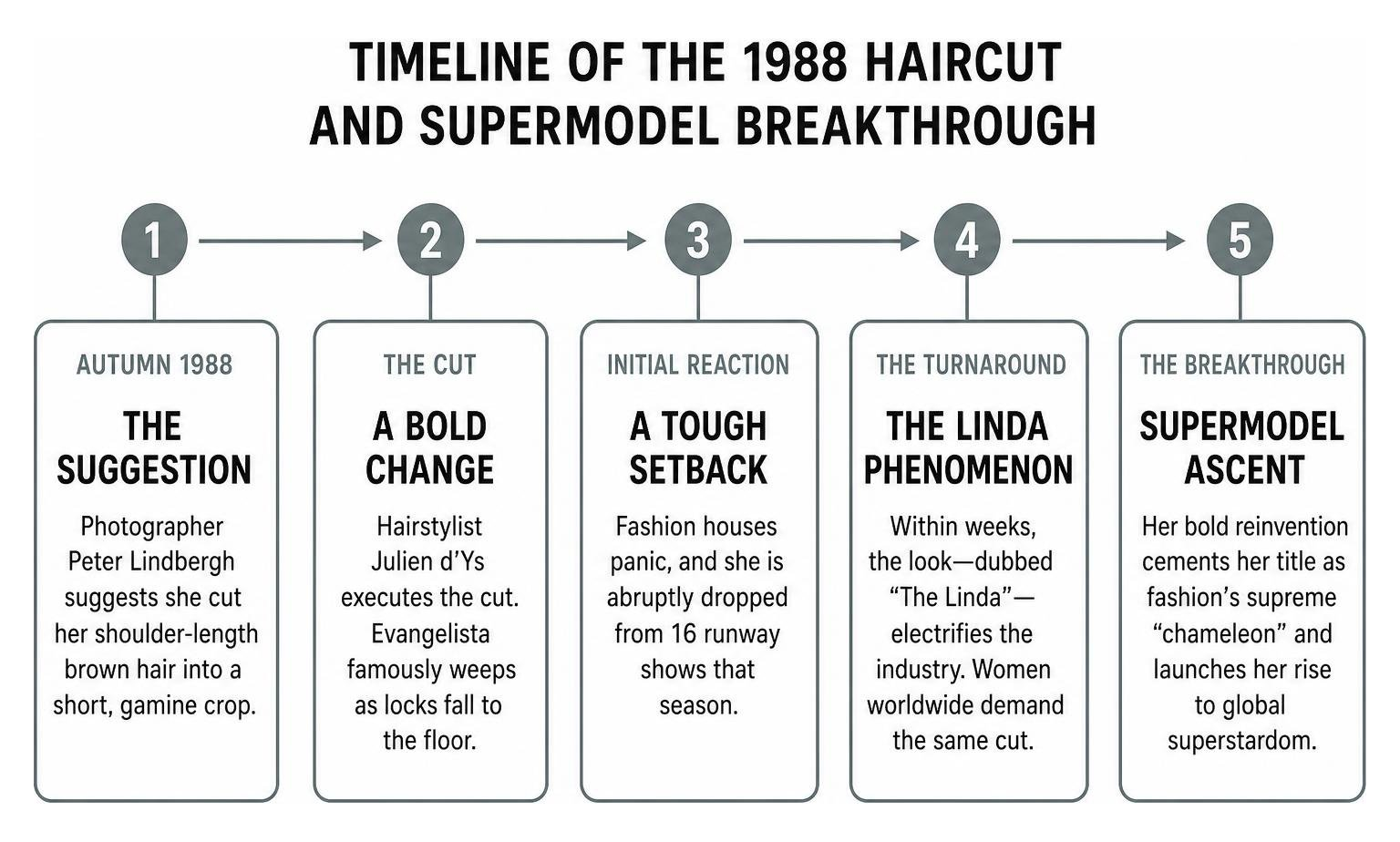
The initial reaction was brutal: fashion houses panicked, and she was abruptly dropped from 16 runway shows that season. Yet within weeks, the bold look—dubbed “The Linda”—electrified the industry. Women flooded salons worldwide demanding the same cut, and manufacturers even created “The Evangelista” wig.
Her willingness to continually alter her image cemented her title as the fashion world’s supreme “chameleon.” In an industry that often valued static predictability, Evangelista dyed her hair dozens of shades—from platinum blonde to fiery red and jet black—becoming the primary muse of visionary photographer Steven Meisel and establishing an enduring record for the most Vogue Italia covers in history.
The Trinity and Defining 1990s Supermodel Culture
By 1990, the fashion industry had transformed. Designers moved away from anonymous clothes hangers, choosing instead powerhouse personalities whose charisma sold a luxury lifestyle. At the center was “The Trinity,” an elite trio comprising Linda Evangelista, Naomi Campbell, and Christy Turlington.
Working closely with designers like Gianni Versace and Karl Lagerfeld at Chanel, they turned catwalk presentations into high-voltage theatrical entertainment. Pop culture took notice: pop star George Michael famously cast them alongside Cindy Crawford and Tatjana Patitz in his iconic “Freedom! ’90” and “Too Funky” music videos, merging the music and fashion industries into a unified cultural phenomenon. Exploring these pop culture touchstones offers insights similar to our review in a comprehensive guide to Pamela Anderson’s life and career.
| Supermodel | Signature Era Trait | Iconic Runway / Editorial Moment | Major Pop Culture Crossover |
|---|---|---|---|
| Linda Evangelista | The “Chameleon” / Constant Reinvention | Record Vogue Italia covers with Meisel | George Michael’s “Freedom! ’90” Video |
| Christy Turlington | Classic, Timeless Symmetry | Calvin Klein Eternity Muse | Global Maternal Health Campaigns |
| Naomi Campbell | Unmatched Runway Walk Power | Versace Atelier Showstoppers | High-Profile Music & Television Appearances |
| Cindy Crawford | Athletic, All-American Appeal | Historic 1992 Pepsi Commercial | House of Style Host / Fitness Videos |
| Claudia Schiffer | Brigitte Bardot Bombshell Look | Guess Jeans Global Campaigns | International Film & Television Cameos |
| Kate Moss | Effortless Grunge & “Waif” Aesthetic | Calvin Klein Obsession Campaigns | Modern Streetwear Style Icon |
The $10,000-a-Day Quote and Modeling Revolution
In a legendary 1990 interview with Vogue, Evangelista uttered the line that came to define an era: “We don’t wake up for less than $10,000 a day.”
While critics labeled the quote arrogant, the remark signaled an unprecedented commercial shift. Top models were no longer just passive participants; they were global brands demanding equitable compensation for their immense marketing power. In 1991, Lanvin paid Evangelista a record $20,000 for a single runway appearance. A few years later, a historic multi-year endorsement contract with Clairol exceeded $5 million.
Her extensive portfolio, cataloged on Linda Evangelista on Fashion Model Directory, demonstrates how she drove the supermodel economy. She used her star power strategically, balancing high-paying corporate deals with creative runway shows, even waiving fees for emerging designers like Anna Sui to help them establish their collections.
Health Battles, Cosmetic Trauma, and Cancer Survivorship
Behind the glamorous magazine covers, Evangelista encountered profound personal and medical trials that tested her resilience.

Between 2015 and 2016, Evangelista underwent cycles of CoolSculpting (cryolipolysis), a non-invasive fat-freezing procedure. Instead of reducing fat cells, she developed a rare adverse side effect called Paradoxical Adipose Hyperplasia (PAH). The condition caused the targeted fat cells to enlarge and harden, leaving permanent, painful masses along her jawline, back, and thighs. Corrective surgeries failed to reverse the damage.
The emotional and physical toll forced her into near-total seclusion for five years. In September 2021, she broke her silence, filing a $50 million lawsuit against Zeltiq Aesthetics (a subsidiary of Allergan). After settling the suit in 2022, Evangelista chose to reclaim her narrative by sharing raw, unretouched photographs of her body with the world, challenging unrealistic beauty expectations across the industry.
Her medical hurdles deepened when she revealed two separate breast cancer diagnoses—first discovered during a routine mammogram in 2018, and again in 2022. Facing the disease with characteristic resolve, she opted for a bilateral mastectomy alongside rigorous chemotherapy and radiation. As highlighted in the IMDb biography of Linda Evangelista, she embraced her surgical scars as badges of survival, using her platform to urge women everywhere to maintain regular screenings.
Her personal life also demanded strength. As a mother to her son, Augustin James, born in 2006, she handled high-profile child support proceedings involving French businessman François-Henri Pinault in 2011–2012 with dignity, protecting her son’s privacy throughout the media coverage.
Cultural Impact and the Enduring Legacy of Linda Evangelista
Today, Linda Evangelista stands as one of fashion’s true pioneers. With over 700 magazine covers worldwide, her impact spans artistic innovation, labor economics, and health advocacy.

In 2003, she received a star on Canada’s Walk of Fame, and in 2008, viewers of CBC’s Fashion File voted her “The Greatest Supermodel of All Time.” Her influence on screen and in print remains unmatched, much like the cultural powerhouses covered in our resource guide on Emilia Clarke.
Linda Evangelista in Modern Media: From Docuseries to the Catwalk
In 2023, Evangelista reunited with Cindy Crawford, Naomi Campbell, and Christy Turlington for the critically acclaimed Apple TV+ docuseries The Super Models, which she also executive produced. The project offered a candid, behind-the-scenes look at how four young women navigated a high-pressure industry to claim creative control.
Far from stepping back, Evangelista continues to grace select high-fashion campaigns and runways, including standout collaborations with Fendi, Perfect Magazine, and Vogue Italia.
Notable Career Milestones & Lifetime Honors:
- Canada’s Walk of Fame Inductee (2003): Honoring her international cultural influence.
- Fashion File’s Greatest Supermodel of All Time (2008): Selected by a global viewer vote.
- Model of the Year Lifetime Achievement (2022): Honoring four decades of runway excellence.
- Executive Producer (The Super Models, 2023): Documenting the historic supermodel era for global audiences.
Redefining Beauty Standards and Global Philanthropy
Now in her sixties, Evangelista’s perspective on beauty centers on authenticity and health. She has long championed philanthropy, working extensively as a spokesperson for the MAC Viva Glam campaign, co-chairing amfAR benefit galas, and raising millions for HIV/AIDS research and breast cancer organizations.
Her advocacy encourages transparency around cosmetic procedures and body neutrality, proving that true style is rooted in personal courage rather than perfection.
Frequently Asked Questions
What caused the cosmetic complications she experienced?
Linda Evangelista developed Paradoxical Adipose Hyperplasia (PAH) after undergoing non-invasive CoolSculpting (cryolipolysis) treatments between 2015 and 2016. PAH is a rare complication where fat cells at the treatment site expand and harden into localized masses instead of shrinking. After two unsuccessful corrective surgeries, she came forward publicly in 2021 to shed light on the physical and psychological risks associated with non-surgical aesthetic procedures.
What is the context behind the famous $10,000 quote?
During a 1990 interview with Vogue writer Jonathan Van Meter, Evangelista commented on the intense demands of the modeling industry, joking, “We don’t wake up for less than $10,000 a day.” Referring to herself and Christy Turlington, the quote highlighted the rising commercial leverage of top models who had evolved into powerful global brand ambassadors.
How many magazine covers did she achieve throughout her career?
Evangelista has appeared on over 700 magazine covers across the globe. She holds the historic record for the most covers of Vogue Italia, created during her decades-long creative partnership with renowned fashion photographer Steven Meisel.
Conclusion
Linda Evangelista’s path from St. Catharines, Ontario, to global runways reflects talent, determination, and resilience. As an architect of the supermodel era, she elevated modeling into an art form, transformed beauty conventions with fearless style choices, and stood up for transparent health practices.
At Capital Region Living, we celebrate stories of creative innovation, cultural impact, and perseverance. Whether you are exploring our regional features or looking for standout local services through our Capital Region Living business directory, we invite you to discover the community leaders and cultural icons shaping our world.