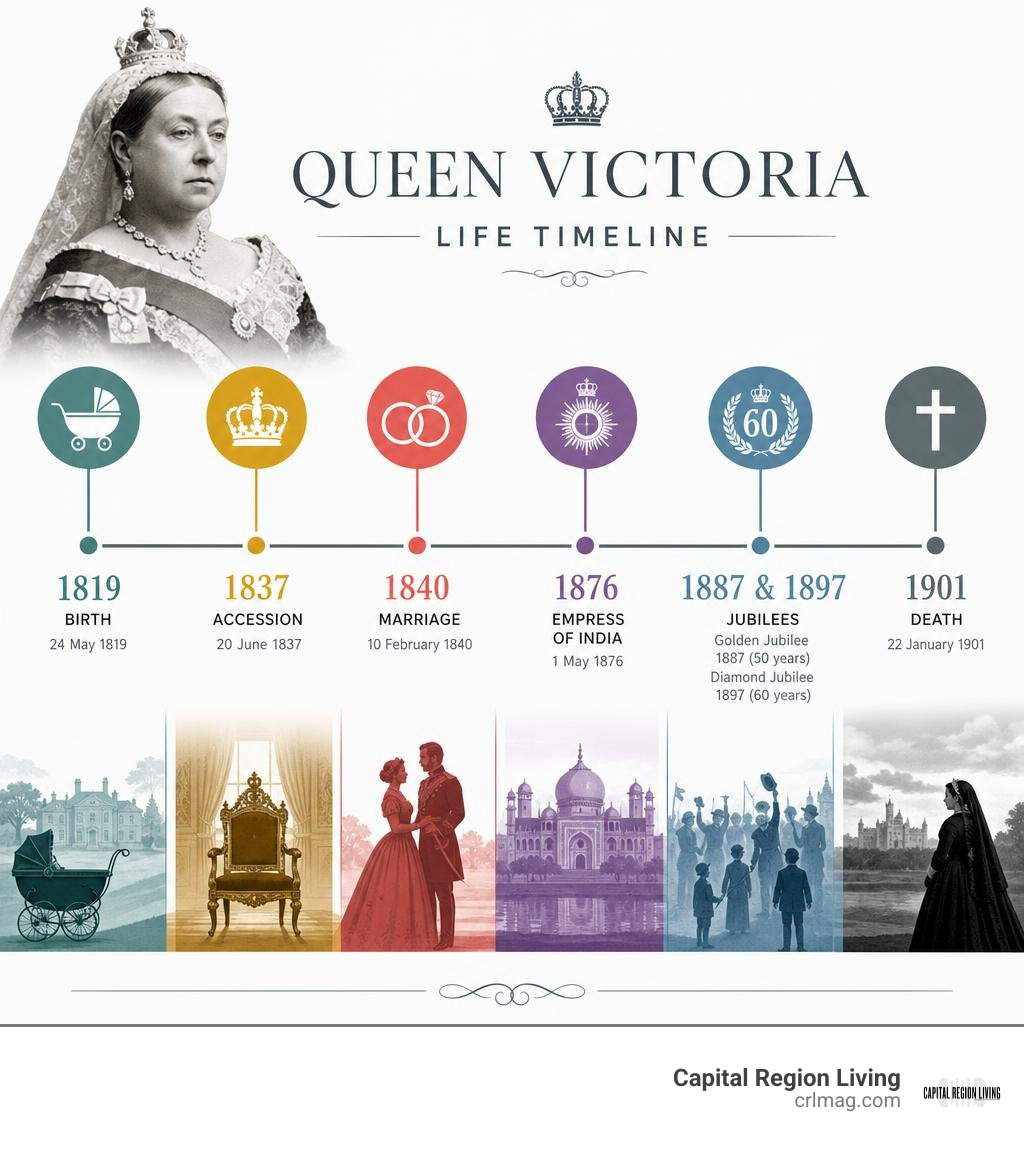
Why Queen Victoria Still Matters
Queen Victoria was the British monarch from 1837 to 1901, a reign of 63 years and 216 days. She became the public face of a fast-changing Britain: one shaped by industrial growth, expanding voting rights, global empire, and a monarchy learning to work within constitutional limits.
Her life was also deeply personal. Raised under the restrictive Kensington System, Victoria came to the throne at 18 determined to rule independently. Her marriage to Prince Albert helped reshape the royal family into a model of domestic duty, while her long mourning after his death tested public support for the Crown.
Victoria was Britain’s last monarch from the House of Hanover, the mother of nine children, and later known as the “Grandmother of Europe” because her descendants married into royal houses across the continent. In 1876, she also became Empress of India, a title that reflected the reach – and tensions – of the British Empire.
This quick guide explains the person behind the Victorian era and why her choices still matter to the modern monarchy.
Explore more about queen victoria:
Early Life and the Accession of Queen Victoria
When Princess Alexandrina Victoria was born at Kensington Palace on May 24, 1819, few expected her to sit upon the throne. Her birth followed a sudden royal succession crisis after the death of Princess Charlotte in 1817. Victoria’s father, Prince Edward, Duke of Kent, died less than a year after her birth, leaving behind substantial debts and an infant daughter fifth in line to the crown.
As her elderly uncles—King George IV, the Duke of York, and King William IV—died without surviving legitimate heirs, the young princess gradually became the heir presumptive. King William IV openly disliked Victoria’s mother and famously declared he hoped to live until Victoria turned 18 so a regency could be avoided entirely. His wish came true by less than a month: William IV passed away on June 20, 1837, weeks after Victoria celebrated her eighteenth birthday.
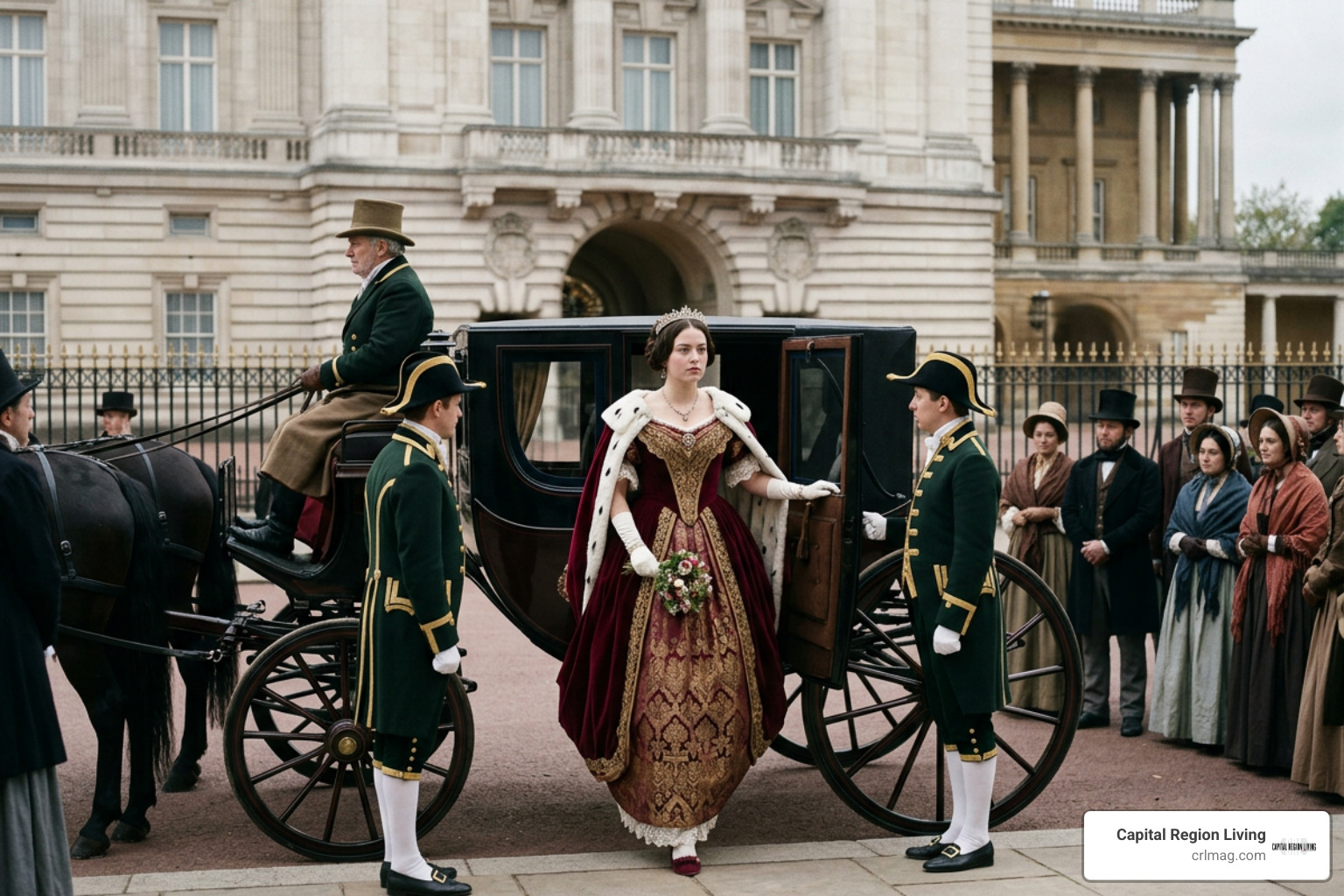
Upon her accession, Victoria demonstrated her newfound independence immediately. She took up official residence at Buckingham Palace, becoming the very first reigning British sovereign to live there, and requested a private bedroom separate from her mother. Her formal coronation took place at Westminster Abbey on June 28, 1838. Over 400,000 visitors flooded into London to celebrate the dawn of a fresh, youthful reign, heralding an era that promised moral revitalization for the British monarchy.
The Kensington System and Queen Victoria’s Childhood
Victoria’s upbringing was defined by the strict and claustrophobic “Kensington System,” engineered by her widowed mother, the Duchess of Kent, and the ambitious comptroller Sir John Conroy. Conroy sought to make Victoria weak, anxious, and utterly dependent on him so that he could wield political influence through a regency.
Under the system, Victoria was never permitted to walk downstairs without an adult holding her hand, could not sleep in a room without her mother, and was banned from playing freely with other children. Despite describing her youth as “rather melancholy,” Victoria used her isolation to focus on studies. A talented linguist, she grew fluent in English and German and studied French, Italian, and Latin. She also began writing regular journals—a daily practice yielding an astonishing average of 2,500 words per day across her adult life, giving modern historians an unparalleled record of her thoughts.
How Queen Victoria Handled the Bedchamber Crisis
Victoria’s early reign was tested politically in May 1839 during the famous “Bedchamber Crisis.” When her beloved mentor, Whig Prime Minister Lord Melbourne, resigned, Conservative leader Sir Robert Peel prepared to form a new government. Peel requested that Victoria dismiss several of her Ladies of the Bedchamber, who were wives and close relatives of prominent Whig politicians, to demonstrate political neutrality.
Fiercely protective of her private household, Victoria flatly refused, treating Peel’s request as an intolerable personal affront. Unable to govern without the Queen’s confidence, Peel declined to serve, allowing Melbourne’s Whig government to return to power for two more years. This confrontation highlighted the transition toward modern constitutional limits: while Victoria won the immediate battle through her royal prerogative, the public pushback taught her that the Crown must remain impartial. The official record of Victoria (r. 1837-1901) | The Royal Family highlights how this moment shaped her evolving understanding of cabinet government.
Prince Albert, Royal Partnership, and Domestic Reform
On February 10, 1840, Victoria married her first cousin, Prince Albert of Saxe-Coburg and Gotha. The wedding revolutionized bridal traditions: Victoria opted for a pristine white court dress accented with delicate Honiton lace rather than heavy ermine and crimson robes, popularizing white wedding dresses across the Western world. To keep her gown unique, the pattern was destroyed immediately after manufacture.
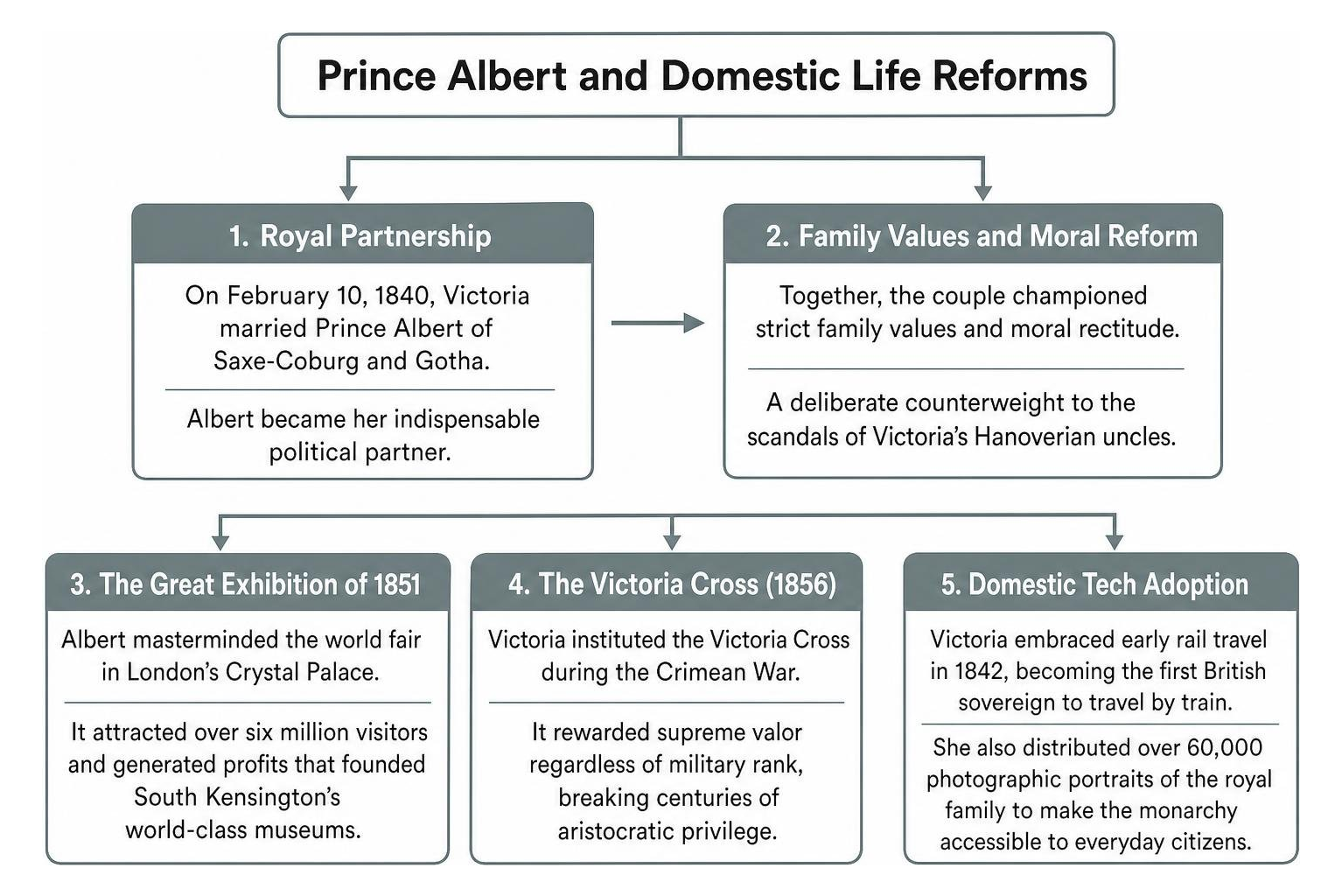
Prince Albert quickly transitioned from consort to indispensable political partner. Together, the couple championed strict family values and moral rectitude, deliberate counterweights to the scandals of Victoria’s Hanoverian uncles. Albert applied his visionary intellect to industrialization, education, and modern science:
- The Great Exhibition of 1851: Albert masterminded this landmark world fair inside London’s Crystal Palace, attracting over six million visitors and generating profits that founded South Kensington’s world-class museums.
- The Victoria Cross (1856): Victoria instituted this decoration during the Crimean War to reward supreme valor regardless of military rank, breaking centuries of aristocratic privilege.
- Domestic Tech Adoption: Victoria embraced early rail travel in 1842, becoming the first British sovereign to travel by train, and distributed over 60,000 photographic portraits of the royal family to make the monarchy accessible to everyday citizens.
Royal Assassination Attempts and Public Security
Victoria’s public visibility came at significant personal peril. Throughout her reign, she survived eight assassination and assault attempts. The first occurred in June 1840, when an eighteen-year-old named Edward Oxford fired two pistols at her carriage along Constitution Hill while she was pregnant with her first child.
In May 1842, John Francis attempted to shoot her in the same location. Knowing Francis was still on the loose, Victoria courageously took the exact carriage route the following day with extra plainclothes police in order to draw him out and enable his capture. Later assaults ranged from John William Bean’s misfiring pistol to Robert Pate striking her face with a brass-tipped cane in 1850. Rather than shrinking from society, Victoria’s calm courage turned these dangerous encounters into triumphs of public goodwill. The attacks spurred Parliament to pass the Treason Act 1842, which updated royal security protocols.
Victoria also demonstrated bravery in her private life by championing medical innovation. Despite religious objections, she used chloroform for pain relief during the births of Prince Leopold (1853) and Princess Beatrice (1857), single-handedly normalizing anaesthesia across modern medicine.
Mourning, Imperial Power, and Prime Ministerial Rivalries
In December 1861, tragedy altered the trajectory of the reign. Prince Albert died suddenly at age 42 from typhoid fever (complicated by chronic stomach illness). Shattered by grief, Victoria plunged into permanent mourning, donning black attire for the remaining 40 years of her life and earning the somber moniker the “Widow of Windsor.”
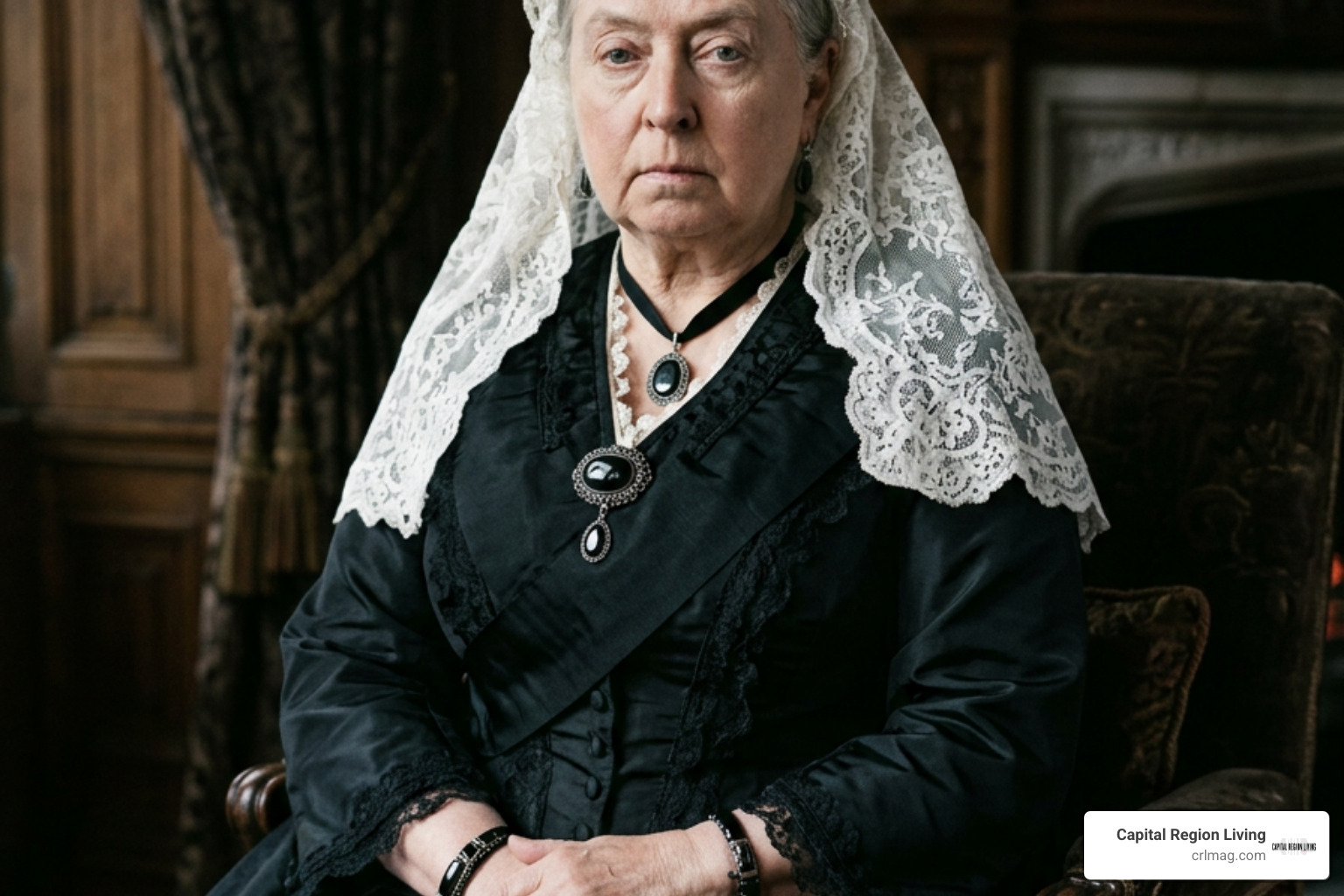
Her prolonged withdrawal from public duties sparked widespread frustration. Republican sentiment surged during the late 1860s; critics complained that the royal family cost substantial public money while remaining hidden from view. Protesters even affixed satirical notices to Buckingham Palace gates declaring the premises “to let or sold in consequence of the late occupant’s declining business.”
Victoria gradually returned to public visibility through her deep emotional connection to the Scottish Highlands at Balmoral Castle, supported by her trusted Scottish ghillie, John Brown. Her return to ceremonial life in the 1870s revitalized her standing, repositioning her as a venerable matriarch of the nation.
Prime Ministers: Melbourne, Disraeli, and Gladstone
Victoria worked with ten different Prime Ministers across her reign. Her personal dynamics with these statesmen heavily influenced government policy and court culture:
| Prime Minister | Party | Relationship Dynamics | Key Events & Policies |
|---|---|---|---|
| Lord Melbourne | Whig | Father figure, close personal friend, and political mentor during her teenage years. | Guided early accession; handled the Bedchamber Crisis (1839); introduced her to parliamentary statecraft. |
| Benjamin Disraeli | Conservative | Flattering, devoted, and charismatic; Victoria adored his courtly manners. | Passed the Royal Titles Act 1876; elevated Victoria to Empress of India; expanded imperial reach. |
| William Gladstone | Liberal | Cold and contentious; she complained he addressed her like “a public meeting.” | Pushed the Second Reform Act (1867); introduced the secret ballot (1872); debated Irish Home Rule. |
Victoria was not merely a ceremonial observer. She actively voiced her views during major socio-economic crises, including supporting the repeal of the Corn Laws in 1846 to alleviate food shortages. During the Great Irish Famine, she personally donated £2,000 to the British Relief Association. In European foreign diplomacy, she used private letters to mediate international disputes, including writing directly to the German Emperor in 1875 to avert a Franco-German conflict.
Imperial Expansion and the Empress of India
Under Victoria’s reign, the British Empire expanded dramatically to cover nearly one-fourth of the world’s landmass. On May 1, 1876, Parliament passed the Royal Titles Act, formally proclaiming Victoria Empress of India (Kaisar-i-Hind) following the transfer of administrative governance from the East India Company to the Crown.
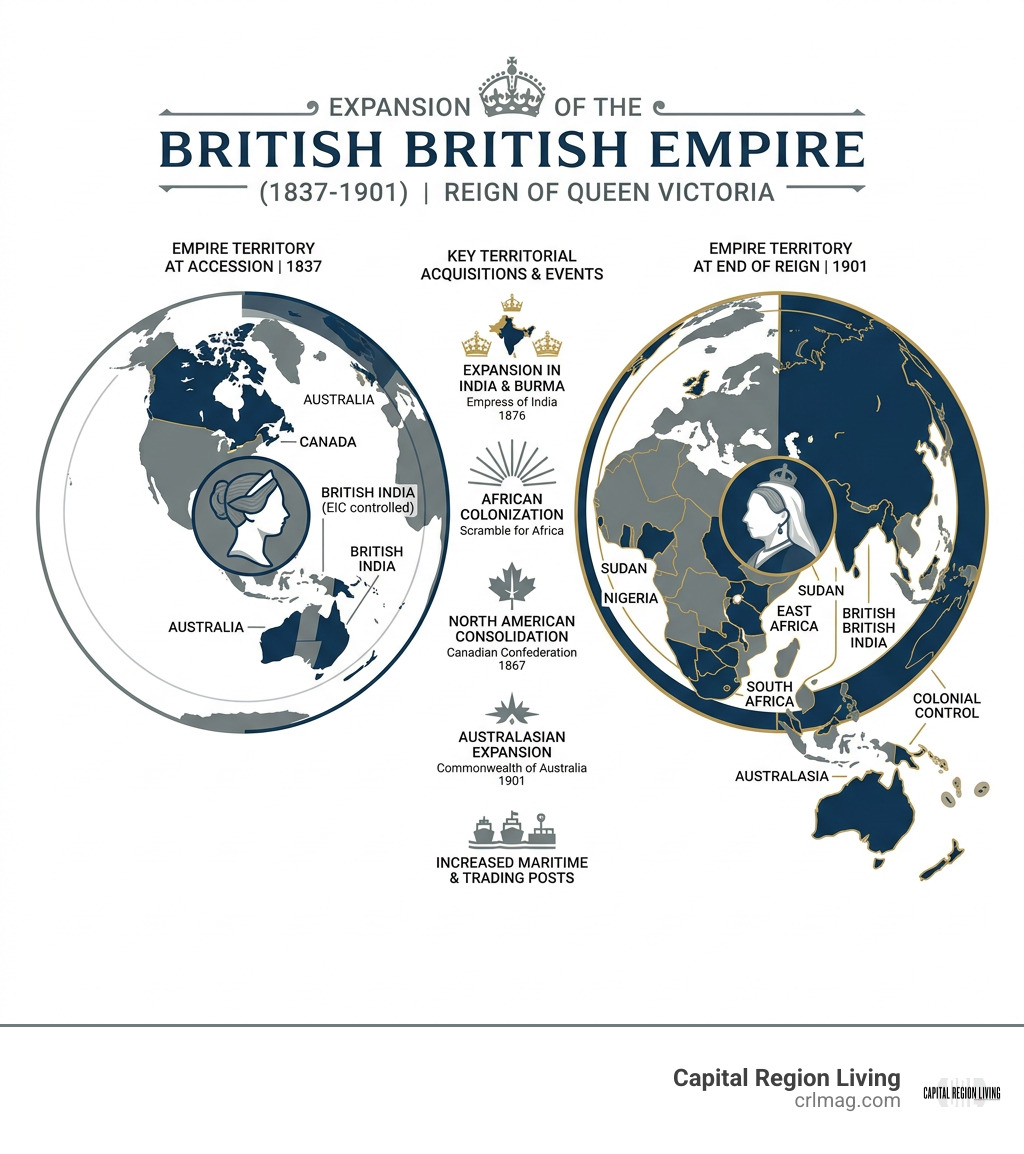
Victoria took her imperial role seriously. She took lessons to learn Hindustani, employed Indian staff including her personal clerk Abdul Karim, and regularly advocated for fair treatment of Indian subjects within imperial policy.
Her imperial influence extended directly into North American governance as well. In 1857, Victoria personally selected Ottawa as the capital of the Province of Canada due to its defensible inland location and position between French and English populations. Her backing paved the way for Confederation in 1867, earning her recognition as the “Mother of Confederation.” For an in-depth perspective on her imperial diplomacy across North America, explore the historical profile of Queen Victoria | The Canadian Encyclopedia.
Dynastic Alliances, Jubilees, and Lasting Legacy
The Grandmother of Europe and Dynastic Marriages
Between 1840 and 1857, Victoria and Albert had nine children. Through calculated diplomatic matchmaking, they orchestrated marriages across the most prominent royal houses of Europe, earning Victoria the enduring nickname the “Grandmother of Europe.”

Key royal unions of her children and grandchildren included:
- Victoria, Princess Royal: Married Crown Prince Frederick William of Prussia, becoming German Empress and mother to Kaiser Wilhelm II.
- Albert Edward (King Edward VII): Married Princess Alexandra of Denmark, securing alliances with Scandinavian monarchies.
- Alice: Married Grand Duke Louis IV of Hesse; her daughter Alix married Tsar Nicholas II of Russia.
- Alfred: Married Grand Duchess Maria Alexandrovna of Russia, directly linking the British and Romanov dynasties.
- Arthur: Married Princess Louise Margaret of Prussia, serving later as Governor General of Canada.
- Beatrice: Married Prince Henry of Battenberg, keeping her mother company in later life.
Tragically, Victoria was an unwitting carrier of haemophilia B, a genetic blood-clotting disorder. She passed the mutated X chromosome to several daughters and her hemophiliac son, Prince Leopold. The condition spread into the royal families of Russia, Spain, and Germany, playing a role in the political instability of early 20th-century Europe.
The Golden and Diamond Jubilees: Celebrating an Era
Victoria’s later reign was punctuated by grand celebrations of imperial unity:
- The Golden Jubilee (1887): Marked 50 years on the throne with fifty European kings and princes attending a banquet at Buckingham Palace, followed by a procession to Westminster Abbey that solidified the global “Brand Victoria.”
- The Diamond Jubilee (1897): Marked 60 years on the throne, celebrated as a “Festival of the British Empire” featuring colonial troops, prime ministers, and celebrations from Canada to India.
Victoria died on January 22, 1901, at age 81 at Osborne House on the Isle of Wight, surrounded by her son (the future King Edward VII) and grandson (Kaiser Wilhelm II). Her death concluded the House of Hanover and transitioned the Crown to the House of Saxe-Coburg-Gotha (later renamed Windsor).
Frequently Asked Questions About the Victorian Monarchy
Why did the British monarch wear black for 40 years?
Following Prince Albert’s death in December 1861, Queen Victoria adopted permanent widow’s weeds. Mourning rituals were central to Victorian culture, but her commitment lasted four decades, popularizing black crepe clothing and jet mourning jewelry across Britain and the Commonwealth.
How tall was Britain’s longest-reigning 19th-century monarch?
Victoria was approximately 4 feet 11 inches (150 cm) tall. Despite her small physical stature, she projected an immense personal dignity that commanded rooms of international dignitaries and seasoned politicians.
Why was the title Empress of India created in 1876?
Prime Minister Benjamin Disraeli spearheaded the Royal Titles Act of 1876 to link India directly to the British Crown following the Indian Rebellion of 1857. The title also placed Victoria on an equal diplomatic footing with the Emperors of Russia, Austria, and Germany.
Conclusion
Queen Victoria’s 63-year reign transformed the British monarchy from an interventionist political power into the enduring, politically neutral institution of today. Her era oversaw sweeping industrial expansion, modern scientific breakthroughs, and deep constitutional reforms that fundamentally reshaped society.
Here in New York’s Capital Region, the Victorian influence lives on through our preserved 19th-century brick brownstones, industrial heritage, and regional architecture. Discover the historic downtowns and local artisans defining our community today by browsing our Capital Region business directory to connect with local culture and heritage.