Val Kilmer’s Life, Landmark Roles, and Lasting Legacy
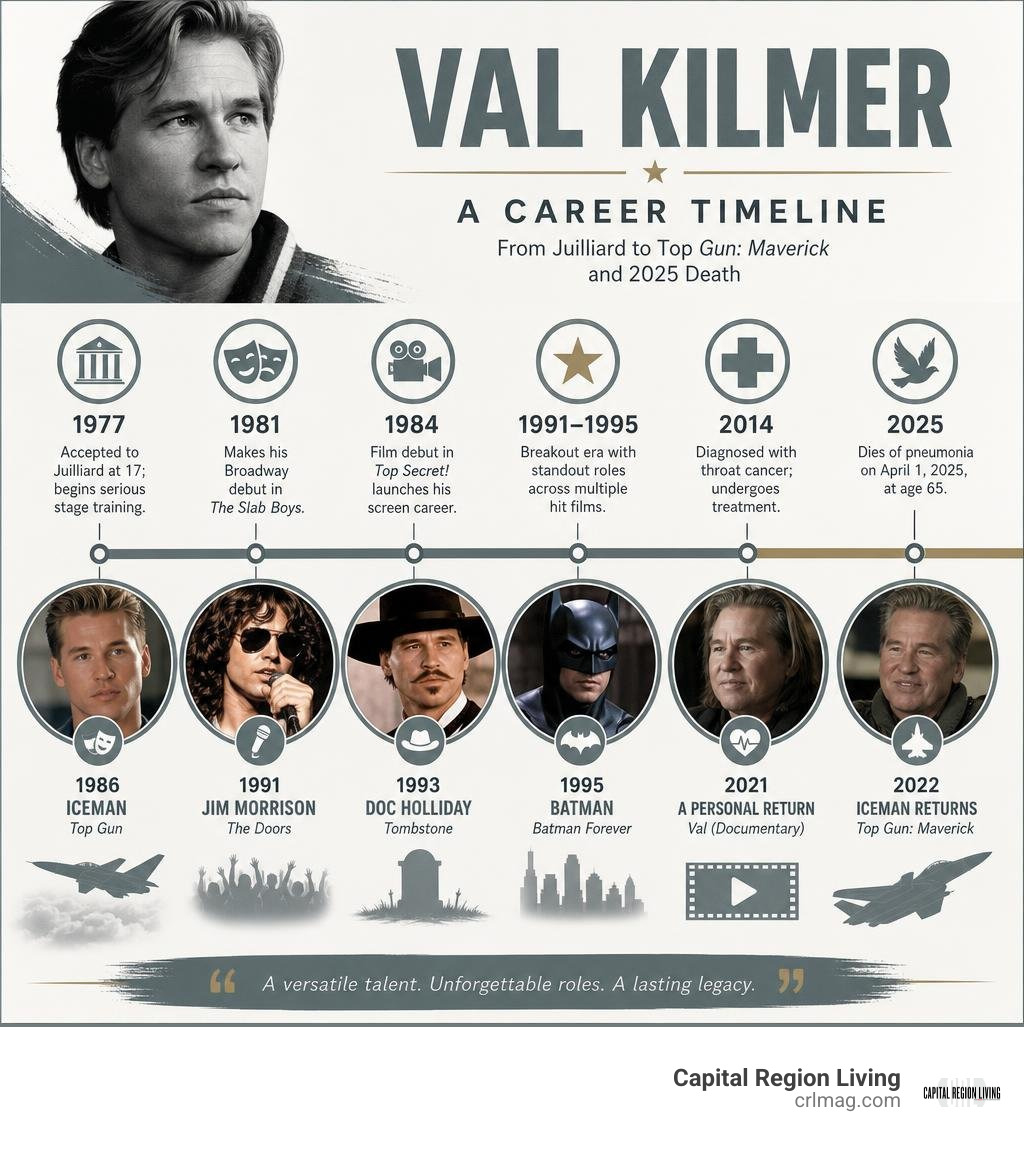
Val Kilmer was an American actor known for playing Iceman in Top Gun, Jim Morrison in The Doors, Doc Holliday in Tombstone, and Bruce Wayne in Batman Forever. He died of pneumonia on April 1, 2025, at age 65, after years of health challenges that followed treatment for throat cancer.
From early stage training at Juilliard – where he was accepted at 17 – Kilmer became one of Hollywood’s most distinctive leading men. His films earned more than $3.85 billion worldwide, spanning broad comedies, westerns, crime dramas, superhero movies, and major blockbusters.
His career also carried contradictions. Kilmer’s deep commitment to roles created unforgettable performances, but it also contributed to reports of difficult working relationships. In his later years, cancer permanently changed his voice, yet he returned as Iceman in Top Gun: Maverick, giving audiences a moving final reminder of his screen presence.
This guide looks at the work, conflicts, health battle, final projects, and tributes that shaped Val Kilmer’s enduring place in film history.
The Life and Career Milestones of Val Kilmer
Kilmer built an expansive catalog of performances that grossed over $3.85 billion globally across four decades. From his early theater training to commanding multimillion-dollar production budgets, he moved fluidly across genres that few actors could navigate with equal authority.
| Movie Title | Release Year | Iconic Role | Worldwide Box Office Gross |
|---|---|---|---|
| Top Gun | 1986 | Tom “Iceman” Kazansky | $344+ Million |
| The Doors | 1991 | Jim Morrison | $34.4 Million |
| Tombstone | 1993 | Doc Holliday | $56.5 Million |
| Batman Forever | 1995 | Bruce Wayne / Batman | $336.5 Million |
| Heat | 1995 | Chris Shiherlis | $187.4 Million |
| The Saint | 1997 | Simon Templar | $169.4 Million |
| The Prince of Egypt | 1998 | Moses / God (Voice) | $218.6 Million |
| Top Gun: Maverick | 2022 | Admiral Tom “Iceman” Kazansky | $1.49+ Billion |
For comprehensive overviews of his major film credits, you can explore the Val Kilmer | Movies, Batman, Death, Tombstone, & Facts | Britannica entry to review his full cinematic history.
Early Training and Breakout Roles for Val Kilmer
Born on December 31, 1959, Kilmer demonstrated a fierce dedication to acting early on. At 17, he became the youngest person accepted into the Drama Division at the Juilliard School. While studying in New York, he helped co-author the stage play How It All Began and made his Broadway debut alongside Kevin Bacon and Sean Penn in 1983’s Slab Boys.
His transition to Hollywood was anything but traditional. He made his feature film debut leading the 1984 Zucker, Abrahams, and Zucker spoof Top Secret!, where he performed all of his own musical numbers as rock star Nick Rivers (even releasing a vinyl album under the moniker). After headlining the 1985 cult comedy Real Genius, director Tony Scott cast him as Tom “Iceman” Kazansky opposite Tom Cruise in 1986’s Top Gun. While Kilmer was initially reluctant to take the role, Scott expanded the character, and the film went on to gross over $344 million worldwide, launching Kilmer into the cinematic stratosphere.
Peak 1990s Stardom: From The Doors to Batman Forever
During the 1990s, Kilmer delivered some of his most transformative work. To play rock icon Jim Morrison in Oliver Stone’s 1991 biopic The Doors, Kilmer spent nearly a year living in Morrison’s signature leather pants, memorizing 50 songs, and copying every stage movement. He recorded the vocals himself, producing tracks so exact that original band members could not distinguish his singing from Morrison’s own tapes.
In 1993, Kilmer turned in what many consider his finest performance as the quick-witted, tuberculosis-stricken Doc Holliday in Tombstone. Despite not knowing how to play the piano, he spent months practicing Chopin’s Nocturne in E minor, Op. 72, No. 1 just to perform it during a single brief scene.
By 1995, Kilmer took over the cape and cowl as Bruce Wayne in Batman Forever, earning praise from Batman co-creator Bob Kane as the most faithful live-action interpretation up to that era. That same year, he starred as getaway driver Chris Shiherlis alongside Al Pacino and Robert De Niro in Michael Mann’s crime classic Heat. He commanded a $6 million salary for 1997’s espionage thriller The Saint, cementing his status as one of Hollywood’s premier box-office draws.
Hollywood Reputation: Artistic Intensity vs. Industry Clashes
Kilmer’s creative intensity was a double-edged sword. To his supporters, he was an uncompromising artist chasing perfection; to his detractors, he was an unpredictable force who frequently questioned directorial choices. As documented in the Val Kilmer obituary: A difficult man but a brilliant actor published by the BBC, Kilmer maintained that he was simply “challenging” rather than difficult, always pushing material to be better.
On-Set Conflicts with Directors
Kilmer’s perfectionism occasionally led to explosive friction with studio executives and directors. During the production of Batman Forever, director Joel Schumacher found Kilmer’s brooding approach and pushback over the character’s emotional depth difficult to manage. Kilmer opted not to return for 1997’s Batman & Robin, choosing The Saint instead due to scheduling conflicts and creative dissatisfaction with how the superhero had been marginalized on screen.
Tensions reached an absolute boiling point on the chaotic 1996 set of The Island of Dr. Moreau. After initial director Richard Stanley was fired, veteran filmmaker John Frankenheimer clashed openly with Kilmer, culminating in public spats that fed tabloid headlines for years.
Protective Mentorship and Praise from Co-Stars
While certain directors struggled with his intense process, Kilmer was widely revered by fellow actors. Co-stars such as Mira Sorvino, Drew Barrymore, and Kurt Russell praised his craft, generosity, and work ethic.
During the filming of the 2010 drama Bloodworth, Kilmer stepped in when co-star Hilarie Burton felt uncomfortable with a gratuitous sex scene. Kilmer spoke with the director and had the scene replaced with an intimate conversation where their characters simply shared barbecue ribs. Legendary film critic Roger Ebert regularly came to his defense, writing in 1992 that Kilmer was “the most unsung leading man of his generation.”
Health Battles, Vocal Loss, and Generative AI Legacy
Kilmer’s later life was defined by quiet resilience in the face of profound medical challenges. Raised as a Christian Scientist, Kilmer long possessed a nuanced view of spiritual prayer and medical science. When faced with advanced throat cancer, he made the decision to undergo standard medical interventions for the sake of his two children, Mercedes and Jack.

Throat Cancer Diagnosis and Val Kilmer in Top Gun: Maverick
Kilmer was diagnosed with throat cancer in 2015. His treatments included rounds of chemotherapy, radiation, and two tracheotomies. While the procedures successfully put the cancer into remission, they permanently scarred his vocal cords, leaving him unable to speak without a tracheostomy tube and an electric voice box.
Detailed overviews of his life and career can be found on Val Kilmer, documenting his resilience and artistic pursuits. His condition was captured intimately in the 2021 A24/Amazon documentary Val, which utilized decades of Kilmer’s personal home video archives.
Despite his vocal challenges, Tom Cruise insisted that Kilmer return for 2022’s Top Gun: Maverick. Director Joseph Kosinski wrote Kilmer’s real-life health condition directly into the script, giving audiences a tender reunion between Maverick and Admiral Iceman. The film grossed nearly $1.5 billion worldwide, revitalizing theatrical cinema and offering Kilmer a triumphant curtain call.
Voice Synthesis Technology and Final Projects
To communicate and explore new artistic territory, Kilmer partnered with software developer Sonantic in 2021. By analyzing hours of his archival audio, the team created more than 40 digital AI vocal variations that modeled his original speaking voice.
This voice restoration opened new frontiers in digital performance preservation. For his final posthumous project As Deep as the Grave, Kilmer’s family authorized the use of generative digital modeling and synthetic voice tools to complete his performance, showing how technology can preserve an actor’s craft for future generations.
Final Years, Death in April 2025, and Lasting Cultural Impact
On April 1, 2025, Kilmer passed away at Ronald Reagan UCLA Medical Center in Los Angeles at the age of 65. The cause of death was pneumonia, compounded by long-term respiratory strain from his prior cancer treatments.
Hollywood paid tribute immediately. Tom Cruise shared heartfelt praise for his lifelong friend, calling him a fearless artist who elevated everyone around him. Beyond acting, Kilmer had spent his later years focusing on fine arts, operating a 6,000-acre ranch in New Mexico for many years and launching “Kamp Kilmer,” a creative community space supporting visual artists and experimental digital media.
Frequently Asked Questions About Val Kilmer
What was Val Kilmer’s cause of death?
Kilmer died on April 1, 2025, at age 65 at Ronald Reagan UCLA Medical Center in Los Angeles. His death was caused by pneumonia alongside underlying respiratory complications from his throat cancer treatments.
Did Val Kilmer use AI for his voice in Top Gun: Maverick?
While Kilmer worked with Sonantic to create AI voice models, director Joseph Kosinski confirmed that Top Gun: Maverick did not use generative voice synthesis. Instead, Kilmer recorded his lines on set using his authentic speaking voice, which was digitally cleaned up and enhanced in post-production.
What were Val Kilmer’s highest-grossing movies?
Kilmer’s films grossed over $3.85 billion worldwide. His highest-earning titles include Top Gun: Maverick ($1.49+ billion), Top Gun ($344 million), Batman Forever ($336.5 million), The Prince of Egypt ($218.6 million), Heat ($187.4 million), and The Saint ($169.4 million).
Conclusion
Val Kilmer remains one of American cinema’s most fascinating and versatile performers. Whether embodying rock royalty in The Doors, delivering iconic one-liners in Tombstone, or returning to the skies in Top Gun: Maverick, he approached every project with raw artistic dedication. His fearless career continues to inspire filmmakers, actors, and audiences worldwide.
At Capital Region Living Magazine, we love celebrating extraordinary cultural stories that stand the test of time. While you reflect on Hollywood’s greatest cinematic talents, take time to explore our regional lifestyle pieces, including the unlikely rise of Voorheesville’s restaurant scene to see how local culinary artists are making their own mark.