Ellen DeGeneres: A Quick Look at Her Life and Career
Ellen DeGeneres is an American comedian, actor, producer, and former daytime TV host whose career changed both popular entertainment and LGBTQ+ visibility on network television.
At a glance, she is known for:
- Building a stand-up career after growing up in Metairie, Louisiana
- Making television history by coming out publicly in 1997 and portraying a gay lead character on Ellen
- Hosting The Ellen DeGeneres Show for 19 seasons, from 2003 to 2022
- Voicing the beloved character Dory in Pixar’s Finding Nemo and Finding Dory
- Winning 33 Daytime Emmy Awards for her talk show and 20 People’s Choice Awards
- Facing major workplace-culture allegations in 2020, followed by the end of her talk show and her 2024 retirement from show business
Her story is not a simple rise-to-fame tale. It includes barrier-breaking work, a powerful daytime-TV brand, charitable efforts, public backlash, and a major shift away from Hollywood. In 2026, DeGeneres is also reported to be living in England’s Cotswolds with her wife, Portia de Rossi, while returning briefly to voice Dory in a new Finding Nemo franchise short.
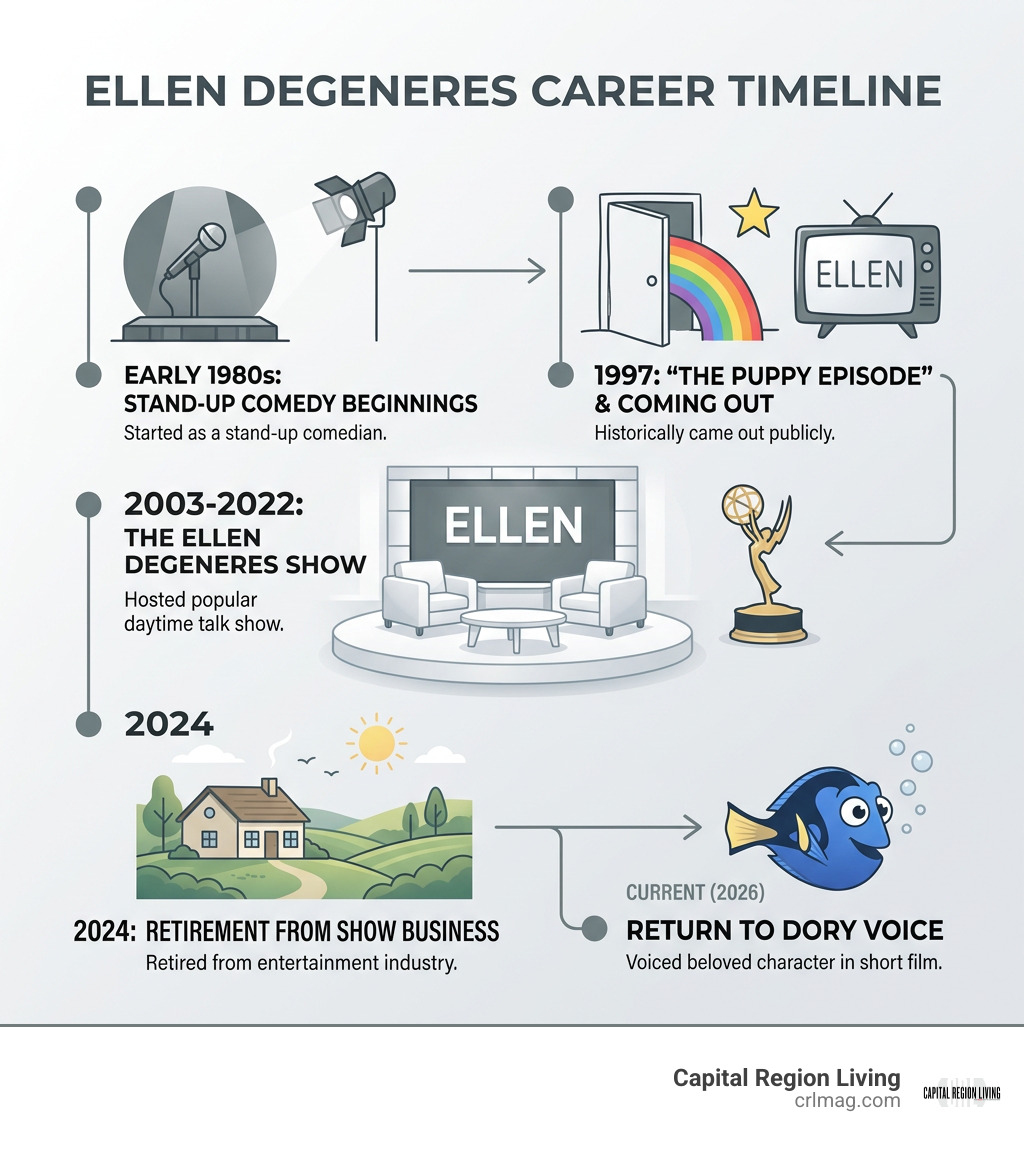
Ellen degeneres glossary:
Early Life, Stand-Up Comedy, and the Rise of Ellen DeGeneres
Long before becoming a household name across America, Ellen Lee DeGeneres spent her formative years navigating a modest childhood in the South. Born on January 26, 1958, in Metairie, Louisiana—a suburb of New Orleans—she was raised by her mother, Betty, an insurance agent, and her father, Elliott, an insurance salesman. Following her parents’ divorce during her teenage years, she moved to Atlanta, Texas, with her mother and stepfather.
Her youth was marked by significant emotional challenges, including personal trauma that she later spoke candidly about in interviews. To cope with difficult family dynamics, DeGeneres turned to humor as a protective mechanism, learning early on that making people laugh could soften tense situations and build immediate connections.
After graduating from Atlanta High School in 1976, she returned to Louisiana to attend the University of New Orleans, majoring in communication studies. However, academic life did not hold her interest for long. She left after one semester to enter the workforce, taking on a wide range of odd jobs:
- Working as a waitress at TGI Fridays
- Painting houses and doing clerical work
- Selling vacuum cleaners and working as a clothing salesperson
It was during these early years that she discovered her natural talent on stage. Her professional start took root in 1981 when she began emceeing and performing regularly at Clyde’s Comedy Club in New Orleans. Her big break arrived in 1982 when her videotaped stand-up audition earned her the title of Showtime’s “Funniest Person in America.”
Her national momentum exploded on November 28, 1986, when she appeared on The Tonight Show Starring Johnny Carson. Following her acclaimed observational performance, Carson called her over to sit on his famous couch—making her the first female stand-up comedian in the show’s history to receive that coveted honor during a debut appearance. To explore more about her early career history and milestones, you can check her Biographical profile on Britannica.
Breakthrough in Stand-Up and Early Television Roles
Following her career-defining performance on The Tonight Show, DeGeneres toured extensively across the country. Her comedy style differed noticeably from many of her contemporaries in the late 1980s. Rather than relying on insult comedy or shock value, she built her routine on clean, quirky, and self-deprecating observational humor. Critics frequently compared her warm, rambling delivery to comedy legend Bob Newhart.
By the late 1980s and early 1990s, television networks began taking notice of her star power. She landed supporting roles in short-lived television sitcoms like Open House (1989–1990) and Laurie Hill (1992). Her natural charm in Laurie Hill impressed producers so much that ABC greenlit a tailored star vehicle for her called These Friends of Mine in 1994, which was renamed Ellen in its second season.
The sitcom was an immediate hit with audiences, showcasing her signature wit and relatable comedic timing. For three seasons, the show maintained solid ratings, establishing DeGeneres as one of network television’s top comedic talents.
The Historic 1997 Coming Out Moment

By 1997, DeGeneres was at the height of her broadcast career, but she made the brave decision to align her public career with her personal truth. In April 1997, she appeared on the cover of Time magazine beside the famous headline: “Yep, I’m Gay.”
Simultaneously, her fictional television character, Ellen Morgan, came out as a lesbian in a special two-part episode of Ellen titled “The Puppy Episode,” which aired on April 30, 1997. This marked the very first time an openly gay lead actor played an openly gay character on an American prime-time network series.
The cultural impact of the broadcast was seismic:
- An estimated 46 million viewers tuned in to watch “The Puppy Episode,” making it one of the highest-rated network sitcom episodes of the decade.
- The episode won a Peabody Award and a Primetime Emmy Award for Outstanding Writing.
- It sparked intense media debate and public advocacy regarding LGBTQ+ visibility in popular culture.
Despite the critical praise and historic rating numbers, the immediate aftermath created severe career setbacks. Conservative groups threatened boycotts, ABC attached parental advisory warnings to subsequent episodes, and advertisers pulled their commercial support. ABC canceled Ellen in May 1998, and DeGeneres found herself largely sidelined by major Hollywood studios for several years, demonstrating both the immense cost and courage of her decision.
The Daytime Empire: Success, Awards, and Humanitarian Work
After a brief return to prime-time television with the CBS sitcom The Ellen Show (2001–2002), DeGeneres reinvented her career by moving to daytime television. On September 8, 2003, The Ellen DeGeneres Show debuted in syndication. The series revitalized the daytime talk format, replacing traditional conflict-driven drama with lighthearted celebrity interviews, musical numbers, playful audience games, and her signature opening dance routines.
The program became a massive ratings success and a cultural staple over its 19-season run, broadcasting 3,294 episodes through May 2022. It became a required stop for A-list celebrities, musicians, world leaders, and viral internet personalities.
Throughout her television reign, DeGeneres earned some of the country’s most prestigious cultural honors:
- Mark Twain Prize for American Humor (2012): Awarded by the Kennedy Center in recognition of her lasting contributions to American comedy.
- Presidential Medal of Freedom (2016): Presented by President Barack Obama at the White House for her courage in advancing civil rights and entertainment.
| Award / Honor | Years Received / Highlights | Significance & Context |
|---|---|---|
| Daytime Emmy Awards | 33 Total Wins (2003–2022) | Most Emmy wins for a daytime talk show; won Outstanding Talk Show in its first 3 consecutive seasons |
| People’s Choice Awards | 20 Total Wins | More wins than any other individual in the award show’s history |
| Peabody Award | 1997 | Awarded for groundbreaking storytelling in Ellen (“The Puppy Episode”) |
| Mark Twain Prize | 2012 | Presented by the Kennedy Center for her lifelong influence on American comedy |
| Presidential Medal of Freedom | 2016 | Highest civilian honor in the U.S., awarded for societal and cultural impact |
| Saturn Award | 2004 | Best Supporting Actress for voicing Dory in Finding Nemo (rare voice-acting win) |
Record-Breaking Daytime Emmy Wins for Ellen DeGeneres
During its nearly two decades on the air, The Ellen DeGeneres Show dominated industry award ceremonies. The series received a record 33 Daytime Emmy Awards, setting a standard for daytime television production. In its first three seasons alone, it swept the Outstanding Talk Show category, a feat never before accomplished by a daytime talk show.
Her popularity with television audiences was equally evident at the People’s Choice Awards, where she amassed 20 individual trophies, surpassing every other entertainer in the history of the event.
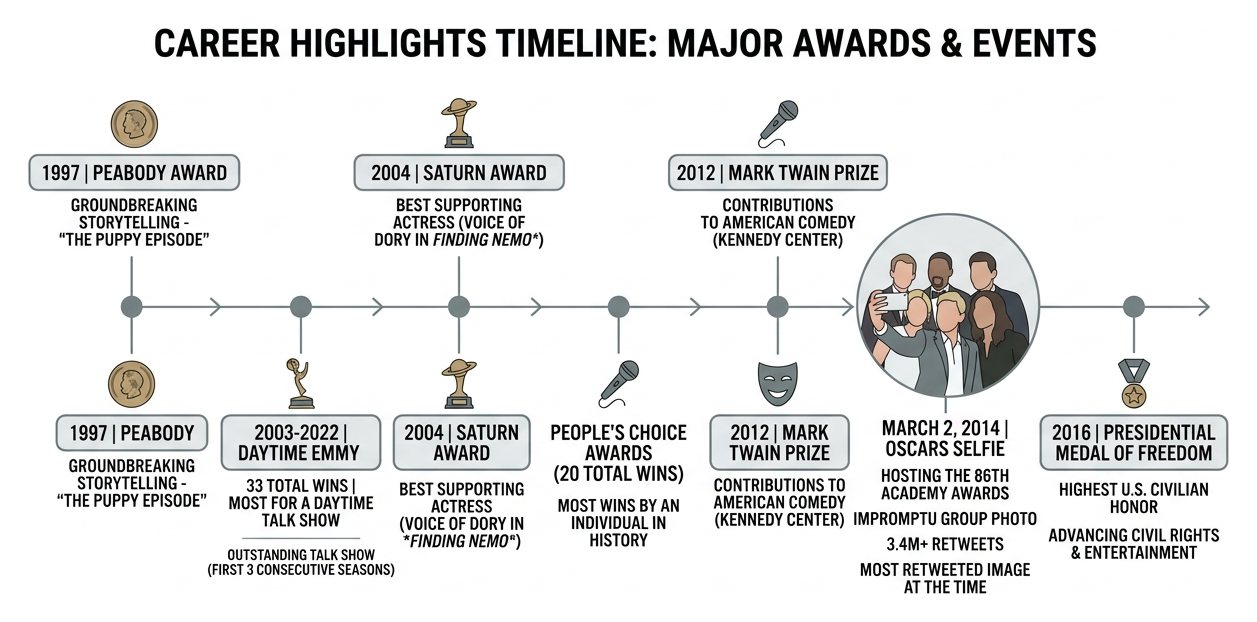
Beyond daytime TV broadcasts, DeGeneres demonstrated unmatched cultural reach through digital media. While hosting the 86th Academy Awards on March 2, 2014, she gathered an ensemble of top Hollywood actors—including Meryl Streep, Bradley Cooper, Julia Roberts, and Brad Pitt—to take an impromptu group photo. The resulting “Oscars selfie” was retweeted more than 3.4 million times, temporarily crashing Twitter servers and holding the record for the most retweeted image in social media history for years.
Iconic Film Roles, Voicing Dory, and Hosting Major Events
While her talk show was her main daily platform, DeGeneres also established herself in feature film and live event hosting:
- Voicing Dory in Pixar’s Animated Universe: In 2003, she voiced Dory, a blue tang fish with short-term memory loss, in Disney/Pixar’s animated feature Finding Nemo. Her endearing performance earned universal acclaim and a Saturn Award—one of the few times an actor won a major film performance award for voice acting alone. She reprised the character as the title lead in the 2016 sequel Finding Dory, which grossed over $1 billion worldwide.
- Hosting Top Entertainment Telecasts: She is one of the few performers to host the Academy Awards (2007 and 2014), the Primetime Emmy Awards (2001 and 2005), and the Grammy Awards (1996 and 1997). Her hosting of the 2001 Primetime Emmys—held shortly after the September 11 terror attacks—garnered praise for its thoughtful blend of gentle humor and emotional sensitivity.
- Philanthropy and Disaster Relief: Leveraging her daily platform, she raised over $10 million for Hurricane Katrina relief in her home state of Louisiana. Over her career, she helped direct more than $50 million to charities supporting animal welfare, anti-bullying efforts, cancer research, and global AIDS initiatives.
Workplace Allegations, Controversy, and the End of the Show
Despite her public brand slogan, “Be Kind,” the atmosphere surrounding the show shifted dramatically in 2020. Public criticism began in March 2020 when comedian Kevin T. Porter started a viral Twitter thread asking users to share stories of DeGeneres being unkind, offering to donate money to a Los Angeles food bank for each story shared. The thread quickly received thousands of responses containing allegations about her behavior.
The situation expanded significantly in July 2020 when BuzzFeed News published a series of investigative reports containing detailed accounts from dozens of former and current employees. The articles detailed systemic workplace issues:
- A culture of workplace bullying, intimidation, and fear
- Allegations of racial microaggressions and insensitive comments by senior producers
- Claims of executive sexual misconduct and harassment directed at lower-level staff members
In response to the growing public backlash, parent company WarnerMedia launched an internal investigation into the production environment. While the investigation did not directly implicate DeGeneres in sexual misconduct, it confirmed structural cultural failures, resulting in the termination of three top executive producers in August 2020.
The Toxic Workplace Controversy Surrounding Ellen DeGeneres
When Season 18 premiered in September 2020, DeGeneres opened the broadcast with an on-air apology, taking responsibility for issues occurring under her name. She admitted that being known as the “Be Kind” lady had placed her in a box where she felt pressured to maintain a polished public image while failing to catch internal operational issues behind the scenes.
However, the public reaction was severe. The controversy significantly damaged her reputation and led to a sharp drop in viewership. During the 2020–2021 television season, The Ellen DeGeneres Show lost over one million daily viewers, representing an unprecedented 43% decline in audience retention.
Show Business Retirement and Departure from Departure from Daytime TV
In May 2021, DeGeneres announced that the show’s upcoming 19th season would be its last. While she publicly stated that her decision was driven by a desire for new creative challenges, media analysts widely connected the conclusion to declining ratings and the ongoing toxic workplace controversy.
The series finale aired on May 26, 2022, featuring retrospective clips and high-profile guests like Jennifer Aniston, Billie Eilish, and Pink.
Following the talk show’s end, DeGeneres largely stepped away from public life before embarking on a final stand-up comedy tour in mid-2024 titled Ellen’s Last Stand… Up. During the tour, she addressed the controversy directly with her signature humor, reflecting on her rise, her public fall, and her exit from the industry. She recorded her final Netflix stand-up special, For Your Approval, in mid-2024, announcing that it would mark her official retirement from show business and public stand-up comedy.
Current Status in 2026: UK Relocation and Returning as Dory
In late 2024, DeGeneres made headlines by moving across the Atlantic. Seeking privacy and a complete departure from Southern California, she and her wife, actor Portia de Rossi, relocated to the picturesque Cotswolds region in South West England. They listed and sold several of their high-profile California real estate properties—including their expansive Carpinteria estate for $96 million—to establish a permanent residency in the UK countryside.
Her financial standing remains substantial; financial publications listed her net worth at approximately $370 million (£363 million), backed by her decades of television production earnings, real estate trading, and consumer lifestyle product partnerships.
Although she announced her retirement from stand-up and broadcast television, 2026 brought a brief return to the recording booth. DeGeneres returned to voice Dory for a special Pixar animated short film within the Finding Nemo franchise. Aside from this vocal recording, she maintains a quiet life in England, focusing on personal projects, animal rights support, and international property restoration. To read more details about her personal history and career credits, visit her Overview on Wikipedia.
Frequently Asked Questions About Ellen DeGeneres
When did Ellen DeGeneres publicly come out?
Ellen DeGeneres publicly came out as a lesbian in April 1997. She made her announcement on the cover of Time magazine with the headline “Yep, I’m Gay.” Later that month, her character on the ABC sitcom Ellen came out in “The Puppy Episode,” which attracted 46 million viewers and marked a major turning point for LGBTQ+ representation on American network television.
Why did The Ellen DeGeneres Show end in 2022?
The Ellen DeGeneres Show ended its 19-season run in May 2022 following a series of detailed workplace allegations published in 2020. Investigations revealed a toxic workplace culture, executive misconduct, and employee harassment, which resulted in an internal WarnerMedia probe, executive turnover, and a dramatic drop in daily ratings. DeGeneres subsequently decided to conclude the program at the end of her contract.
Where does Ellen DeGeneres live now in 2026?
As of 2026, Ellen DeGeneres lives in the Cotswolds region of England in the United Kingdom alongside her wife, Portia de Rossi. The couple relocated to the English countryside in late 2024 after selling off the majority of their real estate portfolio in California.
Conclusion
Ellen DeGeneres’ legacy in American entertainment is both complex and undeniable. From her early beginnings in Louisiana stand-up clubs to making network history in 1997, she opened doors for LGBTQ+ performers and helped reshape prime-time television. Her subsequent 19-season reign on daytime TV cemented her status as one of pop culture’s most influential hosts, bringing comedy, celebrity culture, and philanthropy to millions of homes every day.
While workplace allegations in 2020 forever altered her public image and hastened the end of her broadcast empire, her impact on television history and mainstream representation remains profound. Today, enjoying a quiet retirement in the United Kingdom, her career stands as an extraordinary chapter in modern entertainment culture.
At Capital Region Living, we love bringing you deep dives into pop culture history alongside local stories from our community. Explore regional lifestyle stories and community updates to discover the food, events, and people shaping our own neighborhood.