Why the Manti Te’o Catfishing Scandal Still Matters
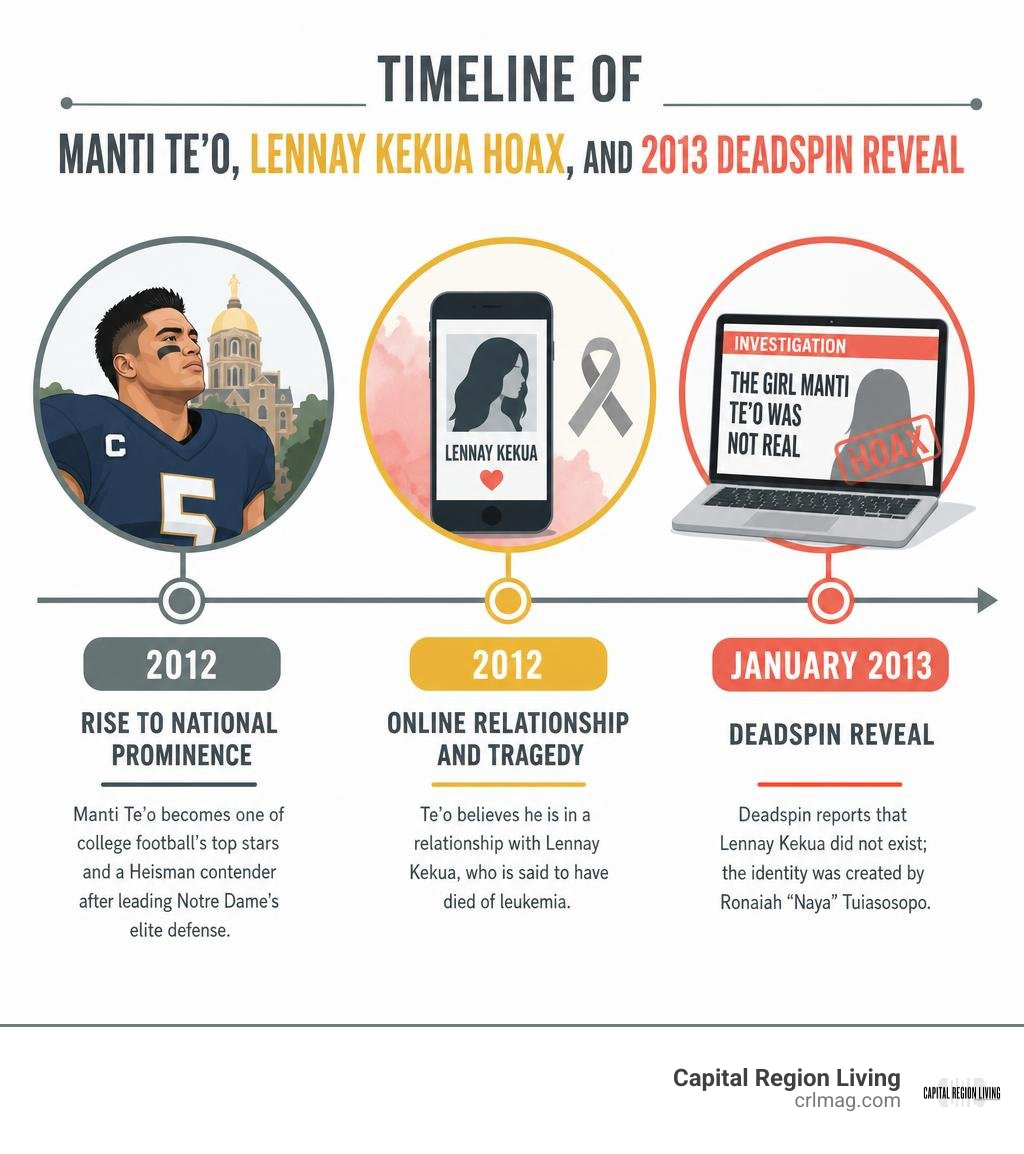
Manti Te’o was a Notre Dame football star who became the victim of a widely publicized online catfishing hoax. In 2012, he believed he was in a relationship with Lennay Kekua, a woman he knew online who was said to have died of leukemia. In January 2013, reporting by Deadspin showed that Kekua did not exist. The identity had been created by Ronaiah “Naya” Tuiasosopo.
The story mattered because it collided with Te’o’s rise as one of college football’s biggest names. He finished second in 2012 Heisman Trophy voting after leading Notre Dame’s elite defense, yet the scandal quickly shifted public attention from his play to questions about whether he had been involved.
This case study explains what happened, why many people initially misunderstood it, and how the episode shaped Te’o’s public image as he entered the NFL.
The Rise and Dominance of Linebacker Manti Te’o
Before headlines turned into late-night punchlines, we knew Manti Te’o as one of the most electric, dominant, and inspiring defensive players in collegiate history. Born in Laie, Hawaii, Te’o grew up in a close-knit family grounded in his Samoan heritage and Latter-day Saint (LDS) faith. He excelled at the prestigious Punahou School in Honolulu, earning national attention as the 2008 Sporting News High School Athlete of the Year—the first high school athlete from Hawaii and the first person of Polynesian descent to receive that specific honor.
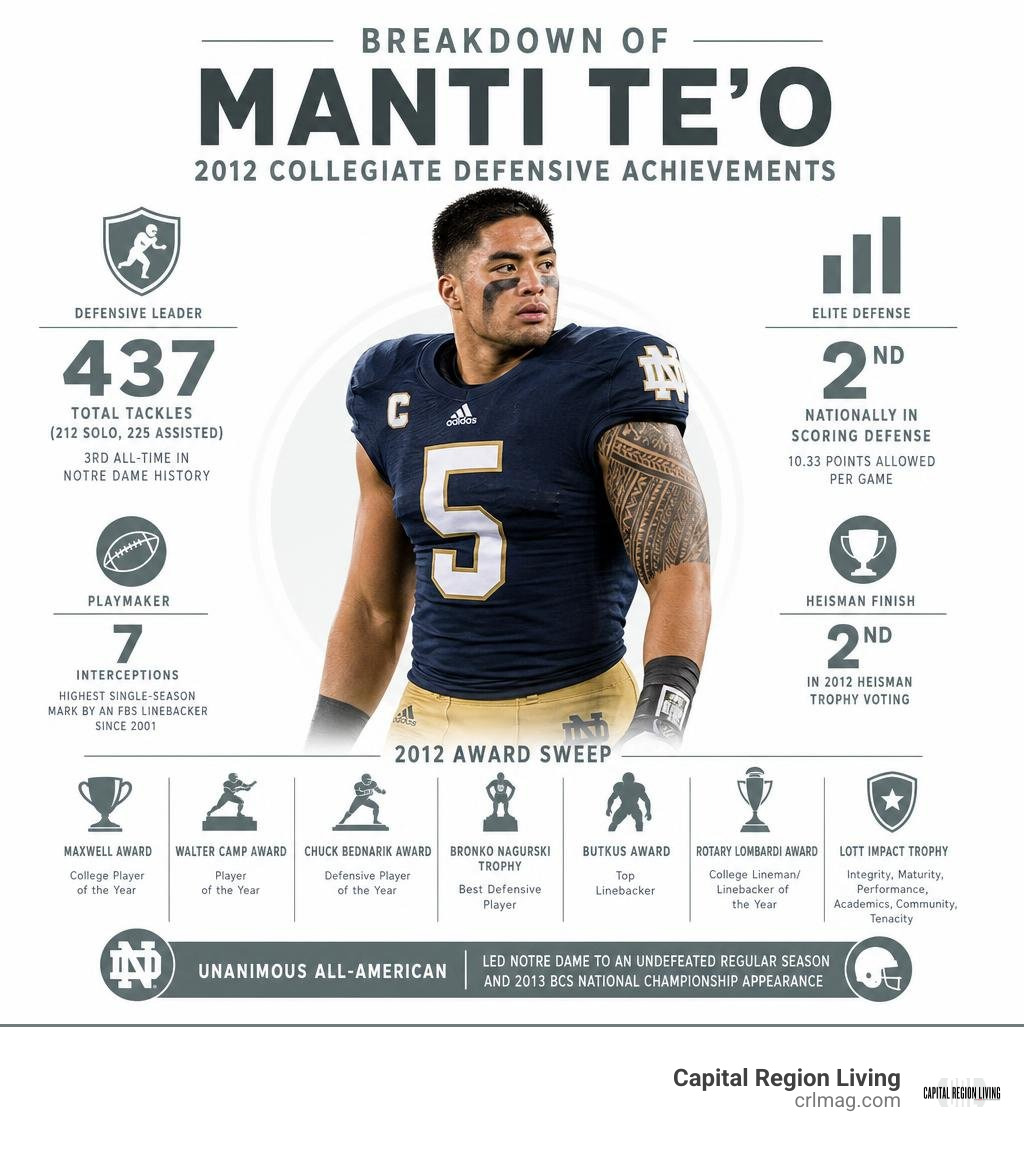
When Te’o committed to the University of Notre Dame, he did not just bring an imposing physical presence; he brought an unwavering work ethic. Over his collegiate career spanning 51 games, Te’o amassed 437 total tackles (212 solo and 225 assisted), placing him third on the Fighting Irish all-time career list. As detailed in the Manti Te’o official college statistics, he demonstrated rare field vision and lateral quickness, anchoring a defense that carried Notre Dame to an undefeated regular season and a berth in the 2013 BCS National Championship Game. In 2012, his unit ranked second nationally in scoring defense, yielding just 10.33 points per contest.
Defensive Accolades of the 2012 Manti Te’o Campaign
The 2012 season turned into a historic individual showcase for the inside linebacker. Te’o pulled down seven interceptions—the highest single-season mark by any NCAA Football Bowl Subdivision (FBS) linebacker since 2001—proving he was far more than an in-the-box run stopper.
His dominant play earned him unanimous All-American honors and saw him sweep almost every major piece of hardware available to a collegiate defender:
- The Maxwell Award (College Player of the Year)
- The Walter Camp Award (Player of the Year)
- The Chuck Bednarik Award (Defensive Player of the Year)
- The Bronko Nagurski Trophy (Best Defensive Player)
- The Butkus Award (Top Linebacker)
- The Rotary Lombardi Award (College Lineman/Linebacker of the Year)
- The Lott IMPACT Trophy (Integrity, Maturity, Performance, Academics, Community, Tenacity)
As outlined in the Manti Teʻo biographical profile, Te’o finished second in the 2012 Heisman Trophy balloting behind Texas A&M quarterback Johnny Manziel. Defensive players almost never break the top two in modern Heisman voting, underscoring how completely he had captured the national imagination.
The Lennay Kekua Hoax: Anatomy of a Digital Scam
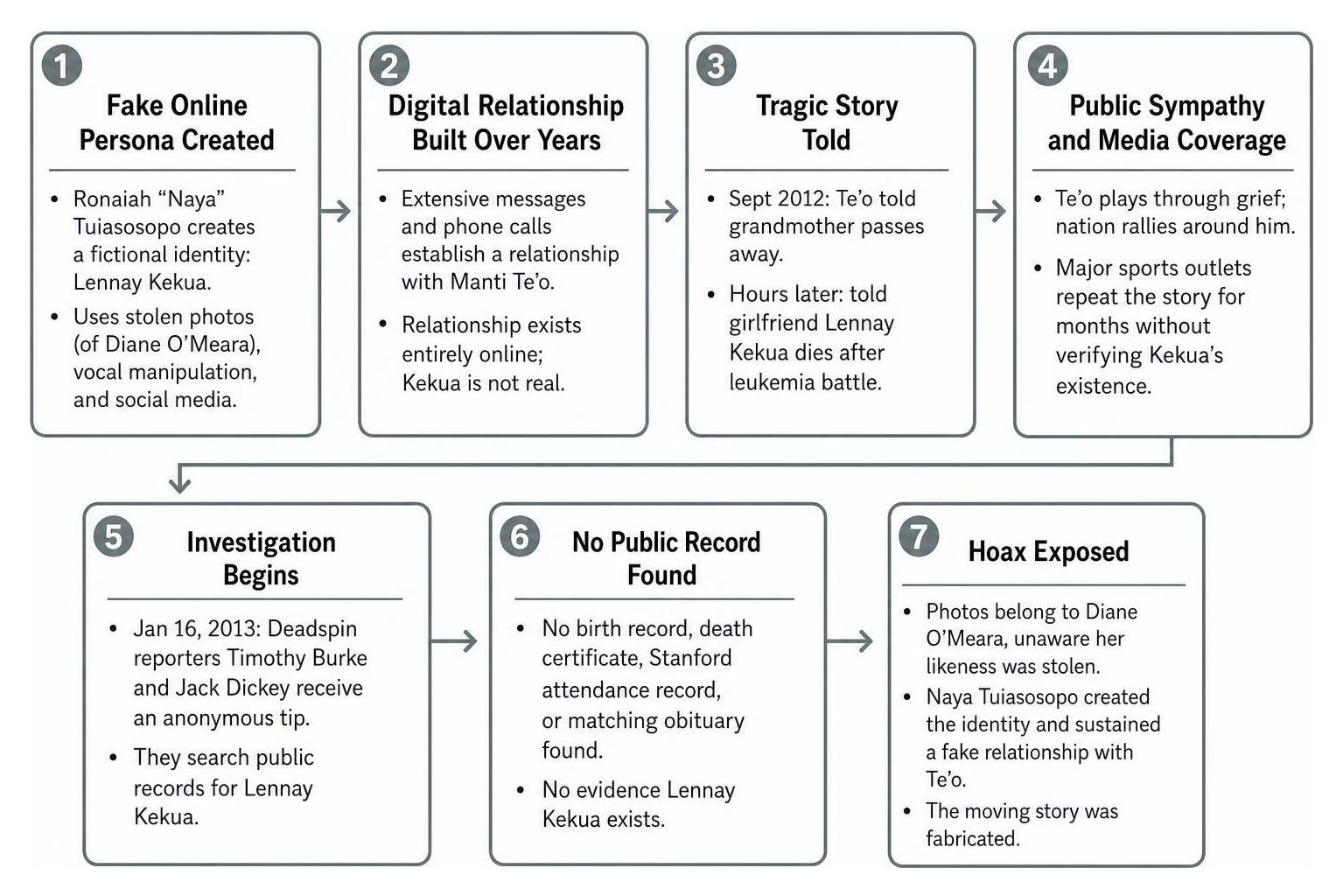
Parallel to his on-field success was an emotional storyline that captivated the nation throughout the autumn of 2012. Media outlets regularly reported that Te’o was playing through unimaginable personal heartbreak. In September 2012, Te’o was told that his maternal grandmother, Annette Santiago, had passed away. Mere hours later, he received word that his girlfriend, a Stanford student named Lennay Kekua, had also died following a battle with leukemia after surviving a serious car crash.
Te’o played on, channeling his grief into inspired performances that fueled Notre Dame’s march toward a national championship appearance. The sports world rallied around him, viewing his composure as a testament to personal strength.
However, beneath this moving tribute lay a fabricated web. The relationship had existed entirely through digital exchanges, social media messages, and extensive phone calls. Kekua was not real.
How Deadspin Uncovered the Fictional Persona
The narrative unraveled on January 16, 2013, when reporters Timothy Burke and Jack Dickey published an investigative report on the sports website Deadspin. Tipped off by an anonymous source, the journalists attempted to locate public records for Lennay Kekua. They found no birth record, no death certificate, no record of attendance at Stanford University, and no obituary matching her details.
The investigation revealed that the photos representing Kekua belonged to a high school acquaintance of Ronaiah “Naya” Tuiasosopo named Diane O’Meara, who had no knowledge her likeness was being stolen. Tuiasosopo had created the fake digital identity, used vocal manipulation over phone calls, and sustained an artificial relationship with Te’o over several years. Major sports journalism networks had repeated the heartwarming narrative for months without independently verifying the public existence of the young woman at the center of the story.
The Public and Emotional Repercussions for Manti Te’o
When the truth broke, public perception swung violently. Because early internet culture in 2013 had far less mainstream familiarity with the mechanics of digital deception—the term “catfishing” had only recently emerged from documentary film into the lexicon—many observers assumed Te’o was complicit in a publicity stunt.
Te’o endured widespread public ridicule, hostile internet memes, and relentless late-night television mockery. High-profile national television interviews, including a sit-down with Katie Couric, scrutinized his honesty and questioned whether he had knowingly fabricated the story to boost his Heisman Trophy campaign. Te’o admitted that once inconsistencies began surfacing in late December 2012, he had repeated claims of meeting her in person out of sheer embarrassment because he feared people would judge him for having an intense online-only relationship.
The emotional toll was immense. It took years, culminating in the 2022 Netflix documentary Untold: The Girlfriend Who Didn’t Exist, for public opinion to fully realign and recognize that Te’o was the victim of a manipulative digital hoax.
NFL Draft Fallout and Professional Playing Career
The media frenzy coincided with the build-up to the 2013 NFL Draft. Evaluators questioned how the national spectacle would affect locker room dynamics, and some scouts expressed concern over his 4.82-second 40-yard dash at the NFL Scouting Combine (which he later improved to the 4.71–4.75 range during his Notre Dame Pro Day).
Originally projected as a surefire mid-to-late first-round selection, Te’o slid into the second round. The San Diego Chargers traded up to select him with the 38th overall pick. While the fall cost him millions in guaranteed rookie contract value, it allowed him to focus entirely on returning to the football field.
According to his Manti Te’o professional defensive metrics, Te’o put together a solid eight-season career in the NFL, appearing in 62 regular season games and making 48 starts across stints with the Chargers, New Orleans Saints, and Chicago Bears.
| Career Level | Games Played | Total Tackles | Sacks | Interceptions | Notable Honors / Career Highs |
|---|---|---|---|---|---|
| Notre Dame (2009–2012) | 51 | 437 | 8.5 | 7 | Heisman Runner-Up (2012), 7 Major National Awards |
| NFL Career (2013–2020) | 62 | 307 | 1.5 | 2 | 2017 Comeback Player Vote-Getter, 13-Tackle Game (2015) |
Professional Stints in San Diego, New Orleans, and Chicago
During his four seasons with the San Diego Chargers (2013–2016), Te’o became a core contributor at inside linebacker. He logged his first career interception against Tom Brady in 2014 and registered a career-high 13 solo tackles against the Cleveland Browns in October 2015. Notably, the first player he ever tackled in college (Colin Kaepernick) was the same quarterback he recorded his first NFL sack against in December 2014.
Te’o joined the New Orleans Saints in 2017, leading the team in tackles for loss during his opening campaign and receiving votes for the AP NFL Comeback Player of the Year award. He concluded his on-field career with the Chicago Bears in 2020. Across his NFL tenure, Te’o logged 307 total regular-season tackles (212 solo, 95 assisted), 1.5 sacks, two interceptions, 13 passes defended, and 31 postseason tackles across five playoff appearances.
Frequently Asked Questions About the Scandal
Who was responsible for creating the Lennay Kekua identity?
The Lennay Kekua identity was created by Ronaiah “Naya” Tuiasosopo. Tuiasosopo established the fake online profile, sourced photographs from a former high school classmate without permission, and sustained the long-distance relationship by altering vocal pitch during phone calls. Tuiasosopo later publicly confessed to orchestrating the entire deception.
How did the controversy impact draft projections?
Prior to the Deadspin investigation and his combine performance, Te’o was widely projected to be chosen in the first round of the 2013 NFL Draft. The intense national media circus, combined with questions surrounding his athletic testing, contributed to a draft slide. The San Diego Chargers selected him in the second round with the 38th overall pick, signing him to a four-year rookie contract.
What ventures occupy the former linebacker today?
Today, Te’o has built a flourishing post-football career. In 2024, he joined NFL Network as an on-air analyst, appearing regularly on Good Morning Football and contributing to major holiday broadcast teams. Alongside his media career, he manages real estate investments through his company, Te’o Legacy, and advocates for athlete mental health through wellness organizations. He resides with his wife, Jovi Nicole Engbino, and their children.
Conclusion
The story of Manti Te’o remains one of the most instructive case studies in the intersection of digital vulnerability, viral media cycles, and modern athletics. It exposed how unverified narratives could sweep through major newsrooms, while highlighting the human reality of a young athlete who navigated severe personal humiliation with grace and resilience.
Today, Te’o stands as a respected voice in sports broadcasting and a symbol of personal perseverance. For more inspiring sports profiles, local community highlights, and exciting regional athletic highlights and local gatherings, stay connected with our ongoing coverage at Capital Region Living Magazine.