What Are Fulani Braids and How Can You Style Them Quickly?
Fulani braids are an iconic West African protective style defined by a signature central cornrow, side-flowing cornrows braided forward toward the face, and loose individual braids in the back. Often adorned with beads, cowrie shells, or metallic cuffs, this look combines scalp protection with versatile styling.
To switch up your Fulani braids in under two minutes:
- Half-Up Topknot: Gather the top cornrows into a high bun at your crown while letting the back plaits hang loose.
- Side-Swept Drape: Sweep all braids over one shoulder to highlight your cheekbones and decorative temple beads.
- Low Regal Ponytail: Pull the braids back to the nape of your neck and wrap one braid around the base to hide the elastic.
- High Volume Bun: Twist the full length of your braids upward into a neat, high updo to keep hair off your neck.
- Flip-Over Restyle: Shift your side plaits across the center line for an instant volume boost and asymmetrical shape.
Originating with the nomadic Fula (Fulani) people across West and Central Africa, these braids carry a rich history of cultural identity, status, and artistry. Today, they remain one of the most popular protective styles because they keep your natural hair tucked away, retain moisture, and transition effortlessly from casual workdays to formal weekend outings.
Cultural Origins and Anatomy of Traditional African Braiding
To truly appreciate the beauty of this hairstyle, we have to look back at its deep historical roots. Fulani braids originate from the nomadic Fulani (or Fula) ethnic group, who historically inhabited vast stretches across West and Central Africa, including modern-day Senegal, Mali, Guinea, Nigeria, and Cameroon. For generations, hair was never merely cosmetic; it served as a visual language communicating community standing, marital status, wealth, and spiritual heritage.
Historically, traditional Senegalese Peulh women wore their hair plaited into intricate patterns featuring at least five distinct sections. These sections either hung freely or looped softly along the sides before converging into an ornate crown or central bun. The inclusion of cowrie shells, wooden beads, coins, and silver ornaments reflected familial prosperity and personal pride. The gentle clicking sound of these adornments moving with each step was an intentional, rhythmic expression of grace.
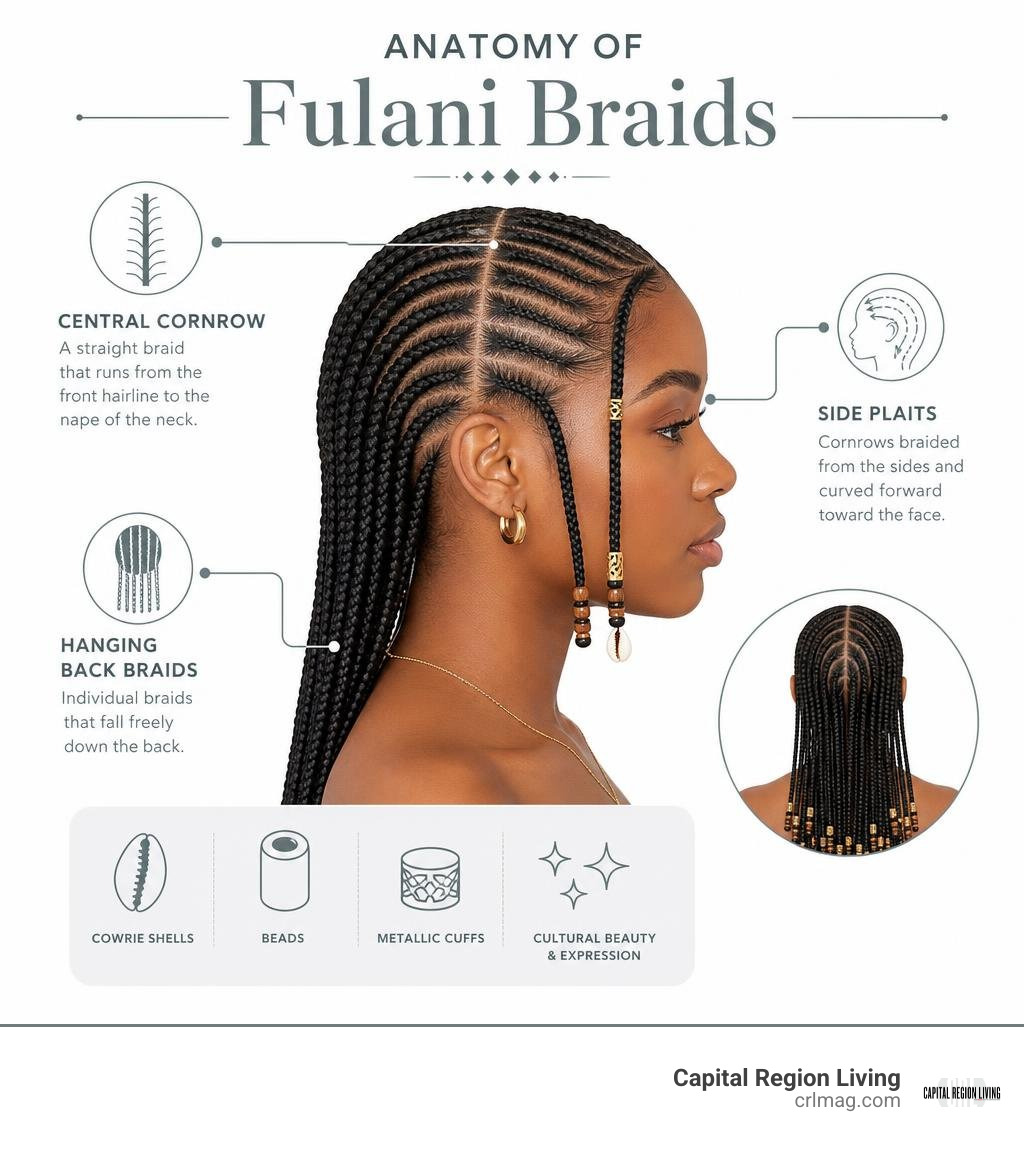
The core structural identity of the style relies on a symmetrical anatomy:
- The Central Anchor: A razor-sharp cornrow braided directly down the center line of the scalp, running from the hairline back toward the crown or nape.
- Forward-Facing Temple Braids: Distinct cornrows braided on either side of the head that curve forward toward the temples, allowing individual strands to hang in front of the ears.
- The Crown & Nape Base: A transition at the mid-scalp where cornrows either meet or give way to loose, cascading box braids or knotless individual plaits.
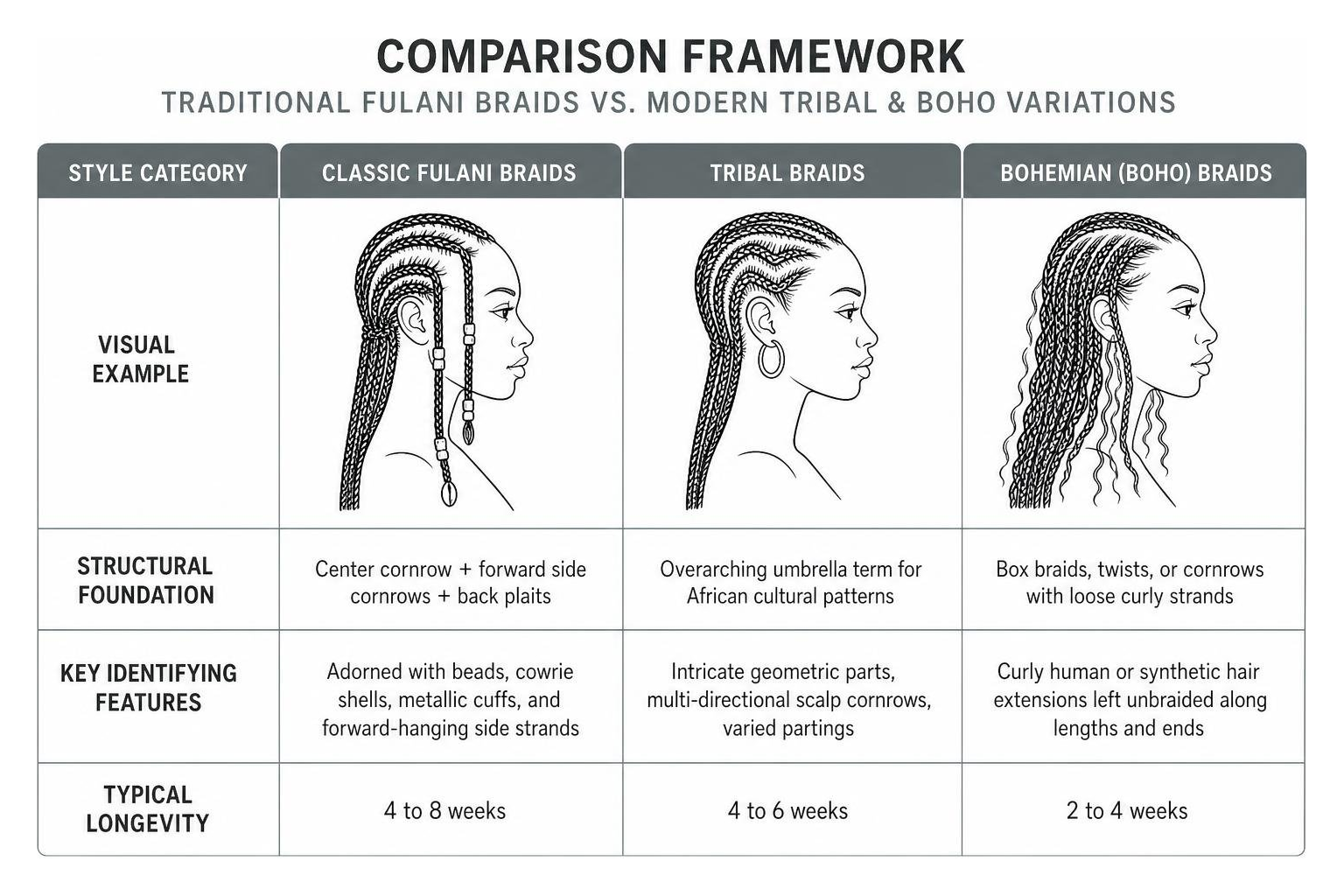
Many people wonder how this traditional look compares to other popular protective options. While modern stylists celebrate Fulani tribal braids: the complete style guide as a distinct art form, clients often mix up related braiding categories:
| Style Category | Structural Foundation | Key Identifying Features | Typical Longevity |
|---|---|---|---|
| Classic Fulani Braids | Center cornrow + forward side cornrows + back plaits | Adorned with beads, cowrie shells, metallic cuffs, and forward-hanging side strands | 4 to 8 weeks |
| Tribal Braids | Overarching umbrella term for African cultural patterns | Intricate geometric parts, multi-directional scalp cornrows, varied partings | 4 to 6 weeks |
| Bohemian (Boho) Braids | Box braids, twists, or cornrows with loose curly strands | Curly human or synthetic hair extensions left unbraided along lengths and ends | 2 to 4 weeks |
As a hybrid protective style, this look gives you the best of both worlds: the sleek, low-profile neatness of cornrows along the scalp combined with the fluid movement and styling freedom of individual hanging braids.
5 Quick Ways to Style Fulani Braids for Any Occasion
One of our favorite things about this style is its incredible versatility. Whether you are heading into an early morning business meeting in downtown Albany, running weekend errands, or attending an evening gallery gala, you can transform your look in just minutes.
1. The Half-Up Topknot
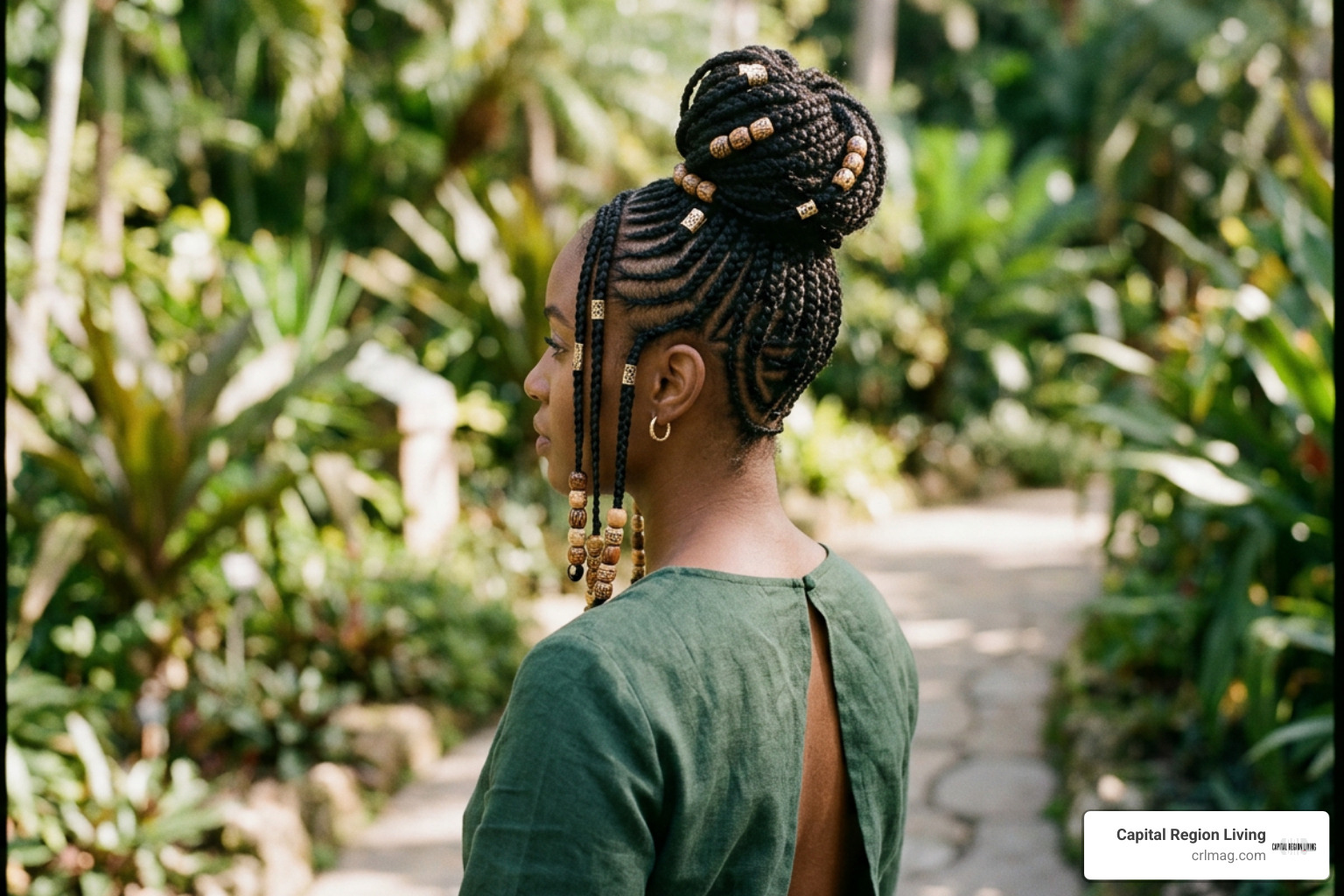
The half-up topknot is the quintessential everyday look. It lifts the weight of your braids off your face while keeping the detailed geometric cornrows on full display.
- How to do it: Section off the top half of your braids, gathering them right at the crown of your head. Secure with a snag-free elastic band, twist the gathered braids loosely around the base, and tuck the ends underneath.
- Best for: Casual outings, coffee catch-ups, or whenever you want an effortless lifted look.
2. The Side-Swept Lemonade Drape
Channel red-carpet drama with a dramatic side sweep. This variation highlights your cheekbones and gives your decorative cuffs and beads maximum visibility on one side.
- How to do it: Gather all your hanging braids from the back and side, sweeping them cleanly over your preferred shoulder. Use a single large bobby pin tucked invisibly near the nape of your neck to hold the weight securely in place.
- Best for: Evening dinners, date nights, and formal events where you want your accessories to shine.
3. The Low Regal Ponytail
Clean, polished, and sophisticated, the low ponytail lets your scalp parting take center stage without placing any tension on your delicate edges.
- How to do it: Gather all braids at the nape of your neck. Fasten with a thick hair tie. Take one individual braid from the underside of the ponytail, wrap it neatly around the hair tie to conceal it, and tuck the end into the base.
- Best for: Professional office settings, formal interviews, and workouts.
4. The Textured Crown Updo
When the humidity rises or you want an elevated, regal aesthetic, sweeping all of your braids into a high crown updo creates stunning structural volume.
- How to do it: Gather all braids directly onto the top of your head. Divide the ponytail into two thick sections, twist them loosely around each other, and coil them into a large bun. Secure with large hairpins.
- Best for: Summer heat, weddings, and formal galas.
5. The Flip-Over Restyle
If you opted for a parting design with versatile sectioning, flipping your braids across your head creates instantaneous, bouncy volume. Much like deciding whether do curtain bangs suit you? a survival guide helps frame your facial features, shifting your braided side parts can dramatically enhance your jawline and cheekbones without a single hair tie.
- How to do it: Use your fingers to gently flip the front side-braids over your natural parting to the opposite side, instantly creating a glamorous, faux-side-shave effect.
- Best for: Weekend brunch, music festivals, and quick transitions from day to night.
Step-by-Step Installation and Hair Maintenance
A beautiful braid install starts long before you sit in the stylist’s chair. Proper preparation ensures that your natural hair stays hydrated, healthy, and completely protected beneath your extensions.

Hair Prep and Step-by-Step Installation
- Clarify and Hydrate: Cleanse your scalp thoroughly using a sulfate-free clarifying shampoo to remove residue, followed by a deep conditioning treatment to maximize elasticity.
- Blowout and Stretch: Apply a lightweight leave-in conditioner and heat protectant, then blow-dry your natural hair straight on low-to-medium heat. Stretching your natural curl pattern makes parting crisp and eliminates knotting.
- Map the Geometric Parts: Using a metal rat-tail comb and a conditioning styling gel, carve out the signature center part and symmetrical curved side sections.
- Feed-In Cornrows: Braid the central cornrow straight back to the nape, gradually feeding in thin layers of pre-stretched Kanekalon braiding hair. Repeat on the side sections, braiding forward toward the ears to create face-framing strands.
- Install the Back Plaits: Plait the remaining crown and nape sections into individual box braids or knotless braids for fluid movement.
- Set and Polish: Dip the ends in hot water to seal them, apply a generous amount of styling mousse across the cornrows, and tie down with a silk or satin scarf for 15 minutes to lock in a sleek, frizz-free finish.
Finding a master braider who prioritizes scalp comfort is key to protecting your hairline. Local standouts like Choices Hair Studio dominates the 2024 beauty besties for their commitment to healthy, customized styling techniques that honor hair integrity.
To keep your style looking fresh at home, keep these essentials in your hair kit:
- Pre-stretched Kanekalon Hair: Ensures lightweight, tapered braid ends without excess bulk at the roots.
- Rat-Tail Comb: For razor-sharp, symmetrical parts.
- Lightweight Scalp Oils (Jojoba, Almond, or Tea Tree): Keeps your scalp hydrated without clogging hair follicles.
- Foaming Braid Mousse: Tames flyaways and refreshes dull braids once or twice weekly.
- Silk or Satin Scarf & Bonnet: Essential for reducing nighttime friction and preserving moisture.
Modern Variations: Boho, Knotless, and Curls in Fulani Braids
While traditional Fulani styles remain timeless, modern braiders have created incredible hybrid variations. Incorporating knotless root techniques has transformed the experience for people with sensitive scalps. By gradually feeding hair into your natural base without a bulky knot at the follicle, knotless methods drastically reduce tension on fragile edges.
For those who love soft texture, boho iterations introduce curls along the lengths. You can explore creative hybrid variations like Fulani braids with quick weave: easy install, styles & care – boho braids or weave human hair deep-wave curls throughout the back plaits. If you prefer high-fashion runway looks, modern styling allows you to weave metallic gold wire around individual strands, incorporate heart-shaped scalp parts, or blend warm honey-blonde and auburn ombre tones for dimensional sunlight reflection. For even more visual inspiration, you can browse Fulani braids hairstyles: 15 stunning looks + care tips – boho braids to see how modern creators customize these patterns.
How to Prep and Maintain Fulani Braids at Night
Your nighttime routine makes all the difference in keeping your braids neat and preventing frizz:
If you are rocking waist-length or extra-long braids, use two scarves—one wrapped snugly around your scalp and hairline, and a second wrapped down the length of your braids—to prevent friction against your sheets.
When cleansing your hair during wear, avoid aggressive scrubbing in the shower. Instead, dilute a gentle shampoo with water in a squeeze bottle, apply it directly along the exposed scalp parts, massage softly with your fingertips, and rinse gently. Pat dry with a microfiber towel and sit under a hooded dryer to ensure the natural hair inside the braids dries completely to prevent odor and mildew.
Frequently Asked Questions About Braided Hair Care
How long do braided styles typically last?
Fulani braids typically last between 4 to 6 weeks, with an absolute safe maximum wear time of 8 weeks. How long your style lasts depends on your natural hair texture, how well you protect it at night, and your lifestyle. Coarser, tighter curl patterns tend to hold braided styles longer than fine or straight textures.
If you opt for boho variations with loose curls, expect the style to look its best for 2 to 4 weeks, as the exposed curly hair requires extra maintenance to prevent matting. We always recommend giving your hair a resting break of 2 to 3 weeks between protective installs to deep condition your natural strands and prevent tension fatigue.
How much do salon braiding services cost and how long is install?
Salon pricing for Fulani braids typically ranges from $120 to $350, though high-end custom styling with intricate geometric parts, extended lengths (such as butt-length), or human hair curls can reach between $400 and $800.
Installation generally takes 4 to 8 hours. Here is what to expect based on size:
- Large / Chunky Braids: 2 to 4 hours
- Medium Braids (The Goldilocks Size): 4 to 6 hours
- Small / Micro Braids: 6 to 8+ hours
To get an idea of professional styling packages, review service listings like Fulani braids (medium – small) | braiders in NYC, DC & LA before booking. Remember to arrive at your appointment with your hair clean, detangled, blown out straight, and completely free of heavy oils or butters so your stylist can get right to work.
How can you safely take down protective styles to prevent breakage?
Safe braid removal requires patience to preserve the length your protective style helped you retain:
- Cut the Extensions Safely: Identify where your natural hair ends within the braid, and use scissors to cut the synthetic extension at least 2 to 3 inches below that point.
- Unravel with a Tail Comb: Gently unpick each plait from the bottom up using the tip of a metal rat-tail comb.
- Soften Product Buildup: At the root base, where dead hair and gel accumulate into small bulbs, apply a leave-in conditioner or jojoba oil to soften the buildup before gently sliding the shed hair apart with your fingers.
- Detangle Before Washing: Thoroughly finger-detangle and comb through your entire head with a wide-tooth comb before applying water. Skipping this step can turn shed hair into severe knots when wet.
- Clarify and Deep Condition: Follow up with a clarifying shampoo to cleanse your scalp, then apply a rich, restorative deep conditioning mask to restore moisture and elasticity.
For more insights on sizing and maintenance timelines, check out Fulani braid hairstyles: the ultimate guide to styles, sizes & lengths – Savannah Herald as well as trend overviews from beauty authorities like Fulani braids are the perfect hybrid protective style | Allure.
Conclusion
Fulani braids are far more than a passing fashion trend; they are a centuries-old cultural art form that seamlessly blends West African heritage with versatile modern style. Whether you rock a half-up bun for daily convenience, sweep your braids over one shoulder for evening glamour, or experiment with boho curls and metallic cuffs, this protective style keeps your natural hair healthy, vibrant, and protected.
Are you ready to book your next braiding transformation or find expert stylists right here in Upstate New York? Explore our comprehensive Capital Region business directory to discover top-rated local salons, natural hair specialists, and beauty destinations across Albany, Saratoga, Troy, and Schenectady today!